
Aerospace & Defense: the real bottleneck isn't AI adoption, it's the capacity to absorb it
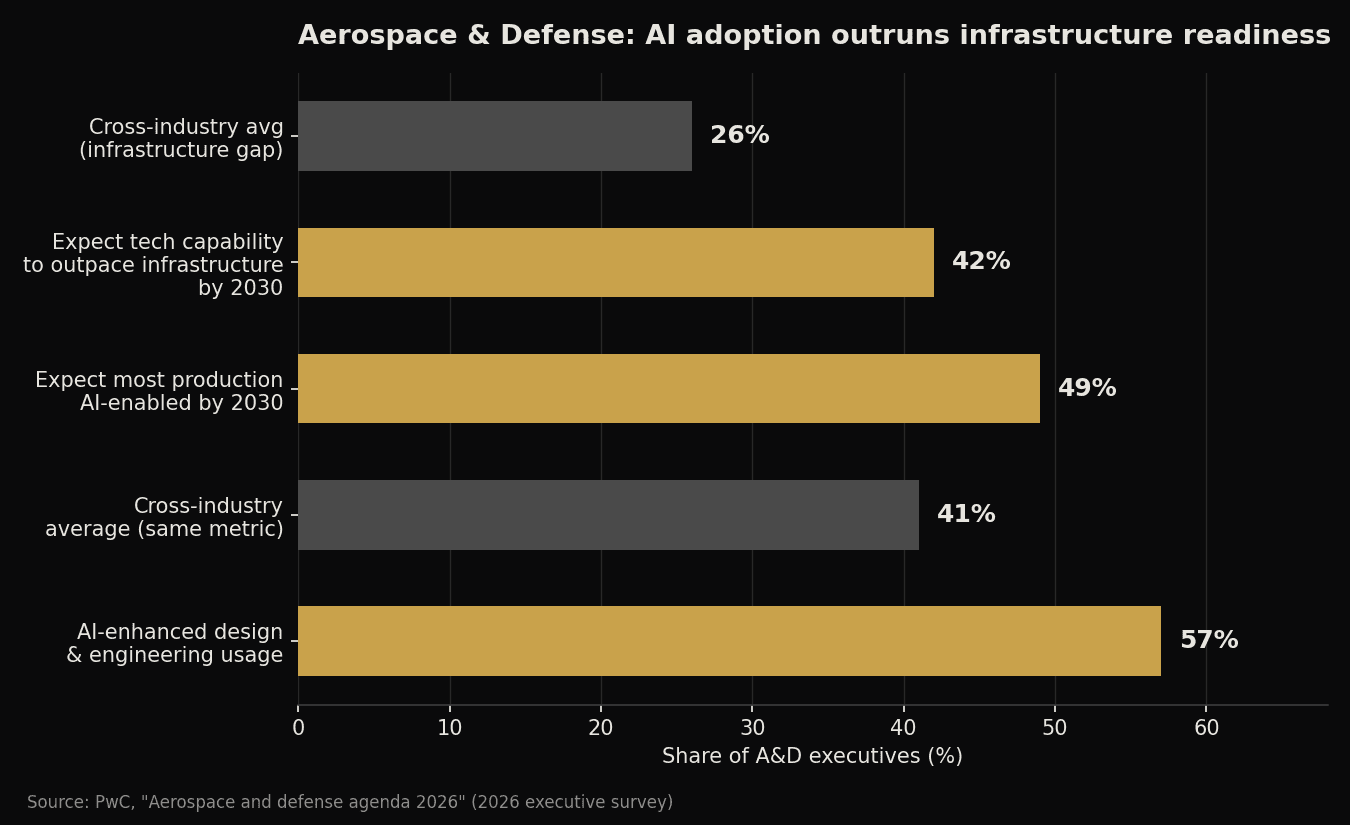
PwC puts AI usage in A&D design workflows at 57%, 16 points above the cross-industry average — yet 42% of executives already expect their infrastructure won't keep up. An economist's read: the bottleneck has shifted from adoption to organizational absorptive capacity.
PwC's "Aerospace and defense agenda 2026" survey of sector executives delivers one of the highest technology-adoption figures in manufacturing: 57% of A&D executives say they use AI to transform design and engineering workflows, versus 41% cross-industry — a 16-point gap that puts the sector at the front of industrial AI adoption. Nearly half (49%) expect most of their production to be AI-enabled by 2030.
Taken alone, these two figures would tell a story of successful transformation. But the same survey contains a mirror statistic that flips the reading: 42% of these executives — roughly three-quarters of those already using AI — expect their technology capabilities to outpace their existing infrastructure by 2030. The cross-industry average on this point is only 26%. The sector fastest to adopt is also the one projecting itself furthest out of balance.
The usual explanation for this kind of gap points to capital constraints — budget, compute, or data shortages. That doesn't fit the facts here: a sector already deploying $45 billion in annual capex (AIA "2026 Facts & Figures," analyzed by Cardan-AI on 08/09) and posting a record trade surplus is not capital-constrained. The relevant framework lies elsewhere: the "absorptive capacity" theory formulated by Cohen and Levinthal in 1990, which holds that an organization's ability to exploit external knowledge or technology depends less on access to that technology than on a pre-existing internal capacity to identify, assimilate, and commercially apply it.
Absorptive capacity is not a stock bought outright — it accumulates through prior organizational learning, the quality of data-management processes, and the depth of internal skills already in place. A sector that has long operated with long certification cycles, structural risk aversion (echoed in our 08/07 analysis of the trust gap between predictive maintenance and decision autonomy), and program-siloed information systems has not necessarily built, alongside its industrial excellence, the organizational capacity to digest an AI innovation flow as fast as the one it is now funding.
The empirical corollary shows up upstream in the supply chain data: only 26% of executives currently invest in redundant system failover to build self-healing supply chains, while 45% plan to reshore or nearshore most production by 2030. Reshoring, though framed as a response to geopolitical fragility, is itself a digitally intensive operation — multi-supplier traceability, digital twins, real-time orchestration. Concentrating it around 2030 without closing the absorptive-capacity gap beforehand schedules a bottleneck on a predictable horizon rather than resolving one.
The strategic implication for a buyer of AI consulting in this sector is not to choose between adopting faster or slower, but to treat absorptive capacity as an asset to be built alongside technical deployment — data governance, team training, integration architecture — rather than as an externality that resolves itself. The executives who have already identified this gap (42% of them, per the PwC survey) hold a rare advantage: the ability to act before the gap becomes visible in performance metrics.
Analysis by
Cardan-AI Intelligence
Our research and analysis unit, dedicated to applied AI for business, industry and regulatory compliance.
Let's talk about your next competitive edge
Thirty minutes to identify the two or three use cases in your operations that pay for themselves within the first year.