
A 250-person aerospace supplier: start AI with late parts, not reports
Six in ten manufacturers faced significant supplier delays last year, and most A&D leaders say AI for sourcing is a priority. A mid-size supplier should start with one costly weekly decision, not a platform.
Key takeaways
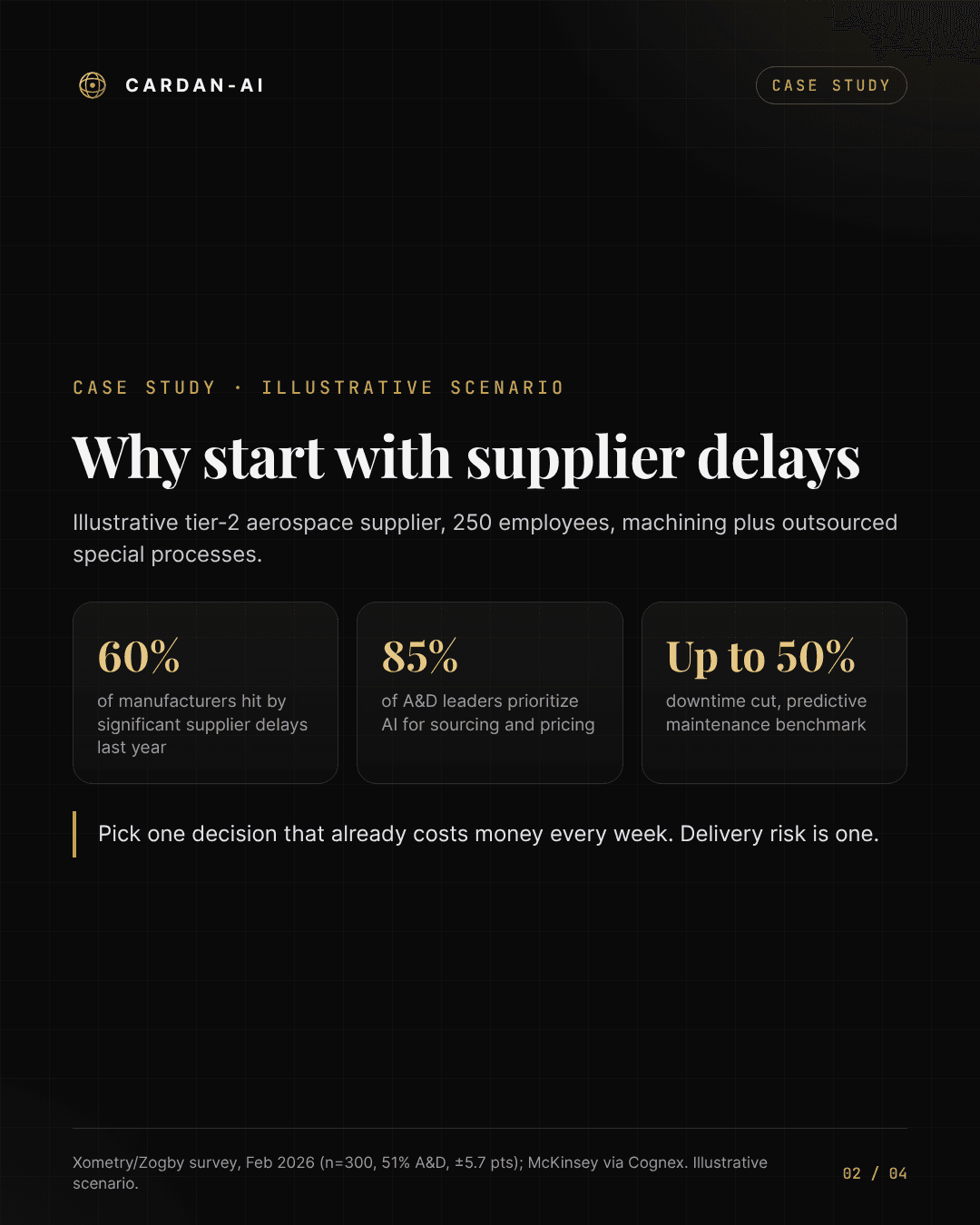
- 60% of surveyed manufacturers experienced significant supplier delays in the prior year (Xometry/Zogby, Dec 2025, n=300).
- 85% of A&D leaders prioritize AI for pricing visibility and sourcing, against 63% in general industry.
- McKinsey, cited by Cognex, reports predictive maintenance can cut machine downtime by up to 50%: a benchmark for a different use case, not a promise.
- Run any model in shadow mode first; quality sign-off stays human.
This is an illustrative scenario, not a client engagement. Picture a tier-2 aerospace supplier with 250 employees: precision machining, plus outsourced special processes such as heat treatment and non-destructive testing, serving two or three primes.
Its planners spend part of every week chasing late material and late outsourced operations. The cost is not the chase itself but the orders that ship late anyway, with penalties, expediting and a weaker position at the next supplier rating.
The market context supports the choice. A Zogby survey for Xometry (December 2025, 300 manufacturing leaders, 51% in A&D, margin of error ±5.7 points) reports that 60% of organizations had significant supplier delays in the prior year and that 85% of A&D leaders prioritize AI for pricing visibility and sourcing workflows, versus 63% across industry.
Economic mechanism: in a capacity-constrained chain, a day of slip is not evenly costly. Late parts on the critical path of a prime's delivery carry penalties and lost allocation; late parts elsewhere cost little. A model that ranks open orders by probability of slipping and cost of slipping concentrates scarce management attention where value is at stake.
Why not start with report writing or a generic assistant? Those are easy to launch but have no measurable baseline. Delivery performance does: on-time-in-full rate, expediting hours, penalty cost. A first project needs a number that the finance director already tracks.
Order of magnitude for ambition: McKinsey, as cited by Cognex, says predictive maintenance can cut machine downtime by up to 50%. That is a different use case and a vendor-relayed figure; treat it as evidence that prediction on operational data can pay, not as a target for this project.
Implication by actor: the head of planning owns the decision and the baseline; quality keeps release authority over anything touching conformity; purchasing owns the supplier conversation; the CEO sponsors one use case, not five.
Limits: the Xometry survey is commissioned by a manufacturing marketplace, the A&D-only sample is not disclosed, and data quality in a 250-person firm is usually the real constraint. If ERP due dates are overwritten rather than versioned, the first month is spent rebuilding history.
Case study
Illustrative tier-2 aerospace supplier, 250 employees, precision machining plus outsourced special processes, serving a small number of primes.
Challenge: Planners lose time chasing late material and outsourced operations, and some orders ship late anyway, with penalties and weaker supplier ratings.
60%
of surveyed manufacturers had significant supplier delays (Xometry/Zogby, 2025)
85%
of A&D leaders prioritize AI for sourcing (same survey)
Up to 50%
downtime cut in predictive maintenance (McKinsey via Cognex; adjacent use case)
Approach
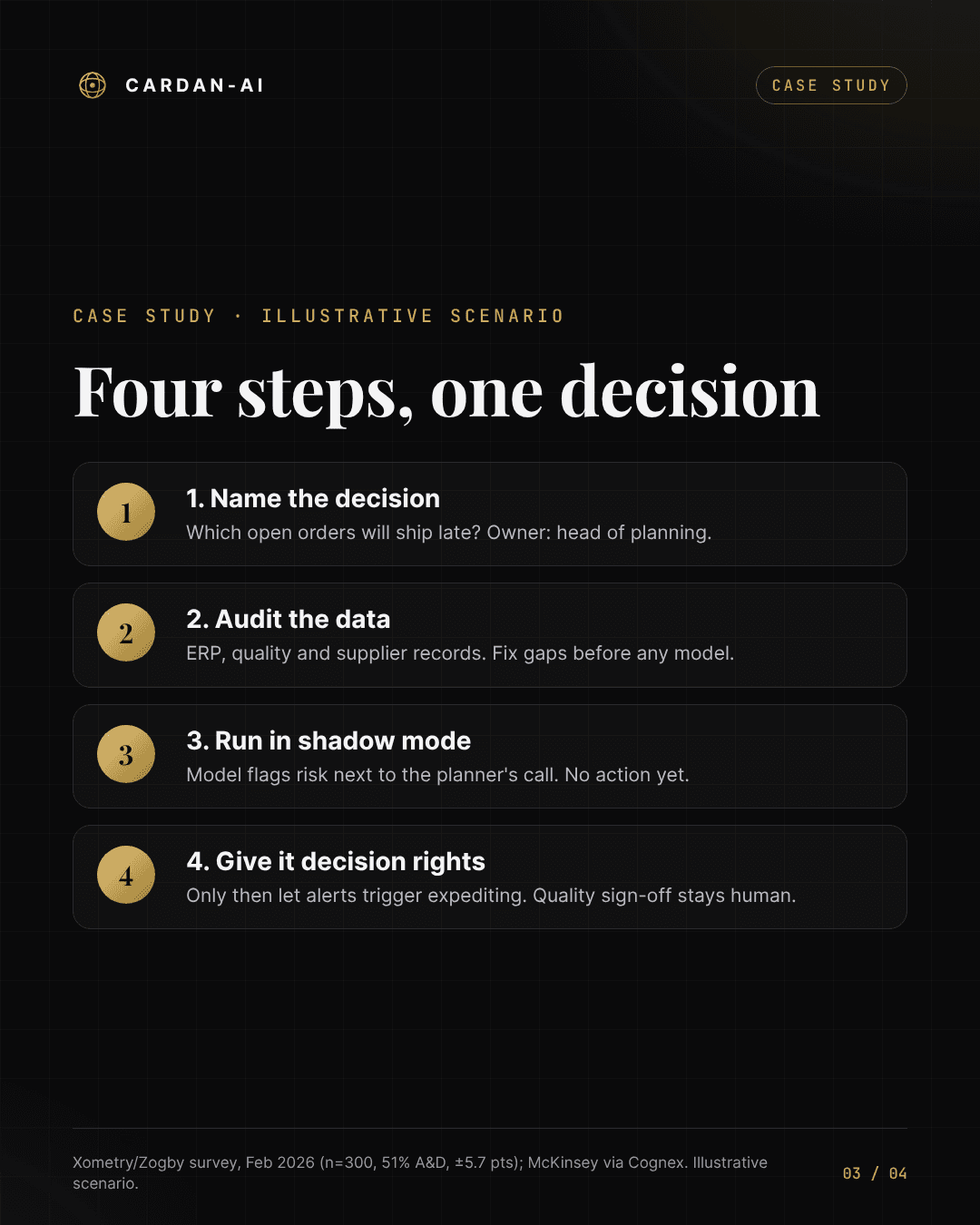
- 1.Name one decision: which open orders will ship late, owned by the head of planning.
- 2.Audit ERP, supplier and quality data and repair gaps before choosing a model.
- 3.Run the model in shadow mode next to the planner for a full quarter.
- 4.Grant alert-triggered actions in stages; quality keeps release authority.
- 5.Extend to a second use case only after a measured gain.
Success is decided before any model is trained: one decision, one owner, one baseline, and staged decision rights.
Case study built from public benchmarks and Cardan-AI's sector experience; orders of magnitude are sourced below.
Our recommendations
- 1
Name one decision and one owner
Write the decision as a question the head of planning answers every week, for example which open orders will ship late. Record today's on-time-in-full rate and expediting hours as the baseline.
- 2
Audit the data before choosing a model
Check ERP order history, supplier confirmations and quality records for gaps and overwritten dates. Budget the first weeks for data repair; skip tool selection until then.
- 3
Run in shadow mode against the planner
Let the model flag risk beside the planner's own judgment for a full quarter. Compare hit rate and false alarms with the baseline before changing any process.
- 4
Grant decision rights in stages
Allow alerts to trigger expediting only after shadow results beat the baseline. Keep conformity and release decisions with quality, and document it for customer audits.
- 5
Scale only what survived
Extend to a second use case, such as outsourced special-process lead times, only when the first one shows a measured gain.
Analysis by
Cardan-AI Intelligence
Our research and analysis unit, dedicated to applied AI for business, industry and regulatory compliance.
Let's talk about your next competitive edge
Thirty minutes to identify the two or three use cases in your operations that pay for themselves within the first year.