
Aerospace AI: The Temptation to Extrapolate an Early Growth Rate Over Eight Years
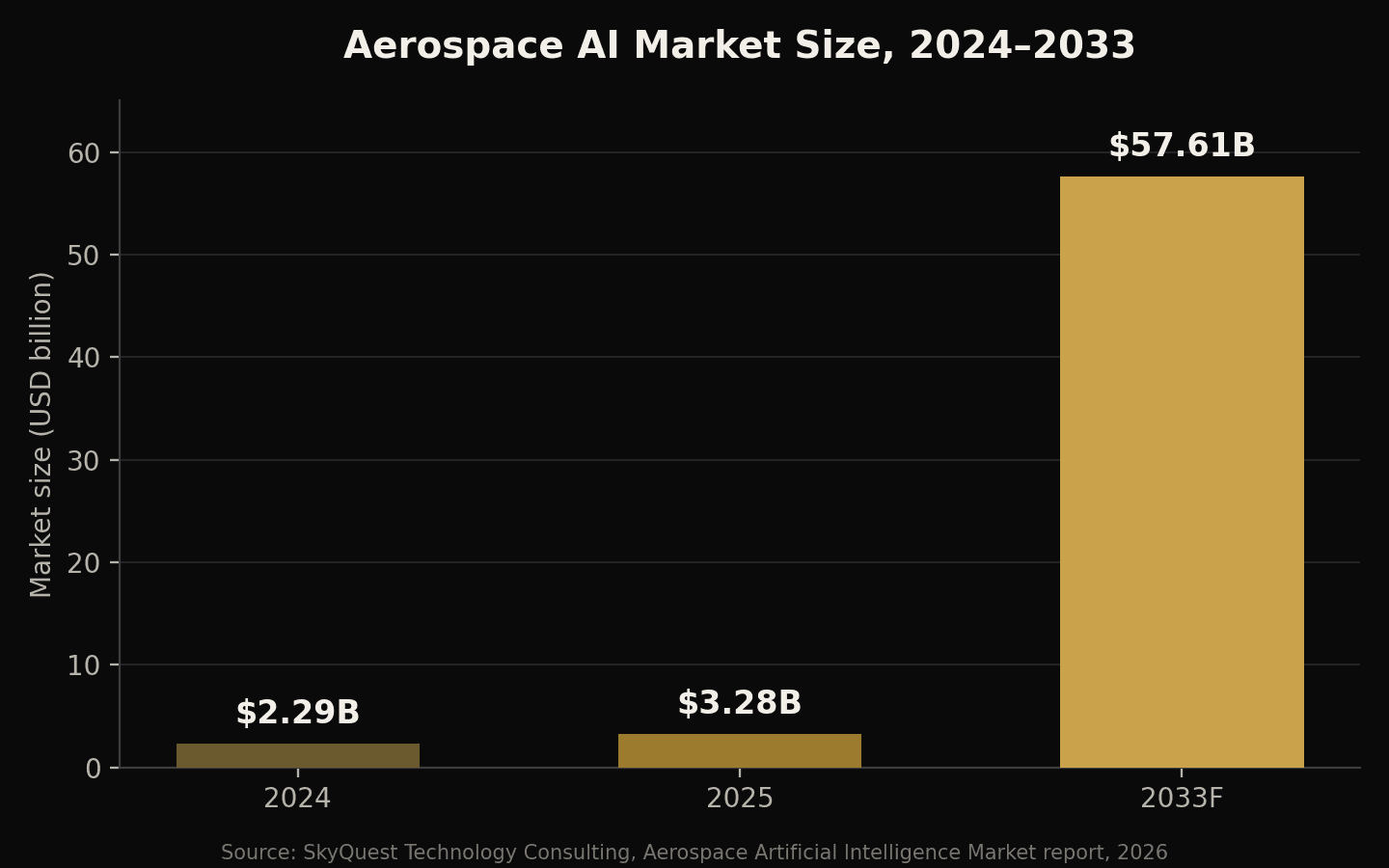
The global aerospace AI market jumps from $2.29B (2024) to $3.28B (2025), and SkyQuest's report extends that pace (43.1% CAGR) to $57.61B by 2033. An economist's read: extrapolating a first-year growth rate off a tiny base is the classic trap of nascent markets — the law of small numbers applied to market forecasting.
According to a report published by SkyQuest Technology Consulting, the global aerospace artificial intelligence market grows from $2.29 billion in 2024 to $3.28 billion in 2025, a 43.2% increase in one year. The report then extends this trajectory across 2026-2033 with a stated compound annual growth rate (CAGR) of 43.1%, reaching $57.61 billion by 2033 — a roughly 25x increase in nine years.
The drivers behind this growth are documented and plausible at the sector level: predictive maintenance from sensors embedded in engines, wings and avionics; the exploding volume of data generated by modern aircraft systems; and rising demand for autonomous aircraft, military drones and UAVs, driven by both defense needs and commercial aviation. Software currently dominates the offering (data analytics, predictive-maintenance algorithms), with hardware — sensors, embedded computers — flagged as the fastest-growing segment. North America remains the dominant region by value, Asia-Pacific the fastest-growing by pace.
The point worth an economic examination isn't the plausibility of the cited drivers, but the projection method itself. A CAGR is, by construction, a geometric average: it implicitly assumes that the pace observed over an initial period repeats identically over the entire projection horizon. Yet the first observed year here — 2024 to 2025 — starts from a base of just $2.29 billion, a tiny fraction of the global aerospace industry, which alone generates several hundred billion dollars in annual revenue. On such a narrow base, a limited number of new contracts or deployments is enough to produce a spectacular growth percentage, without that revealing a diffusion pace sustainable at scale.
This conflation of seeding-phase pace with structural pace echoes what Tversky and Kahneman called the law of small numbers (1971): statistical intuition tends to extrapolate from overly small samples, overestimating the reliability of trends calculated from few observations. Applied to market forecasting, this psychological bias has a well-documented economic analogue: technology diffusion models (Bass, 1969; Rogers, 1962) show that adoption of a new technology typically follows an S-curve — slow growth at launch, rapid acceleration in the middle phase, then mechanical deceleration as the addressable market saturates. A 43% CAGR calculated over an S-curve's first two years measures the slope of the acceleration phase, not the more moderate one that will inevitably follow during maturation.
The order-of-magnitude gap with adjacent markets illustrates the issue: the AI beauty and cosmetics market, analyzed by Cardan-AI last week, shows a CAGR of 19.6% to 21.1% on a starting base ten times larger ($4.38B) — and its growth rate is already declining year over year. Nothing suggests the aerospace AI market will escape that same convergence dynamic once its base widens; the history of technology diffusion suggests the opposite.
For aerospace and defense executives building investment plans or due diligence on this kind of figure, the operational lesson is simple: an eight-year CAGR extrapolated from a two-year base should be treated as a trajectory hypothesis, not an established fact. The scrutiny belongs less on the endpoint ($57.61B by 2033) than on the robustness of the constant-pace assumption required to reach it — an assumption that technology diffusion theory gives good reason to doubt.
Analysis by
Cardan-AI Intelligence
Our research and analysis unit, dedicated to applied AI for business, industry and regulatory compliance.
Let's talk about your next competitive edge
Thirty minutes to identify the two or three use cases in your operations that pay for themselves within the first year.