
Rules versus discretion: what Kydland and Prescott say about the EU AI Board's silence
On September 17, 2026, the European AI Board met and decided nothing. Kydland and Prescott's framework on policy credibility explains why that silence carries a direct, measurable cost for companies that have to invest in compliance today.
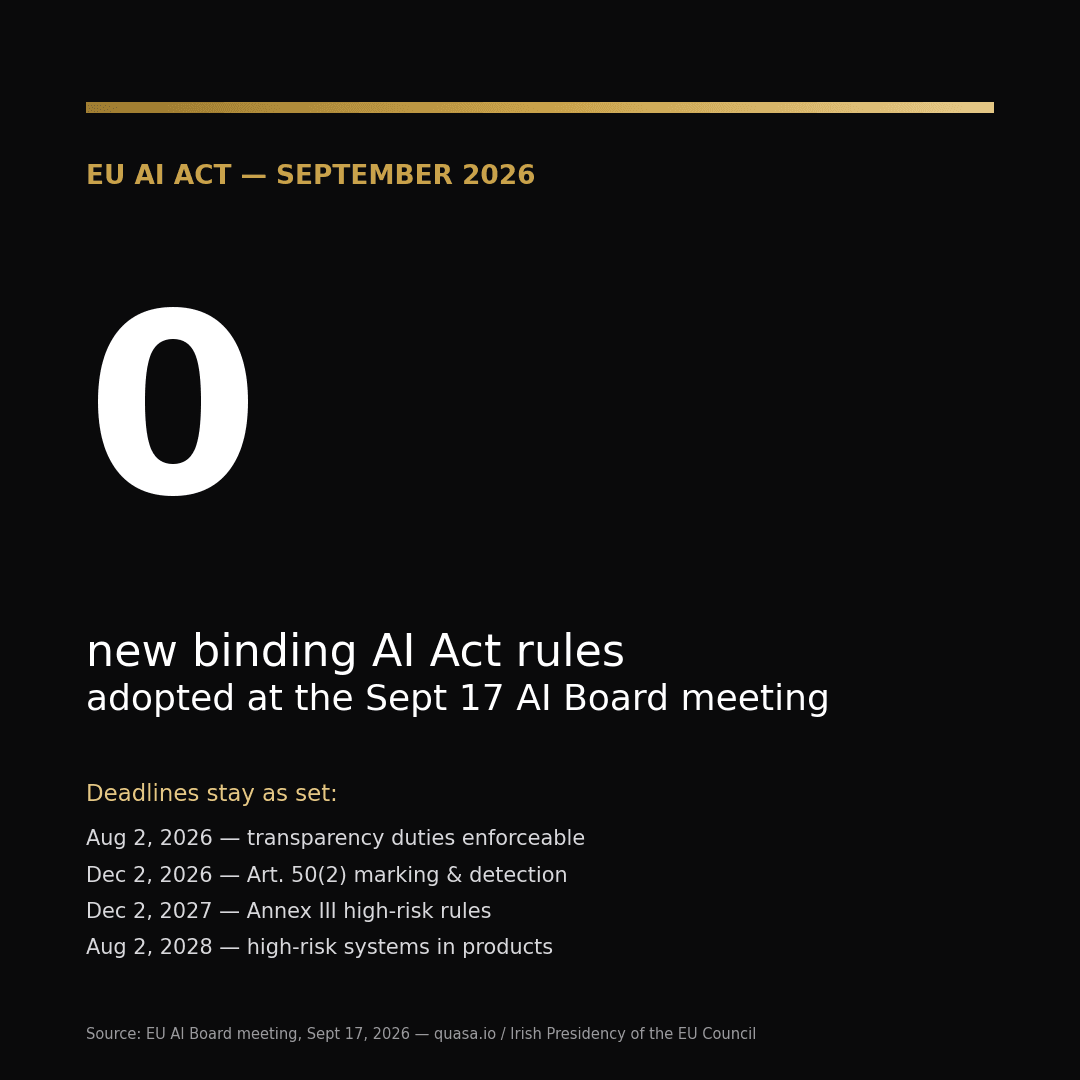
On September 17, 2026, under the Irish Presidency of the EU Council, the AI Board — the body that brings together representatives of all twenty-seven member states to coordinate AI Act enforcement — met for a full day to discuss enforcement priorities, transparency, market-surveillance cooperation and frontier-model cybersecurity testing. The outcome, documented plainly in the meeting readout: no adopted rule, no new company obligation, no revised compliance date.
That is not a failure in itself — perhaps nothing urgent needed deciding that day. But the fact is telling of a structural choice the AI Act made from the start: a legally fixed calendar of deadlines (transparency from August 2, 2026; marking and detection from December 2, 2026; Annex III high-risk rules from December 2, 2027; regulated products from August 2, 2028), but much of the operational content of those obligations left to coordinating bodies like the AI Board, which meet, discuss, and sometimes — as on September 17 — decide nothing.
This is exactly the tension Finn Kydland and Edward Prescott formalized in their 1977 paper "Rules Rather than Discretion: The Inconsistency of Optimal Plans" (Journal of Political Economy), which won them the 2004 Nobel Memorial Prize in Economic Sciences. Their argument, built for monetary policy, is simple: a regulator that reserves the freedom to adjust decisions case by case, rather than committing to fixed, pre-announced rules, systematically produces worse outcomes — even though, at any given moment, the discretionary decision looks like the reasonable one.
The reason is a credibility problem, not a competence problem. Economic actors — here, companies subject to the AI Act — form expectations and size their investments based on what they believe the regulator will do, not just on what it announces. If the AI Board can clarify, tighten or loosen enforcement details at any time without contractual notice, the rational firm under-invests in the costliest, most uncertain compliance work and over-invests in cheap, reversible measures — a wait-and-see pattern that delays exactly the kind of investment (technical documentation, training-data governance, bias testing) the AI Act is meant to induce.
The paradox is that the legal calendar itself is perfectly fixed and public — the AI Act does not suffer from time-inconsistency in the strict Kydland-Prescott sense. The credibility gap sits in the enforcement layer: what "compliance" with Annex III will actually mean in December 2027 depends on recommendations, guidelines and a market-surveillance governance structure still being built eighteen months before the deadline. For an airline certifying a predictive-maintenance system, or a refiner deploying control-room AI, the date is known but the bar to clear is not yet fully defined.
There is a corporate-finance equivalent to this: the option value of delaying an irreversible investment rises with uncertainty about the rules of the game, even when the deadline itself does not move. Every AI Board meeting that ends without further clarification mechanically extends that waiting option — rational for any single firm in isolation, but collectively costly if it pushes the whole regulated sector toward a compliance crunch in the final months before each deadline.
There is a more charitable reading too: preserving discretion at this stage may also guard against the opposite error — freezing technical standards prematurely on AI systems that are still evolving fast, creating the symmetric risk of a framework that is obsolete on arrival. Kydland and Prescott themselves acknowledged that discretion has its place when the environment is too unstable for a rigid rule to stay optimal over its full lifetime.
For an industrial executive, the operational takeaway is not to wait for the AI Board to decide, but to flip the logic: treat the legal calendar as the only reliably fixed variable, and build the compliance roadmap on the most demanding reasonable reading of Annex III — rather than on the optimistic assumption that today's discretion will resolve into a lighter final standard. It is the same lesson Kydland and Prescott drew for monetary policy: absent credible regulator commitment, it falls to the private actor to build its own decision rule.
Analysis by
Cardan-AI Intelligence
Our research and analysis unit, dedicated to applied AI for business, industry and regulatory compliance.
Let's talk about your next competitive edge
Thirty minutes to identify the two or three use cases in your operations that pay for themselves within the first year.