
Beauty and AI: when a booming market is already slowing down
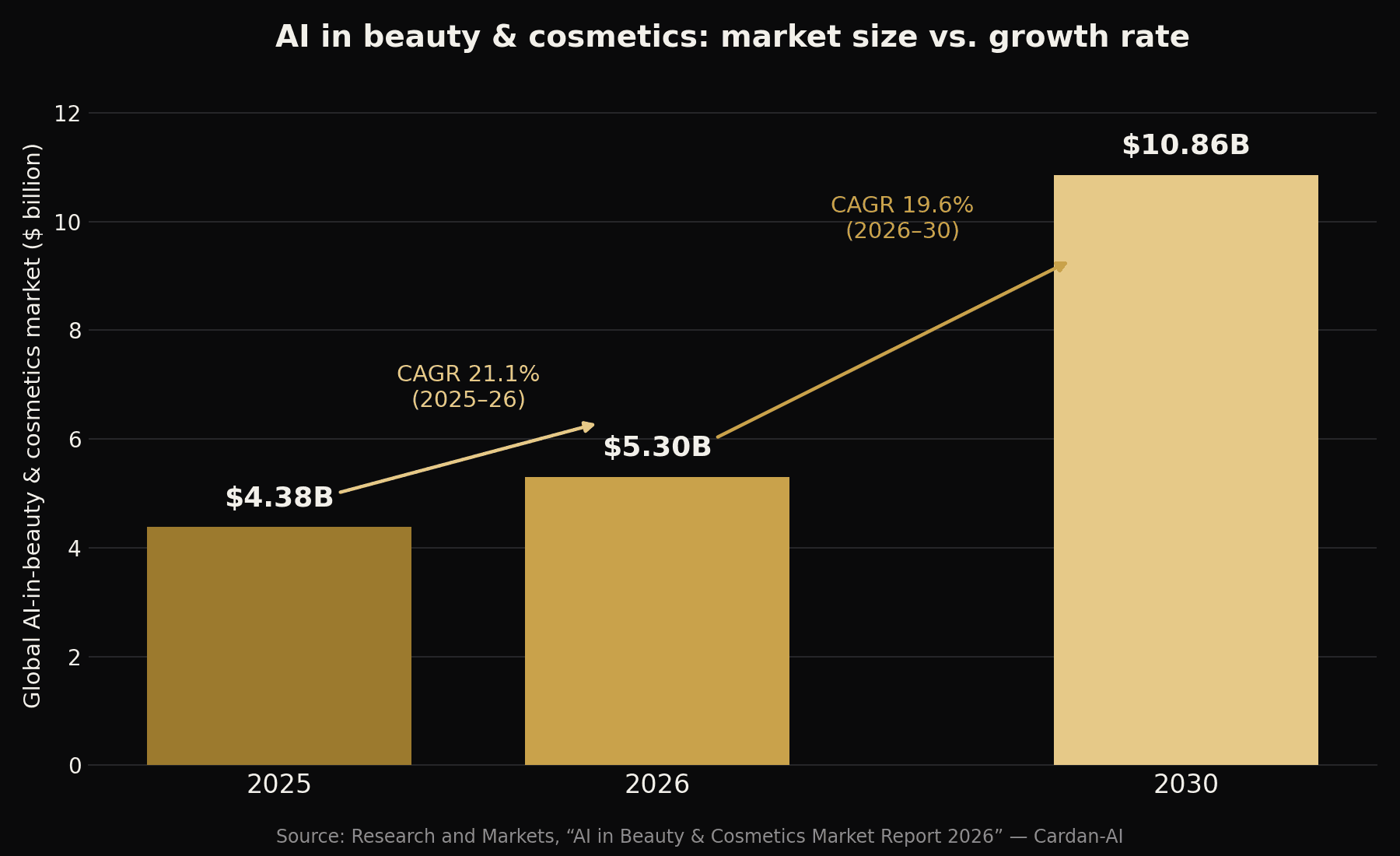
The global AI-in-beauty-and-cosmetics market grows from $4.38B (2025) to $10.86B (2030), yet its CAGR falls from 21.1% to 19.6%. An economist's read: diminishing marginal returns and base effects — the same mechanics that explain why growth rates slow as an economy, or a market, gets larger.
According to the report published by Research and Markets, the global market for AI applied to beauty and cosmetics is valued at $4.38 billion in 2025. It is expected to reach $5.3 billion as early as 2026, then $10.86 billion by 2030 — a market that nearly 2.5x's in four years. North America remains the largest region in 2025, ahead of Europe and Asia-Pacific, which together with North America make up most of the sixteen geographies covered by the study.
The detail deserves a closer look: the compound annual growth rate (CAGR) calculated over the single 2025-2026 year is 21.1%, versus 19.6% for the longer 2026-2030 period. On the surface the difference looks minor — 1.5 points — but it traces a deceleration trajectory as early as the second observed year, even as the market is set to nearly triple in absolute value over the following period.
This configuration — acceleration in dollars, deceleration in percentage — is not a statistical contradiction: it is the classic signature of a base effect. A 20% growth rate applied to a $4 billion base produces a much smaller dollar addition than the same rate applied to an $8 or $9 billion base. Arithmetically, sustaining a constant CAGR on a growing base requires a genuine acceleration in the pace of adoption — absent that, the percentage mechanically declines, even though investors and operators only perceive the rise in absolute dollar figures.
An economist will recognize here the same convergence mechanics described by the Solow growth model (1956): as an economy accumulates capital, the marginal return on each additional unit declines, and the growth rate tends to slow even as the absolute level of output keeps rising. The AI-beauty market is not a national economy, but the logic of diminishing marginal returns applies the same way: the first high-ROI use cases (personalized recommendation, automated customer service) are already widely adopted by major groups, and each new segment (connected beauty devices, demand forecasting) captures a smaller incremental return than the one before it.
The five categories identified in the report — personalized recommendation, marketing measurement, demand forecasting and supply chain, real-time customer service, AI-based beauty devices — confirm this reading: they already span the full value chain, from marketing to logistics to the product itself. A market that has already diffused AI across five distinct functions is, by definition, no longer a narrow frontier with high catch-up potential — it is an established market whose future growth will depend more on deepening usage than on first-time adoption.
For the luxury and cosmetics brands Cardan-AI advises, the strategic implication is direct: the window to capture a first-mover advantage on high-ROI use cases (recommendation, customer service) is already closing — competition will shift toward execution quality and proprietary-data differentiation rather than mere market presence. Investing in beauty AI today means investing in a market that will still grow substantially in absolute terms (+$5.56 billion between 2026 and 2030), but whose marginal return per dollar invested is already declining — an essential nuance for calibrating the expected return of a project launched in 2026 rather than in 2022.
This is not an alarm signal: a 19.6% CAGR over four years remains a very high pace for any established sector, and the deceleration observed here (1.5 points) is marginal compared to the maturation of earlier technology markets, where CAGRs can drop ten points or more within a few years. But it is a useful reminder: absolute-value growth and rate-of-growth tell two different stories, and only the second one indicates how fast a market is approaching its maturity phase.
Analysis by
Cardan-AI Intelligence
Our research and analysis unit, dedicated to applied AI for business, industry and regulatory compliance.
Let's talk about your next competitive edge
Thirty minutes to identify the two or three use cases in your operations that pay for themselves within the first year.