
AI Compute Futures: Why Oil Can Be Stored and Compute Cannot
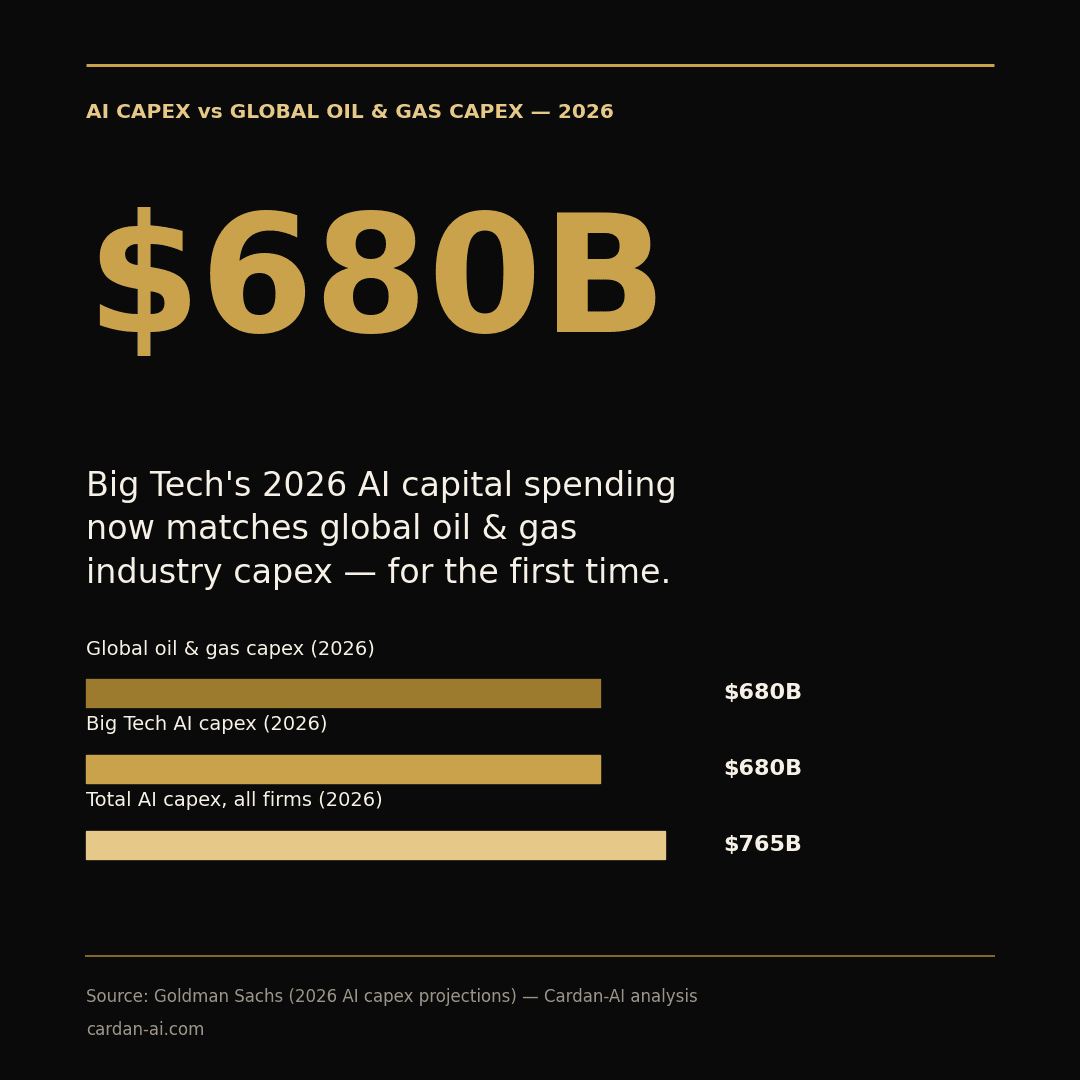
Big Tech's 2026 AI capex reaches parity with global oil & gas capex ($680B each), just as Wall Street launches the first regulated futures contracts on GPU computing power. Commodity storage theory reveals a fundamental structural gap between the two markets.
In 2026, for the first time, Big Tech's AI capital expenditure — roughly $680 billion according to Goldman Sachs — matches the annual capex of the entire global oil & gas industry, a sector over a century old. Total AI capex across all firms reaches $765 billion. Investor Chamath Palihapitiya flagged this threshold on August 24, 2026 as a symbolic milestone: an industry less than a decade old has caught up to the capital deployed by one of the most capital-intensive sectors in industrial history.
This dollar-for-dollar catch-up comes with a deeper convergence: the emergence of a derivatives infrastructure for compute, modeled on the one historically built around oil. CME Group and Silicon Data plan to launch a regulated US futures contract on GPU computing power on October 5, 2026, pending CFTC approval — the compute equivalent of NYMEX's 1983 launch of WTI crude futures. ICE (via its Ornn unit) is preparing a competing offering; Architect Financial has already been running unregulated GPU perpetual contracts on a Bermuda exchange since January 2026.
Commodity storage theory (Kaldor, 1939; Working, 1949) explains why a futures market works for oil: the physical stock — a barrel sitting in a tank — enables cash-and-carry arbitrage that disciplines the spread between spot and futures prices, via storage cost and convenience yield. That arbitrage mechanism is what makes an oil futures market robust and liquid.
GPU compute, however, cannot be stored or shipped: a compute-hour not consumed at time t is gone forever, exactly like an unproduced megawatt-hour of electricity. The relevant analogy is therefore not oil but electricity — a futures market where the absence of storage blocks classical arbitrage, and where risk premia, as documented in Bessembinder's work on electricity markets, are structurally larger and more volatile than for storable commodities.
Keynes's theory of normal backwardation (1930) holds that a futures market exists because a producer hedges future price risk by paying a premium to a speculator willing to bear it. For oil, the identity of the 'producer' — the oil producer — is unambiguous. For compute, it is not: are data center operators the ones hedging future GPU-rental revenue, or are AI labs hedging future training costs? The direction of the risk premium in this nascent market remains to be established empirically.
A second lens, Harold Hotelling's (1931) theory of exhaustible resources, sharpens the contrast: oil is a stock whose future extraction is arbitraged against present extraction, with a scarcity rent that in theory rises at the interest rate. GPU compute is not an exhaustible resource but a reproducible good: its capacity depends on deployed capex and depreciates over three to five years before renewal. The dollar parity between the two capex figures therefore masks two fundamentally different underlying economics — one governed by geological scarcity, the other by the investment and technological-obsolescence cycle.
The risk that financialization does not resolve is explicitly flagged by the source: 'returns on that buildout remain unproven,' with capex-to-revenue ratios of 54% at Meta, 47% at Microsoft, and 46% at Alphabet — levels that in the oil industry would already trigger immediate shareholder scrutiny. A futures market does not correct a misallocation of capital; it simply internalizes and propagates expectations, good or bad, into a price curve.
For Cardan-AI clients in energy, O&G, and aerospace & defense, the practical lesson goes beyond market curiosity: the same institutional investors are now weighing AI capex against traditional industrial capex on directly comparable dollar scales. This does not make the two capital pools fungible — a GPU cluster is not an offshore platform — but it does change how each sector's cost of capital will be narrated, benchmarked, and negotiated in front of the same investment committees over the next twelve to eighteen months.
Analysis by
Cardan-AI Intelligence
Our research and analysis unit, dedicated to applied AI for business, industry and regulatory compliance.
Let's talk about your next competitive edge
Thirty minutes to identify the two or three use cases in your operations that pay for themselves within the first year.