
Mandatory AI content labeling gives luxury brands back a costly-to-fake signal
Since August 2, 2026, the EU AI Act (Article 50) and California's AI Transparency Act have independently imposed the same instrument: labeling AI-generated content. Costly-signal theory (Spence, 1973) and the Brussels Effect (Bradford, 2012) explain why this convergence matters especially for luxury brands.
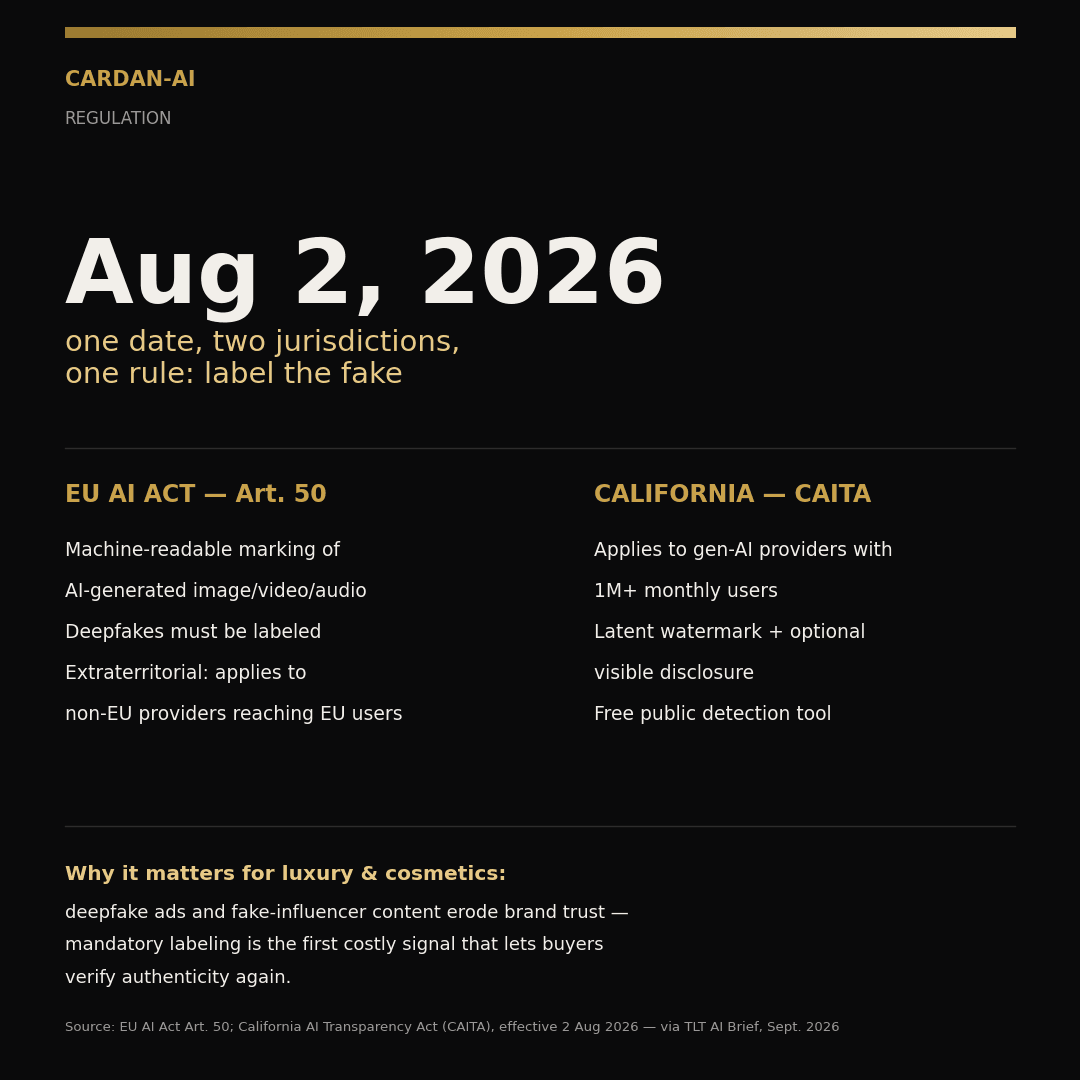
Since August 2, 2026, two independent laws impose the same discipline on generative-AI providers: mark what is artificial. Article 50 of the EU AI Act makes applicable machine-readable marking of AI-generated images, video and audio, deepfake labeling, and notification requirements for emotion-recognition systems, with extraterritorial reach covering any provider whose content reaches EU users. The same day, California's AI Transparency Act (CAITA) requires providers with more than one million monthly users to embed a latent digital watermark, offer an optional visible disclosure, and provide a free public detection tool. According to law firm TLT's September 2026 regulatory brief, this simultaneity occurred with no known formal coordination between Brussels and Sacramento.
The market this labeling addresses suffers from a classic information-asymmetry problem, but of a different nature than the one Akerlof (1970) described for used cars. Here, what is hidden is not a good's intrinsic quality but a content item's origin — human or synthetic. The relevant framework is Michael Spence's costly signaling (1973): in a labor market, a diploma only signals value because it is more costly for a low-productivity worker to obtain than for a high-productivity one. Applied to digital content, mandatory labeling — technically verifiable and legally sanctioned — only works as a signal if it is more costly to evade than to comply with, which is exactly what latent watermarking (CAITA) and machine-readable marking (AI Act) aim to achieve: making concealment technically expensive rather than relying on voluntary disclosure alone.
This lens explains why luxury and cosmetics have a direct, disproportionate stake in this regulation. A luxury brand's value rests heavily on trust capital and perceived authenticity — an intangible asset particularly exposed to fake ads, fabricated ambassador endorsements, or executive deepfakes the brand never produced or authorized. Without reliable labeling, consumers cannot distinguish authentic brand content from fraudulent synthetic content impersonating it — a verification problem that echoes, in digital form, the physical counterfeiting issue Cardan-AI already documented in luxury (\$467bn, analysis of July 31, 2026): digital content counterfeiting follows the same economic logic as product counterfeiting, at a far lower production cost for the fraud.
A second framework explains the timing convergence itself: the Brussels Effect (Anu Bradford, 2012), whereby the size of the EU market and the extraterritorial reach of its regulation push global players to adopt the European standard de facto, even outside the EU, rather than maintain market-differentiated product versions. By binding any provider reaching EU users, the AI Act exerts this pressure on US platforms. But California legislating simultaneously, with a similar instrument yet distinct thresholds and mechanics (one-million-monthly-user threshold, specific technical watermark), suggests a complementary mechanism rather than simple one-way submission: a form of spontaneous regulatory convergence between jurisdictions facing the same problem, without either necessarily copying the other — a pattern the policy-diffusion literature documents independently of direct coercion.
The analogy to a shared technical standard (Katz & Shapiro, 1985) points to a third, indirect benefit: if the two largest regulated markets (EU, California/US) converge on a technically similar labeling format, generative-AI providers and distribution platforms face a lower marginal cost of global compliance — a watermark built for one framework becoming reusable for the other. This regulatory economy of scale should, in theory, favor faster and broader adoption than if the two jurisdictions had chosen incompatible instruments.
The limitation is twofold. First, a costly signal only works if actually enforced and detected downstream: neither the AI Act nor CAITA yet guarantees that distribution platforms (social networks, search engines, marketplaces) systematically deploy the corresponding detection tools — without which the label is emitted but never received. Second, while the AI Act's extraterritorial reach exerts real pressure, it comes without direct enforcement means outside the EU comparable to those the California Attorney General holds within state borders — the enforcement-capacity asymmetry between the two frameworks remains unresolved.
For a luxury or cosmetics company, the immediate operational implication is twofold: audit its own generative-AI use in communications to comply with labeling now mandatory in both jurisdictions, and actively monitor unauthorized use of its brand imagery in unlabeled synthetic content — regulatory labeling only protects a brand if the brand turns it into an active fraud-detection tool.
This analysis extends Cardan-AI's July 31, 2026 note on luxury counterfeiting (detection vs. provenance): AI content labeling is, in digital form, the same race between fraud technology and verification technology — this time backed by a shared legal instrument across two of the world's largest regulated markets.
Analysis by
Cardan-AI Intelligence
Our research and analysis unit, dedicated to applied AI for business, industry and regulatory compliance.
Let's talk about your next competitive edge
Thirty minutes to identify the two or three use cases in your operations that pay for themselves within the first year.