
AI Data Centers and Natural Gas: Real Options Theory Meets a Forecast That Doubled in Nine Months
BloombergNEF just doubled its forecast for U.S. data-center natural gas demand in nine months. McDonald and Siegel's (1986) real options theory explains why this instability should slow gas infrastructure investment — and why competitive racing among hyperscalers produces the opposite effect.
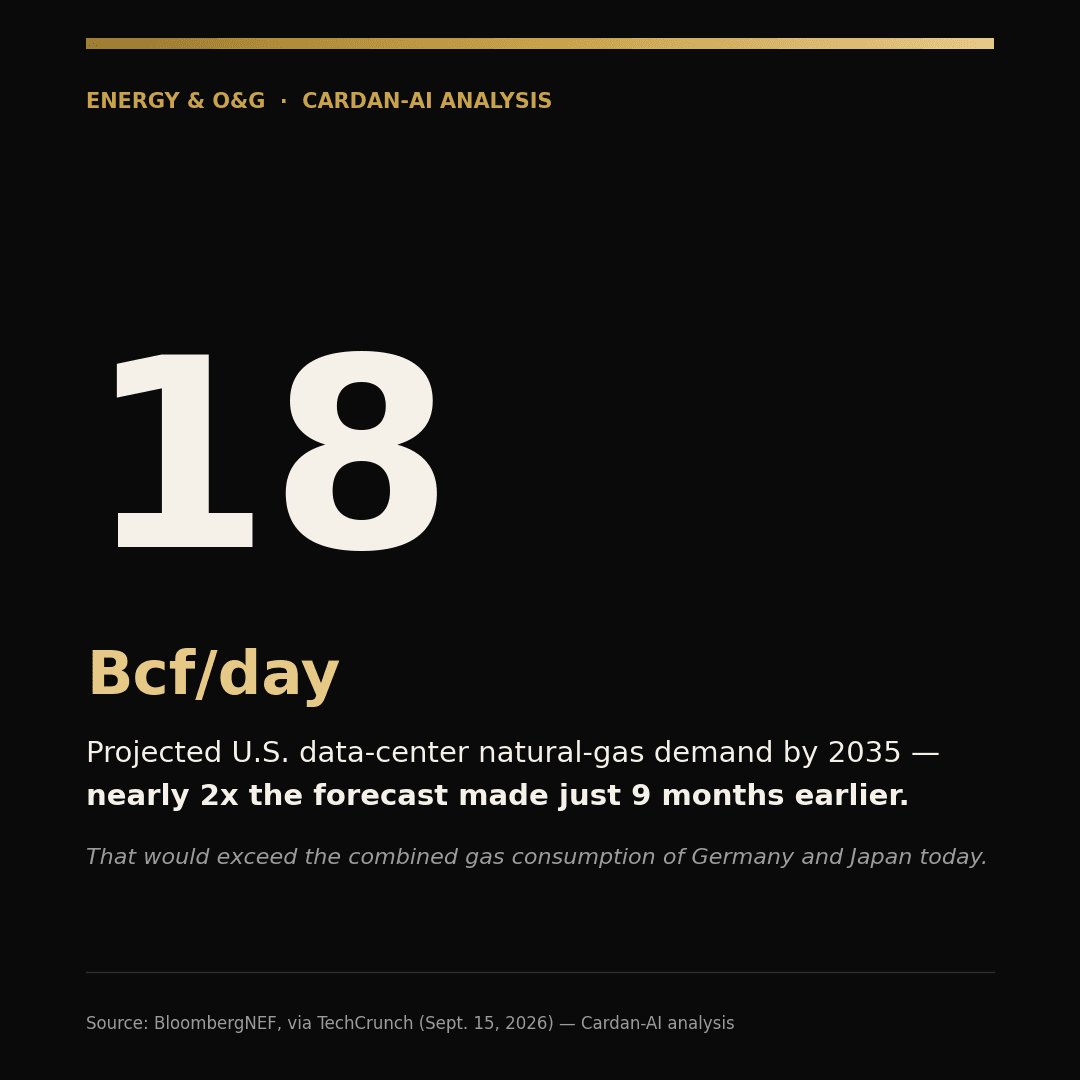
A BloombergNEF report relayed by TechCrunch on September 15 puts U.S. data-center natural gas demand at 18 billion cubic feet per day (Bcf/d) by 2035 — nearly double the estimate made just nine months earlier. The figure would exceed the combined current natural gas consumption of Germany and Japan. The breakdown matters: 2.9 to 3.4 Bcf/d would come from data centers with their own onsite power generation (Meta, Microsoft, Google and Amazon are all building onsite capacity, much of it gas-fired), and roughly 15 Bcf/d more would come from the indirect demand of grid-connected data centers — a demand increase five times larger than all other U.S. sectors combined over the period.
This near-doubling in nine months is not a footnote — it is the central observation. A forecast that shifts this much over such a short horizon signals a regime of genuine uncertainty about the demand trajectory, and that is precisely the situation real options theory was built to address.
In 1986, Robert McDonald and Daniel Siegel published "The Value of Waiting to Invest" (Quarterly Journal of Economics), formalizing a simple but powerful result: when an investment is irreversible (a pipeline, a gas turbine, an LNG terminal cannot be redeployed elsewhere at zero cost) and future demand is uncertain, there is a real economic value in waiting before committing capital — an "option to wait" analogous to a financial option. The higher the volatility of demand, the more valuable that option becomes, and the higher the return threshold needed to justify investing now rather than waiting. A forecast doubling in nine months is exactly the kind of volatility that, under this framework, should delay irreversible capital commitments rather than accelerate them.
Yet the opposite is happening. Meta, Microsoft, Google and Amazon are simultaneously building onsite power capacity, and gas operators and LNG exporters are positioning for the same capacity in anticipation. This is explained by a well-documented mechanism in the literature on investment under oligopolistic competition: when multiple actors fear being locked out of a scarce resource (here, turbine, pipeline and generation-site capacity) if a rival invests first, each individual actor's option value of waiting collapses — not because uncertainty has disappeared, but because the cost of not acting (losing access to the resource) now exceeds the cost of acting too early. The collective result is a synchronized investment wave, committed on the basis of a forecast that has just proven itself unstable.
The implications for the energy and O&G sector are direct. First, a real stranded-asset risk: if AI demand slows — through use-case saturation, model efficiency gains, or an emissions-driven regulatory shock — the gas capacity committed today on the basis of the 18 Bcf/d figure could end up oversized, with long-term supply contracts that are difficult to renegotiate. Second, a price risk for every industrial gas consumer unrelated to AI: simultaneous competition between hyperscalers and LNG exporters for the same physical capacity mechanically tightens prices, an external cost borne by conventional industrial sectors that get none of the demand causing it.
Finally, an often underappreciated point: the volatility of the forecast itself is a usable signal. An industrial company that methodically tracks the quarterly evolution of AI-driven gas demand forecasts (BloombergNEF publishes these revisions regularly) has a cheap leading indicator of future energy price pressure — well before that pressure shows up in supply contracts. In a market where the largest players appear to have better information about the demand trajectory, tracking how fast their own forecasts change often reveals more than the forecasts themselves.
Analysis by
Cardan-AI Intelligence
Our research and analysis unit, dedicated to applied AI for business, industry and regulatory compliance.
Let's talk about your next competitive edge
Thirty minutes to identify the two or three use cases in your operations that pay for themselves within the first year.