
Who Pays for AI's Electricity? What Ramsey and Boiteux Say About the Bill Coming Due
EQT projects that AI power demand could exceed U.S. residential demand by 2030. Ramsey-Boiteux pricing theory explains why the real battle isn't over megawatts but over how their cost is split between households and data centers.
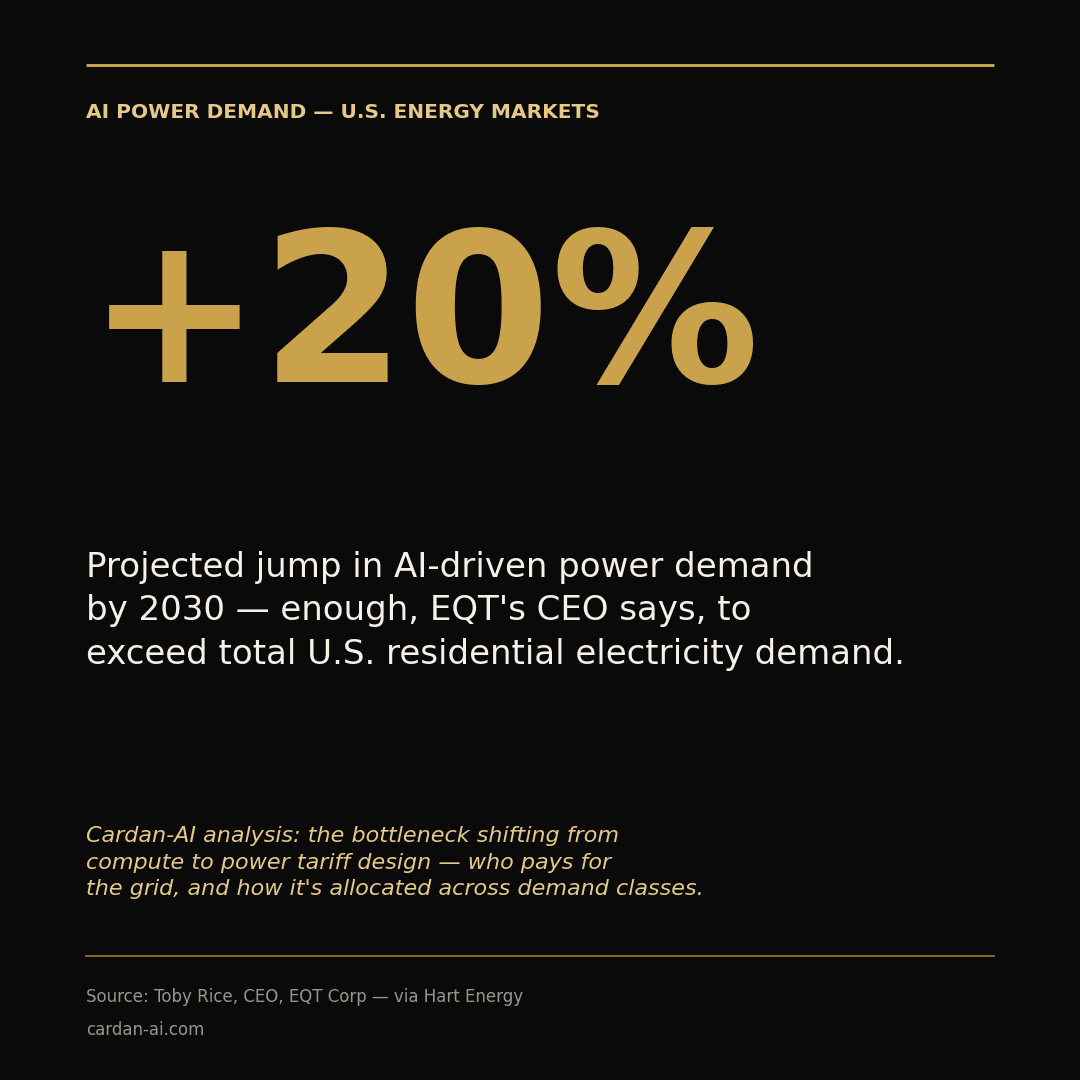
Toby Rice, CEO of EQT Corp — the largest U.S. natural gas producer — recently warned that AI-driven power demand could jump 20% by 2030 and exceed total U.S. residential electricity demand, according to Hart Energy. EQT is already positioning itself to supply AI data centers directly with gas and on-site generated power, bypassing grid interconnection queues.
That figure describes a fixed-capacity infrastructure problem: in the short and medium term, transmission lines, generation capacity and distribution networks cannot expand as fast as demand. Two consumer classes — households, whose bills are politically sensitive, and AI data centers, willing to pay a premium for guaranteed capacity — end up competing for the same scarce resource.
That is exactly the problem Frank Ramsey solved in 1927 in "A Contribution to the Theory of Taxation": how to fund a given budget (here, the grid's fixed cost) while minimizing economic distortion, when consumers differ in price sensitivity — elasticity? His answer, the inverse elasticity rule, holds that the optimal markup should be inversely proportional to demand elasticity: tax most heavily those least likely to change behavior.
French economist Marcel Boiteux carried this result into public utility pricing as early as 1956, while heading EDF's economic studies division: under a budget constraint, the optimal price of a good like electricity departs from marginal cost following that exact same logic — hence the name "Ramsey-Boiteux" pricing, now taught throughout natural-monopoly regulation theory.
Applied here, the Ramsey-Boiteux logic is unambiguous: AI data-center demand is, in the near term, markedly less price-elastic than residential demand — an operator amortizing hundreds of millions of dollars in GPUs won't walk away from a connection over a few extra tariff points, while a household reacts, at minimum politically, to any bill increase. The theory would therefore recommend loading a disproportionate share of grid cost onto data centers while relatively shielding residential rates.
The problem is that real-world tariff regulation almost never works that way. Most distribution tariffs remain built on legacy average-cost-of-service principles, with class allocation that shifts slowly and contentiously through regulatory dockets. The documented outcome in several U.S. jurisdictions runs opposite to the Ramsey-Boiteux prescription: part of the cost of new data-center connections ends up socialized across all ratepayers, residential included — fueling the growing political controversy over electricity bills in regions with heavy data-center buildout.
It is precisely this gap between the theoretically efficient tariff allocation and the slow pace of the regulatory process that explains EQT's strategy and that of comparable players: rather than wait for a regulatory commission to redesign tariffs consistent with the inverse elasticity rule, they bypass the regulated grid monopoly altogether, selling power — or the gas to generate it on-site — directly to data centers. It's an institutional arbitrage: capturing, as a producer, the premium that tariff theory would assign to the grid if the grid actually knew how to price it efficiently.
The limit of this reasoning lies in the uncertainty on both sides of the equation: data-center demand elasticity isn't fixed — it will depend on competition between candidate sites and the availability of alternatives such as batteries or local renewables — and the 20%-by-2030 figure itself remains a projection, as Cardan-AI has already noted when flagging the volatility of AI-driven power demand forecasts. For decision-makers in the Energy & O&G sector, the determining strategic question isn't physical megawatt availability, but whether the regulator or the producer ends up setting the price that reflects the true scarcity.
Analysis by
Cardan-AI Intelligence
Our research and analysis unit, dedicated to applied AI for business, industry and regulatory compliance.
Let's talk about your next competitive edge
Thirty minutes to identify the two or three use cases in your operations that pay for themselves within the first year.