
Diminishing returns in the race for bigger models: what research-productivity economics says
TechCrunch reports that frontier AI development costs are rising faster than the returns they generate — a dynamic that Bloom, Jones, Van Reenen & Webb's (2020) framework on declining research productivity reads with precision.
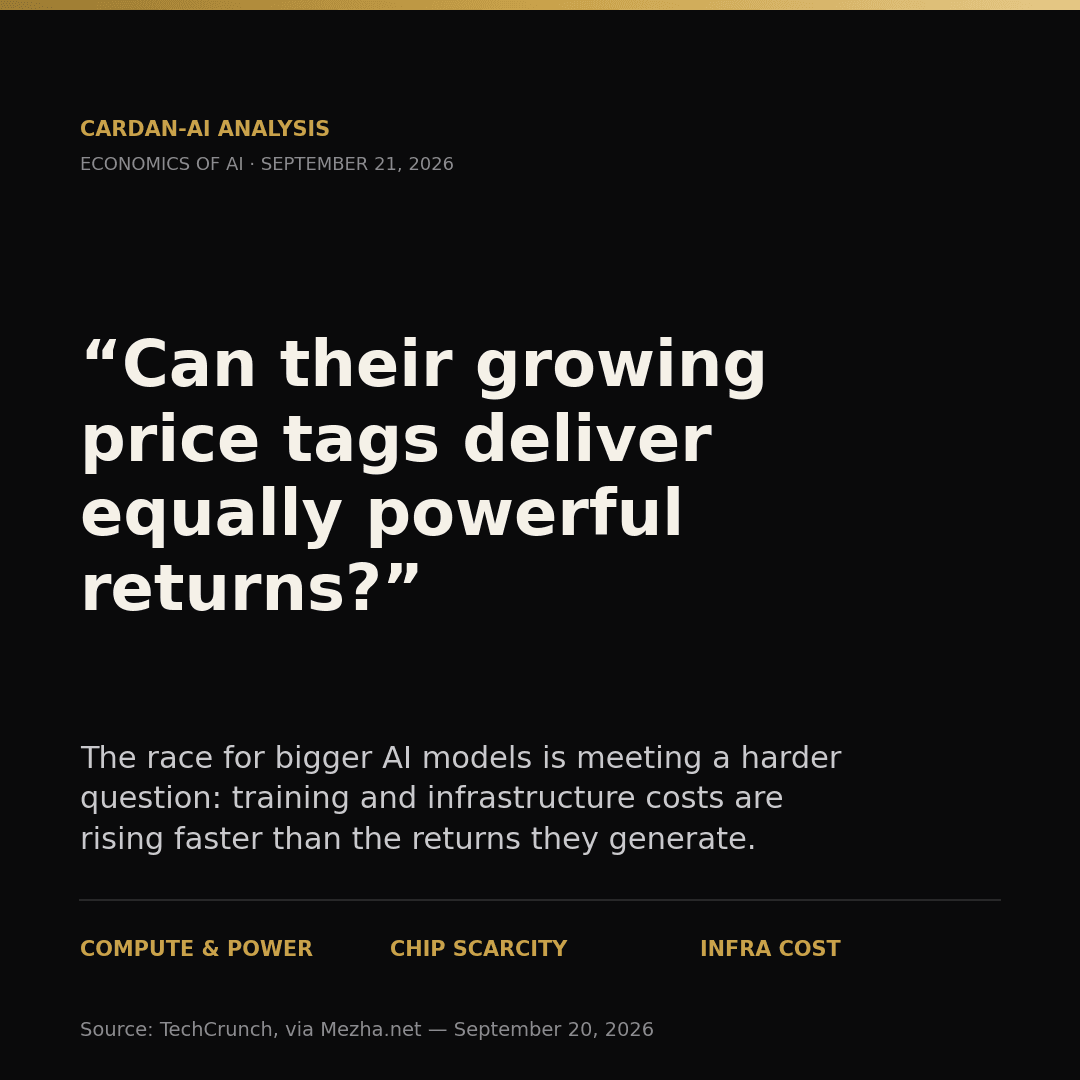
TechCrunch reported on September 20, in an article relayed the same day by Mezha.net, that the race for ever-bigger AI models is meeting a harder question than technical feasibility alone: are training and infrastructure costs rising faster than the returns — in performance and in revenue — they deliver? Three drivers are cited: the enormous computing power and significant electricity consumption required to train the most advanced systems, the high cost of dedicated infrastructure, and a persistent shortage of advanced semiconductors.
This description maps, almost term for term, onto a well-established result in the economics of innovation: Bloom, Jones, Van Reenen and Webb ('Are Ideas Getting Harder to Find?', American Economic Review, 2020) show that across most research fields they study — from semiconductors to agriculture to pharmaceutical R&D — sustaining a constant rate of performance growth requires research effort to grow exponentially. In semiconductors, they estimate it now takes roughly 18 times more researchers than in 1971 to sustain the same pace of progress predicted by Moore's Law. Research productivity — output per researcher or per dollar spent — declines by roughly 5% a year on average across the cases they study.
Applied to frontier generative AI, this framework illuminates a technical fact that has been documented for several years: model capability gains follow an approximately log-linear relationship with the compute used in training, meaning each further step up in capability requires a disproportionately larger compute — and cost — input than the last. That is exactly the signature Bloom and coauthors document in other sectors. What TechCrunch's reporting adds is market-side empirical confirmation that this self-compounding cost curve is now colliding with revenue growth that is not compounding at the same rate.
It is worth distinguishing this mechanism from the already well-covered 'AI capex bubble' debate — an essentially financial question about lenders' and investors' capacity to keep funding infrastructure buildout. The ideas-production framework points to a different, more structural constraint: even with unlimited capital, each further increment of frontier capability requires a disproportionate research input — a constraint on the production function of ideas itself, not merely on its financing.
The history of sectors already facing this dynamic — semiconductors, agriculture, pharmaceutical R&D (where 'Eroom's Law', Moore's Law spelled backwards, is documented for new drugs) — shows two typical responses: either keep scaling research input proportionally, at rising cost, or redirect effort from the race for raw capability toward extracting more value from capability that already exists, through efficiency and applied deployment rather than the next generational leap.
For regulated industrial sectors — aerospace, energy and oil & gas, luxury — the practical implication is direct. If diminishing returns to frontier-model scaling are structural rather than transitory, the economically rational posture for a buyer is not to wait for an ever more capable frontier model before deploying AI, but to capture the second response now: applying already-available capability to well-bounded, measurably-returning tasks, rather than underwriting speculative frontier bets whose research productivity is, by this same logic, falling.
This is also the more defensible framing for a board-level investment case: the question is no longer simply 'how much are competitors spending on AI', but 'where on the ideas-production function does this specific use case sit' — a question a rigorous AI investment case should be able to answer before a budget line is approved.
Analysis by
Cardan-AI Intelligence
Our research and analysis unit, dedicated to applied AI for business, industry and regulatory compliance.
Let's talk about your next competitive edge
Thirty minutes to identify the two or three use cases in your operations that pay for themselves within the first year.