
AI market sizing: the real problem isn't forecasting, it's definition
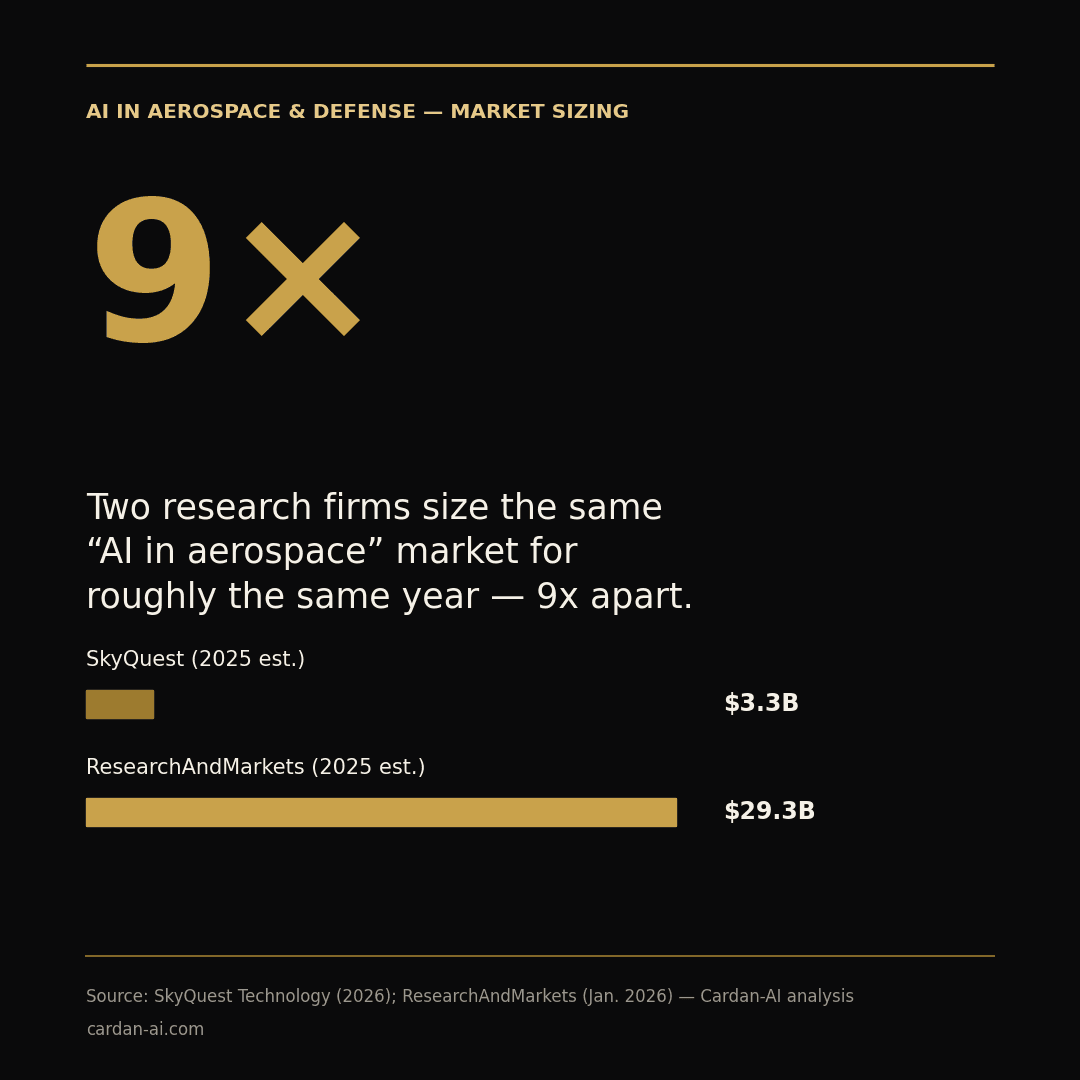
Two reputable firms size the same “AI in aerospace” market at $3.3B and $29.3B for 2025 — a 9x gap. The discrepancy doesn't measure forecast uncertainty; it reflects the absence of a shared definition of what “AI in aerospace” even counts, a problem measurement economics has documented for over sixty years.
SkyQuest Technology Consulting prices the global “AI in aerospace” market at $3.28B for 2025, trending at a 43.1% CAGR through 2033 ($57.61B). ResearchAndMarkets, in a January 2026 report, values the “AI in aerospace and defense” market at $29.27B for the same year 2025, with a far more modest 13.5% CAGR through 2030 ($55.3B). Both are established research firms, both reports date from 2026, and yet the starting estimate differs by a factor of 9.
This isn't forecast uncertainty in the classical statistical sense — two estimators converging on the same quantity with different variance. It's a more fundamental problem, documented as far back as 1963 by economist Oskar Morgenstern in “On the Accuracy of Economic Observations”: published economic statistics are used with far more confidence than their construction warrants, and most of the error doesn't come from sampling — it comes from upstream definitional choices that are rarely made explicit and almost never checked by the end user.
“Market size” isn't a directly observable quantity like temperature — it's a theoretical construct, contingent on classification choices. Tjalling Koopmans made a related point in his famous 1947 critique of NBER-style atheoretical empiricism, “Measurement without Theory”: measuring without specifying what you're measuring produces precise numbers that aren't comparable. AI applied to aerospace still has no stabilized statistical classification code (the equivalent of a NACE or NAICS category), so each research firm invents its own boundary — software alone versus software plus hardware, civil aerospace alone versus aerospace and defense combined, commercially disclosed programs versus classified ones included.
The 9x gap observed here is, in fact, fairly consistent with a scope-driven explanation rather than a plain calculation error: a roughly $3B “civil aerospace AI software” market is plausible next to a roughly $30B “aerospace and defense AI” market that includes embedded systems and avionics, given that defense structurally outweighs civil spend in AI budgets (see our 15/08 analysis on the concentration of US federal AI spending around the Department of Defense, 98.9% of contract value).
The implication reaches beyond aerospace. We flagged a comparable forecast-trajectory divergence on 14/08, between two firms sizing upstream oil-and-gas AI — but that was a disagreement over growth rate from a shared base, a measurement problem in the statistical sense. What the SkyQuest / ResearchAndMarkets comparison reveals is one notch more serious: two starting figures that simply aren't describing the same thing, while both are cited under the identical generic label “AI market.”
For an executive building a business case, an investment thesis, or a competitive comparison on an AI market-size figure, the practical discipline comes down to three questions to ask before citing any number: what exactly does it cover (software, hardware, services)? what precise geography and base year does it rest on? and is defense spend — structurally opaque, see our 15/08 analysis — included or excluded by construction? Those questions cost half an hour of diligence; skipping them can distort a TAM by a factor of 9.
Morgenstern's argument remains, more than sixty years on, the best compass for this kind of number: measurement error in economics is not primarily a sample-size problem, it is an unverified-definition problem. Recognizing that source of error doesn't make market-size figures useless — it simply means treating them as estimates conditional on a defined scope, never as raw facts directly comparable across sources.
Analysis by
Cardan-AI Intelligence
Our research and analysis unit, dedicated to applied AI for business, industry and regulatory compliance.
Let's talk about your next competitive edge
Thirty minutes to identify the two or three use cases in your operations that pay for themselves within the first year.