
AI's real bottleneck is no longer the chip — it's the firm electron, and it's being repriced
The scarce input in AI has moved from silicon to firm, 24/7 power. With data-centre demand doubling past 1,000 TWh while the US interconnection queue tops 1,500 GW and ~85–90 GW of needed new nuclear is <10% available, price theory is playing out: buyers pay 5–10× gas capex for guaranteed electrons. For industrial buyers the lesson is to optimise around secured power and proprietary data, not GPUs; for energy and O&G incumbents it is a demand-side windfall.
For two years, the binding constraint on artificial intelligence was silicon. That is no longer true. As foundries expand and a new GPU generation ships, the scarce input has migrated one layer down the stack — to firm, dispatchable electricity. This is not a footnote to the AI story; for an industrial operator it is the story, because it changes what an AI strategy should be built around. The economically interesting question is no longer “can I get chips?” but “can I get guaranteed electrons, and at what price?”
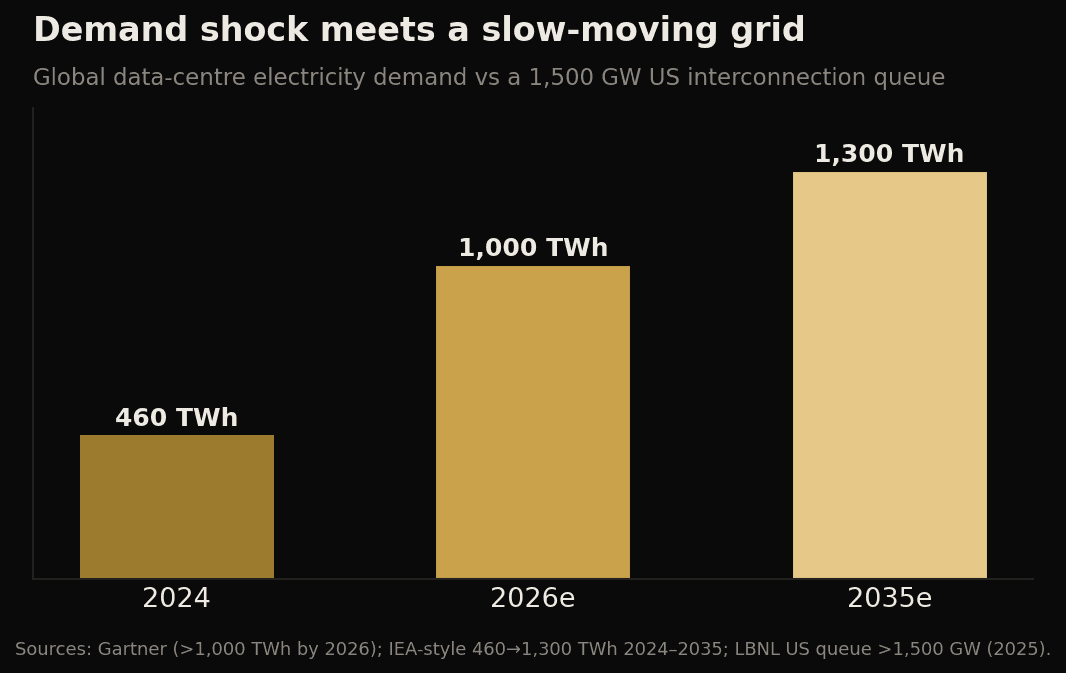
Start with demand. Global data-centre electricity consumption is set to pass 1,000 terawatt-hours in 2026 — roughly double the 2023 baseline, per Gartner — and credible trajectories put it near 1,300 TWh by 2035, up from about 460 TWh in 2024. A single GB200-class server rack now draws 120–140 kW, three to four times the previous generation. This is a demand shock in the precise economic sense: large, fast, and largely price-insensitive, because for a hyperscaler the marginal value of compute still dwarfs the marginal cost of the power to run it.
Now the supply side, which is where the economics bite. New firm generation does not arrive on a demand-shock timescale. The US interconnection queue already exceeds 1,500 GW (Lawrence Berkeley Lab) — a multi-year backlog of projects waiting to connect. Goldman Sachs estimates roughly 85–90 GW of new nuclear will be needed to serve this load by 2030, of which less than 10% is realistically available. When inelastic, slow-moving supply meets a demand shock, price theory gives an unambiguous answer: the scarce complementary input earns a rising rent. That rent accrues to firm power.
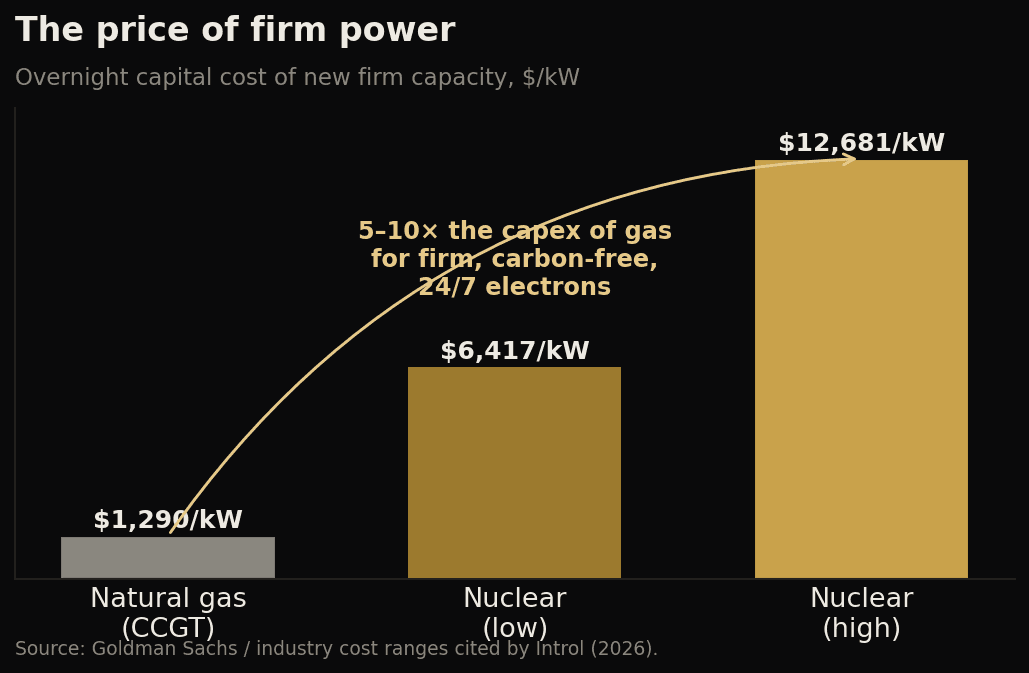
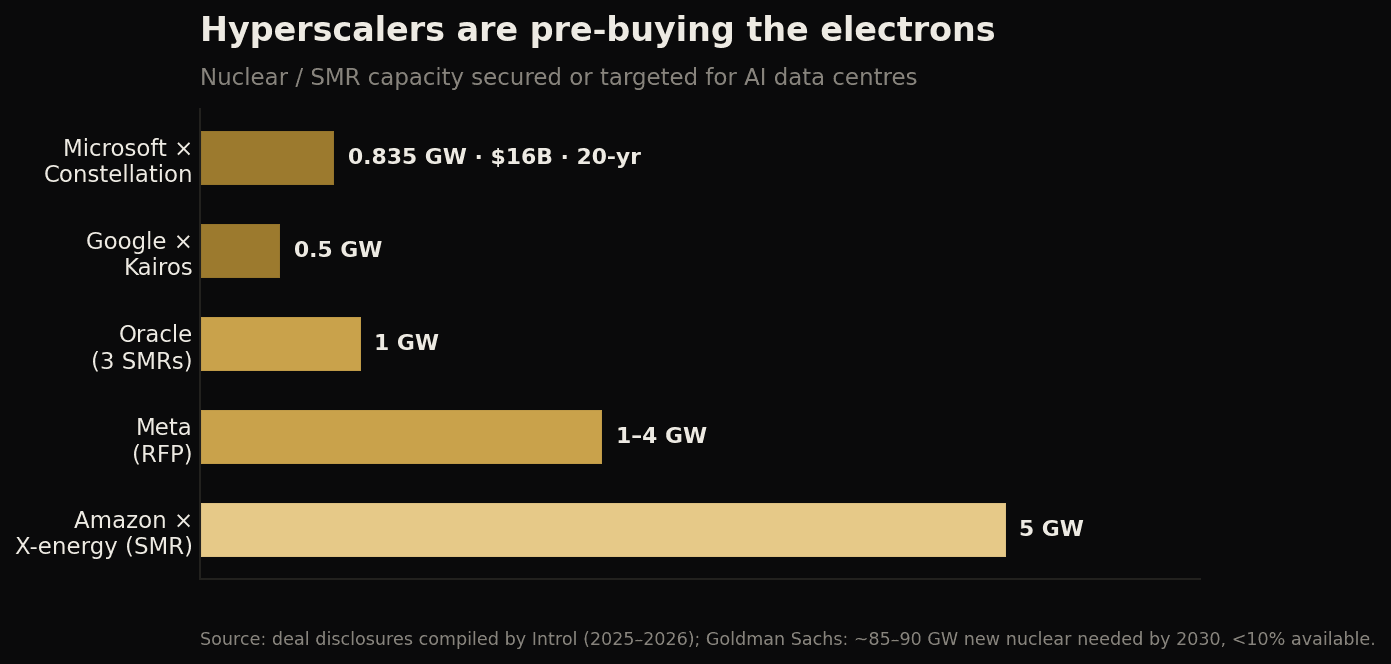
The deal flow is the proof, and it is priced in the open. Microsoft has committed roughly $16 billion over twenty years to restart 835 MW at Three Mile Island (rebranded the Crane Clean Energy Center, online around 2028). Amazon is building out around the Susquehanna nuclear plant and has backed 5 GW of small modular reactor projects; Google has contracted about 500 MW from Kairos Power's SMR fleet; Meta has issued a 1–4 GW nuclear RFP; Oracle is permitting a gigawatt-scale, three-reactor campus. These buyers are paying for firmness explicitly: new nuclear runs $6,400–12,700 per kW of capacity against roughly $1,290 for a combined-cycle gas plant — five to ten times the capex — for the same nameplate megawatt.
Why pay that premium? Because AI compute is a high-capacity-factor, around-the-clock load, and intermittent renewables — cheap per MWh but non-firm — do not match its duty cycle without expensive storage. What the buyers are actually purchasing is the attribute the market under-priced for a decade: dispatchability, 24/7 availability, and carbon-free provenance, bundled. Locking twenty-year offtake at a large capex premium is a revealed-preference statement about the option value of guaranteed electrons. Firmness, not energy, is what is being repriced.
For an industrial AI buyer, this reframes strategy. GPU access is commoditising and, per unit of useful work, deflating — a poor foundation for durable advantage. The complementary inputs are the ones that appreciate: a secured power contract, a grid-connected site with a live interconnection, and proprietary data no competitor can replicate. An AI roadmap optimised around chip procurement is optimising the wrong variable. The scarce, appreciating assets sit on either side of the model — the electrons that feed it and the data that differentiates it — and both are exactly where regulated industrial incumbents already hold positions.
For energy and O&G incumbents the same repricing is a demand-side windfall, and the sector's own history is instructive. Gas-to-power, behind-the-meter generation, and interconnection rights turn an operator into the toll-collector of the AI build-out. But an economist adds a caution about duration: buyers are locking twenty-year firm-power contracts against a compute asset whose economic life is two to three years, betting that AI demand outlives any individual GPU by a wide margin. That asymmetry is where the risk — and the pricing power — will ultimately be settled. The near-term conclusion is unchanged: do not buy the compute narrative, secure the electrons — and if you already sell them, recognise that you now hold the scarce asset in the AI economy.
Analysis by
Cardan-AI Intelligence
Our research and analysis unit, dedicated to applied AI for business, industry and regulatory compliance.
Sources
- Introl — Nuclear power for AI data centers (deal figures, capex ranges)
- Gartner / LBNL figures — AI Data Center Power Requirements 2026 (>1,000 TWh; >1,500 GW queue)
- Goldman Sachs — AI to drive a surge in power demand
- IEA — Energy and AI (data-centre electricity 460→1,300 TWh)
- Constellation Energy — Crane Clean Energy Center (Three Mile Island restart)
Let's talk about your next competitive edge
Thirty minutes to identify the two or three use cases in your operations that pay for themselves within the first year.