
Why US AI-Robotics Firms Are Scaling in the Gulf, Not From the US
Gecko Robotics points to a wider pattern of US industrial robotics firms choosing to scale operations in the Gulf. Dunning's eclectic OLI paradigm (1977) explains why direct investment there — rather than plain export or licensing — is the rational choice for a technology that is both proprietary and sensitive.
A pure software company can internationalize its market without ever placing a team abroad: the product ships over the internet at near-zero marginal distribution cost. Yet that is not the path chosen by several AI-funded US industrial robotics firms, Gecko Robotics among them, which themselves describe a direct build-out in the Gulf — specifically the United Arab Emirates — for technology that combines a software layer (AI) with a hardware one (robots, drones).
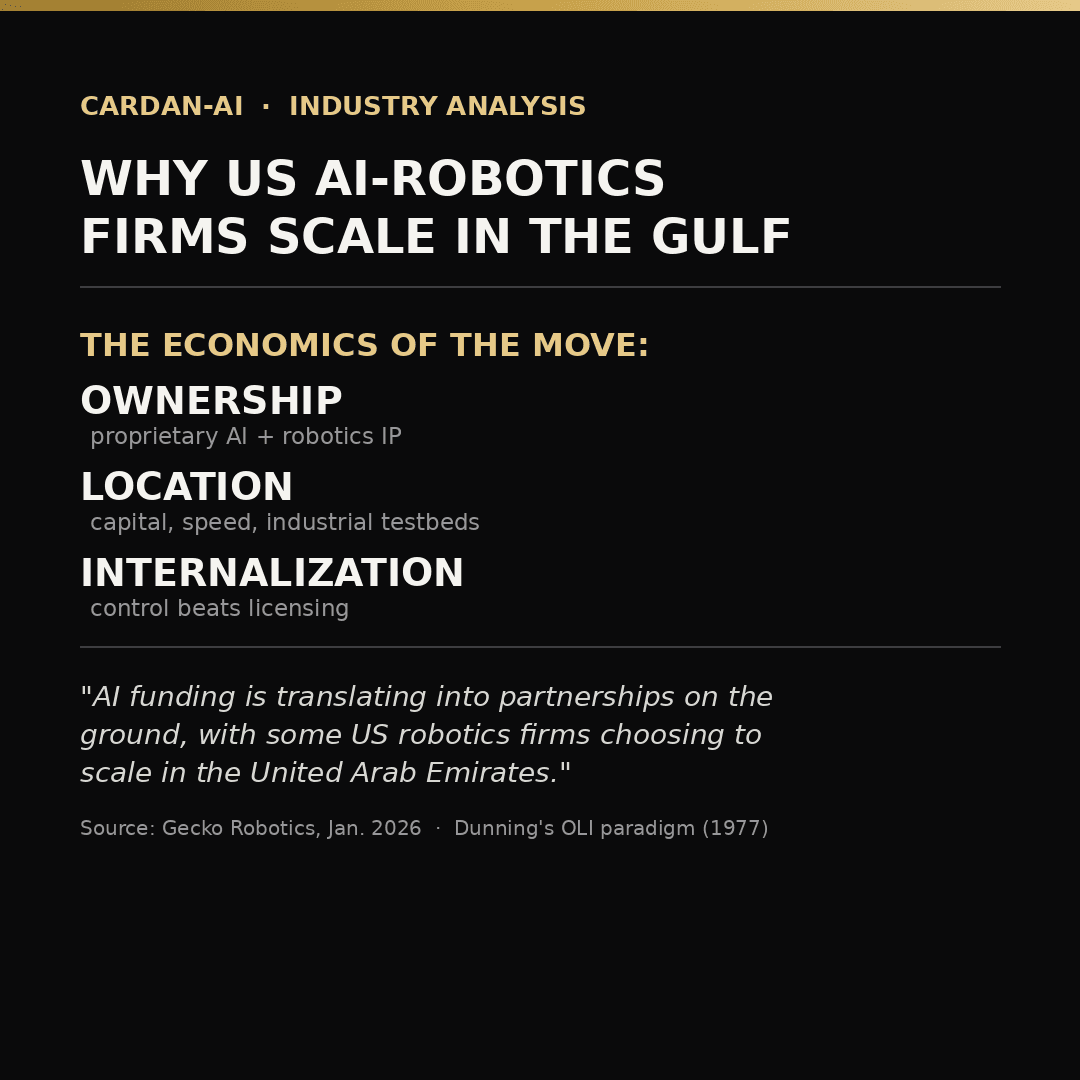
Seen through the lens of international economics, that choice is not trivial. British economist John Dunning proposed a framework in 1977 — the eclectic, or OLI, paradigm — to explain when a firm chooses foreign direct investment (FDI) over exporting or licensing to a local partner. His answer: a firm opts for FDI only when three conditions hold simultaneously — an Ownership advantage it alone holds, a Location advantage that makes the host country more attractive than the home country for exploiting that advantage, and an Internalization advantage that makes managing the asset in-house preferable to handing it to a third party through a license.
The ownership advantage here is obvious: the robot-sensor-AI stack for inspecting critical infrastructure is proprietary technology the firm does not want leaking to a local competitor. It is the easiest condition to verify, and the least informative — it holds for almost any technology firm that internationalizes at all.
The location advantage is more instructive, because it reverses the textbook FDI-to-emerging-markets story. In the standard account, a Western firm relocates to exploit cheaper labor; here, the Gulf offers neither cheap labor nor a mass consumer market comparable to the US. It offers something else: access to patient, abundant capital via sovereign wealth funds (Mubadala, ADQ, PIF), markedly faster regulatory approval cycles for dual-use technology (civilian and defense), and — critically — real industrial assets, from refineries to power plants to mining and defense sites, offered up as full-scale testbeds. This is a capital- and speed-driven location advantage, not a labor-cost one.
The internalization advantage, finally, explains why these firms choose to scale directly rather than license their technology to a local distributor — a simpler, less capital-intensive option. The answer lies in the nature of the asset: inspection technology for sensitive sites (defense, energy) generates data on the integrity of critical infrastructure — data whose leakage or misuse by a third-party local partner would be a largely uninsurable risk. Keeping direct control of operations, via a subsidiary or majority joint venture, reduces that risk, at the cost of a heavier capital and organizational commitment than licensing would require.
This triptych carries a direct practical implication for any Western firm — French firms included — weighing a move into the Gulf, whether in aerospace, energy or industry: Dunning's framework is a ready-made decision checklist. Is the ownership advantage distinctive enough to justify direct investment over licensing? Does the Gulf offer a genuine location advantage for this specific activity — capital, regulatory speed, access to testbed assets — or is this simply a fashionable move? Does the sensitivity of the technology justify the cost of internalization over a cheaper local partnership?
One caveat is warranted: the source of this observation is itself a firm with a commercial stake in the trend it describes — Gecko Robotics has an obvious interest in framing the Gulf as the destination of choice for AI robotics. A single case is not proof of a systematic capital flow. It nonetheless sits within a broader, separately documented pattern (Gulf fund stakes in Western AI champions, large compute campuses announced in the UAE) that makes the underlying hypothesis plausible beyond this one example.
For Cardan-AI's target sectors — aerospace and defense, energy and oil & gas, industry, luxury — the lesson is not to rush to the Gulf, but to track the pace at which competitors are field-validating their own industrial AI there at scale: an accelerated iteration cycle on real foreign assets can, with a lag of a few quarters, become a domestic competitive gap that is hard to close.
Analysis by
Cardan-AI Intelligence
Our research and analysis unit, dedicated to applied AI for business, industry and regulatory compliance.
Let's talk about your next competitive edge
Thirty minutes to identify the two or three use cases in your operations that pay for themselves within the first year.