
AI Agents and the Matching Function: What Adecco's Rollout Means for Labor-Market Frictions
Adecco is rolling out agentic AI to 27,000 employees and reporting 20,000 additional placements. Diamond-Mortensen-Pissarides matching theory explains what's really at stake: an efficiency shock to the very function that staffing intermediaries sell — and an existential question for those who sell it.
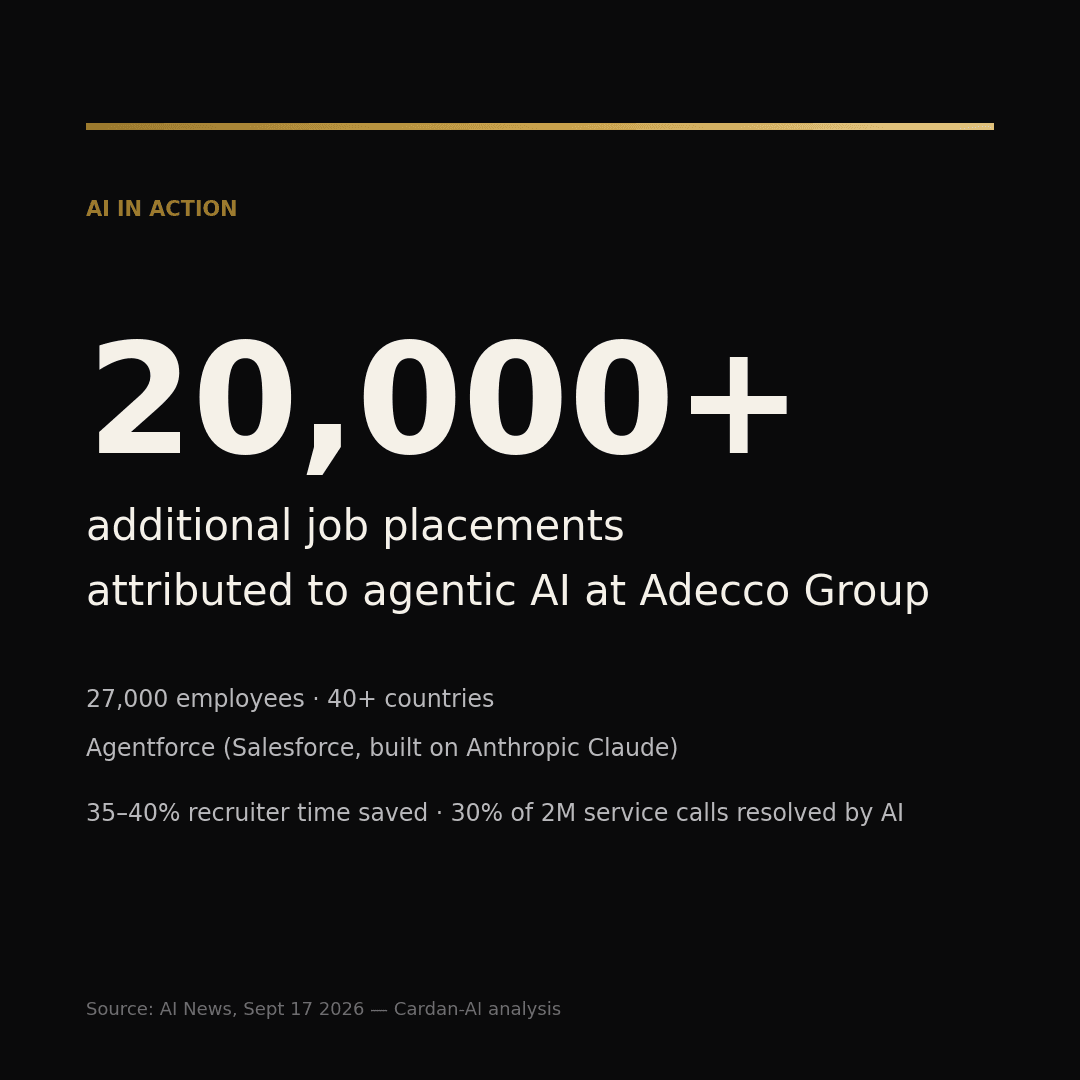
Adecco Group, the world's largest staffing and recruitment firm, announced on September 15, 2026 the global rollout of Agentforce Coworker (Salesforce, built on Anthropic's Claude models) to its 27,000 employees across more than 40 countries. The reported figures are unusually precise for an agentic AI deployment at this scale: 35-40% recruiter time saved, 20,000 additional placements attributed to agents, 30% of two million service calls resolved without human intervention, and 2.6 million agent-candidate interactions over the year.
The interesting economic angle is not individual recruiter productivity — a 35-40% time saving is notable but unremarkable in the long history of office automation. What is less ordinary is that staffing is, by construction, a market-intermediation business: its entire value proposition is reducing the cost and duration of search between labor supply (an open position) and labor demand (an available candidate). Labor-market matching theory, formalized by Diamond, Mortensen and Pissarides (2010 Nobel laureates), models exactly this process through a matching function m(u, v), where u is the number of job seekers, v the number of vacancies, and the rate at which the two meet depends on a market efficiency parameter.
What Adecco is documenting reads directly as a positive shock to that efficiency parameter: AI agents handling pre-screening and application tracking cut the processing time for each (candidate, vacancy) pair, which in the DMP framework corresponds to an inward shift of the Beveridge curve — for a given level of market tightness (the v/u ratio), the job-finding rate rises and average vacancy duration falls. The 20,000 additional placements are not simply a margin gain for Adecco; at the aggregate level, they represent candidate-vacancy pairs that formed faster, or that would not have formed at all under the prior matching technology.
A second framework adds nuance: Autor, Levy and Murnane's task-based model. A recruiter's job decomposes into tasks — sourcing, criteria-based screening, qualifying interviews, negotiation, onboarding. Adecco's agents automate precisely the routine, codifiable cognitive tasks (resume triage, criteria verification, follow-up nudges), leaving human recruiters the tasks with heavy relational and judgment content (cultural-fit assessment, salary negotiation, client-account management). This is task-level complementarity, not outright substitution — consistent with the fact that 35-40% time savings has not been accompanied by any announced reduction in recruiter headcount.
The more interesting question for Adecco's industrial clients — aerospace, defense, energy and manufacturing firms that outsource a meaningful share of hiring to staffing agencies — is who captures the resulting rent. An efficiency shock to the matching function theoretically benefits three parties: the intermediary (higher margin per recruiter), client firms (lower hiring cost, shorter time-to-fill) and candidates (faster job search). The split depends on the degree of competition among staffing agencies: if Adecco alone holds this efficiency edge (a first-mover or data-scale advantage), it captures a temporary rent; if the technology diffuses quickly across the sector — likely, since Agentforce is a commercial Salesforce product sold to any client agency — competition will dissipate most of the surplus toward client firms and candidates, a net gain for the economy but a squeeze on intermediary margins.
This last point matters for an industrial audience: a structural reduction in search costs for skilled labor — engineers, certified maintenance technicians, qualified operators — is not neutral for sectors where a documented skills shortage (aerospace, oil & gas, defense) has constrained growth for several years. If the matching function becomes structurally more efficient market-wide, the expected second-round effect is a partial narrowing of the gap between demand for scarce skills and available supply — not a closing of it, since the underlying scarcity of qualifications does not itself change with search technology.
The Adecco rollout is also a textbook case of vertical technology dependence: the agreement runs through a multi-year exclusive commitment (through 2027) to a Salesforce product built on Anthropic models — three proprietary layers stacked for a function the world's largest staffing player judges strategic. That is a signal any company outsourcing a critical intermediation function should weigh for itself: the question is no longer simply whether to adopt agentic AI, but how much dependence on a proprietary technology stack it is willing to accept for a core business function.
Analysis by
Cardan-AI Intelligence
Our research and analysis unit, dedicated to applied AI for business, industry and regulatory compliance.
Let's talk about your next competitive edge
Thirty minutes to identify the two or three use cases in your operations that pay for themselves within the first year.