
AI Weather Forecasting: What the Value-of-Information Theorem Says About Google's Bet on the Grid
Google DeepMind is now explicitly targeting grid operators with WeatherNext 3. Blackwell's (1953) value-of-information theorem explains why this bet makes growing economic sense: the more the grid decarbonizes, the more a marginally better forecast is worth.
On September 3, 2026, Google DeepMind deployed WeatherNext 3: global resolution improved to 5 kilometres (from 25 km), hourly updates (from six-hourly), latency cut to 3-4 hours, and — notably — a dedicated prediction of wind speed at 100 metres, standard turbine hub height. On accuracy, Google claims up to 60% improvement over NASA's IMERG satellite product and 50% on day-plus precipitation forecasts. It's a technical product, but its explicit targeting — grid operators — makes it an economic one too.
The most useful lens here isn't technological but theoretical: David Blackwell's (1953) value-of-information theorem, later central to Bayesian decision theory. The idea is simple: a decision-maker facing uncertainty can never be worse off, and is generally better off, receiving a more informative signal before acting — provided the cost of that signal stays below the decision gain it enables. A grid operator continuously decides under weather uncertainty: how much spinning reserve to commit, which flexible capacity to dispatch, how much solar or wind output to accept onto the system. A better forecast doesn't change the weather itself — it changes the quality of the decision made before the weather happens.
What makes the timing notable is that the marginal value of that precision is rising mechanically along two independent trends WeatherNext 3 meets at once. First, generation is electrifying and weatherizing: the US added more than 90 GW of new capacity in 2026, including 51.2 GW of solar and 25.7 GW of storage — an overwhelming share of output that depends directly on weather variables (sunlight, wind), unlike a dispatchable thermal plant. The larger that share grows, the larger the underlying supply uncertainty — and the value of a signal that reduces it — grows in proportion.
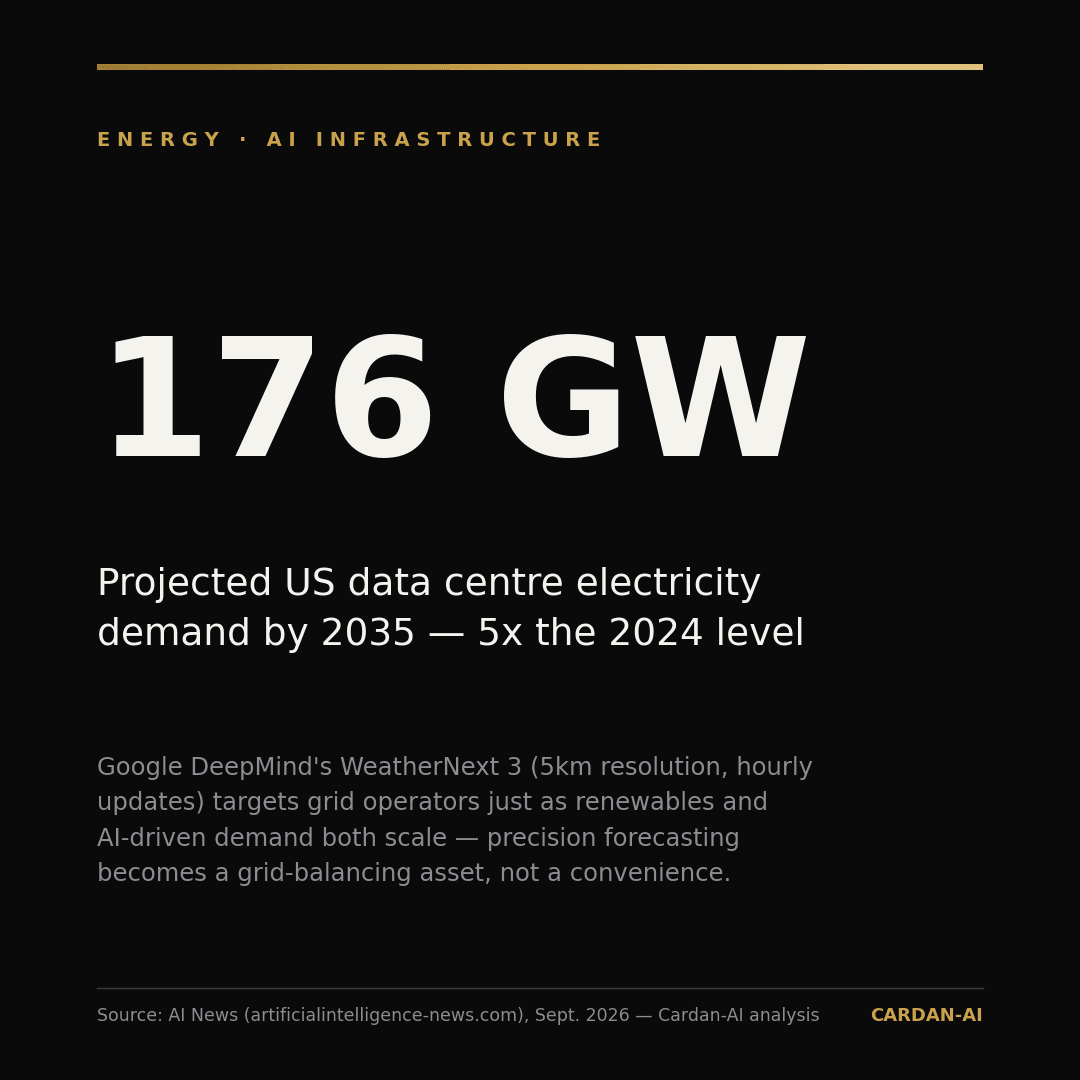
Second, demand growth changes the picture too: US peak demand is projected to rise roughly 26% by 2035, driven substantially by data centres, whose consumption could reach 176 GW by then — five times the 2024 level. A grid under tighter demand pressure has less structural slack to absorb a supply-side forecast error: the same weather miscall costs more in reserve mobilized or load shed when the system runs closer to its ceiling. Blackwell would predict exactly this dynamic: a signal's value is never absolute, only relative to the error margin the system can still absorb without it.
Google's competitive positioning deserves a second, more economic look. The energy-applied weather forecasting market already has specialized players — Vaisala, Solcast, DNV's WindGEMINI, IBM's HyperWatch, Swiss start-up Jua — whose business model rests on selling the forecast itself as the product. Google enters sideways: WeatherNext 3 plugs natively into BigQuery, Earth Engine and Google Maps Platform, cloud infrastructure many energy operators already run other workloads on. This is the dynamic platform economics calls 'commoditizing your complement' (after Joel Spolsky, later formalized in the two-sided-markets literature by Eisenmann, Parker and Van Alstyne): make an adjacent product free or near-free to strengthen retention on the infrastructure layer that actually carries the margin. A specialized forecast vendor can't answer that strategy by improving accuracy alone — the battle shifts to distribution, where it is structurally disadvantaged.
For energy and O&G operators currently evaluating forecasting and decision-support vendors, the question WeatherNext 3 raises isn't just 'which model is more accurate?' but 'which vendor's distribution makes that accuracy — even at a modest edge — cheapest to consume over time?' A few points of accuracy gap can be wiped out by a much larger integration-cost gap — a trade-off no spec sheet settles on its own.
Google's bet, then, isn't only meteorological. It's a bet that the rising value of climate information in a more renewable, more strained grid justifies investing in precision — and that precision, distributed through already-captive infrastructure, captures more value than a forecast sold as a standalone product. Blackwell supplies the theory; the 2026 generation mix supplies the numbers.
Analysis by
Cardan-AI Intelligence
Our research and analysis unit, dedicated to applied AI for business, industry and regulatory compliance.
Let's talk about your next competitive edge
Thirty minutes to identify the two or three use cases in your operations that pay for themselves within the first year.