
Arrow and AI-Driven Drilling: What Learning by Doing Says About the ADNOC-SLB Rollout
ADNOC and SLB deployed their AI drilling platform across more than 120 rigs, with a measured 30-40% drop in per-rig engineering effort. Kenneth Arrow's 1962 theory of learning by doing explains why that gain was unreachable at pilot stage — and what it means for any leadership team still weighing pilots against a full rollout.
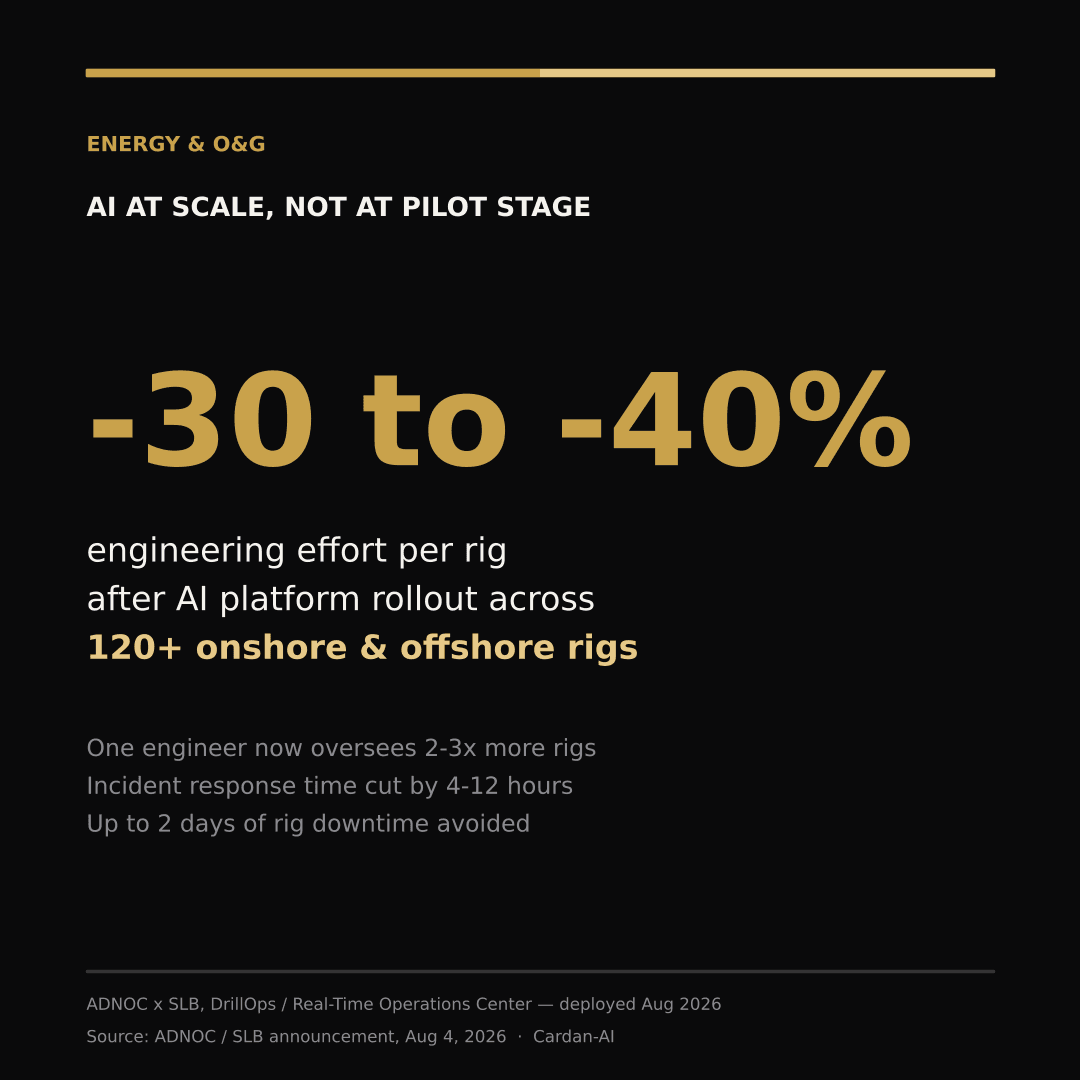
ADNOC and SLB announced the deployment of their AI drilling platform, DrillOps, paired with a Real-Time Operations Center, across more than 120 onshore and offshore rigs in the United Arab Emirates. The published figures are unusually precise for this kind of announcement: a 30% to 40% reduction in engineering effort per rig, two to three times more rigs overseen per engineer, incident response times cut by four to twelve hours, and up to two days of downtime avoided. The platform runs on the group's sovereign cloud.
In 1962, economist Kenneth Arrow published "The Economic Implications of Learning by Doing" in the Review of Economic Studies. Built on wartime and postwar aircraft and shipbuilding production data, his thesis holds that a process's productivity does not grow mainly through capital accumulation, but through the accumulation of experience: each unit produced teaches the organization something the previous one did not reveal, and that knowledge diffuses across the producing organization. Productivity is then a function of cumulative output, not of elapsed time or technical investment alone.
The ADNOC-SLB case illustrates this mechanism with unusual clarity for industrial AI. The 30-40% gains did not show up in a pilot limited to a handful of wells — where configuration, integration and false-positive correction effort would likely have outweighed the gains achieved. They materialize once the platform is exposed to the real diversity of a 120-rig fleet: different geologies, different teams, different incident types. It is this diversity of exposure, not usage duration alone, that produces learning in Arrow's sense.
A second layer of learning, which Arrow could not have anticipated in 1962, is at work here: SLB is not learning solely for ADNOC's benefit, it is capitalizing on this deployment experience across its entire client base — AGR, PETRONAS Carigali, Kuwait Oil Company and Aker BP, to name the public 2026 partnerships alone. Learning by doing is no longer confined to the firm operating the fleet; it is also external, carried by the platform vendor itself, who resells each new client a learning curve already partly climbed elsewhere. This is a structural departure from Arrow's model: the relevant unit of learning is no longer the firm, but the operator-vendor pair.
That distinction carries a direct implication for any industrial leadership team — aerospace, energy, luxury — currently structuring its own AI program. An isolated internal pilot only accesses the slowest learning curve available: a single organization discovering its own use cases alone. A deployment built on a vendor that has already operated at scale elsewhere imports part of a curve already climbed. Partner choice then matters as much as deployment scale.
Caution is warranted on how these figures should be read: they come from a joint ADNOC-SLB announcement, not an independent audit, and ADNOC does not disclose the exact methodology behind the avoided engineering effort or the reference period used. The orders of magnitude (30-40%, 2-3x, 4-12 hours, up to two days) are internally consistent and in line with gains typically documented in the industrial learning-curve literature, but they remain company-reported figures and should be treated as such.
For Cardan-AI, the most robust signal here is not the precise figure but its structure: AI productivity gains often only appear beyond a threshold of scale and exposure diversity, which makes pilot-versus-pilot comparisons across companies largely uninformative — and should push leadership teams to budget for the scale transition from the start of a program's design, rather than treating it as a decision to defer.
Analysis by
Cardan-AI Intelligence
Our research and analysis unit, dedicated to applied AI for business, industry and regulatory compliance.
Let's talk about your next competitive edge
Thirty minutes to identify the two or three use cases in your operations that pay for themselves within the first year.