
NGC2: why Anduril's $1.8B contract is really a race for lock-in, not performance
The U.S. Army handed Anduril a contract worth up to $1.8 billion to expand its NGC2 command system to corps level, while testing Lockheed Martin's rival architecture in parallel on another division. Brian Arthur's (1989) theory of technological lock-in and Katz & Shapiro's (1985) network externalities explain why this still-open race risks closing before the better architecture has actually won on the ground.
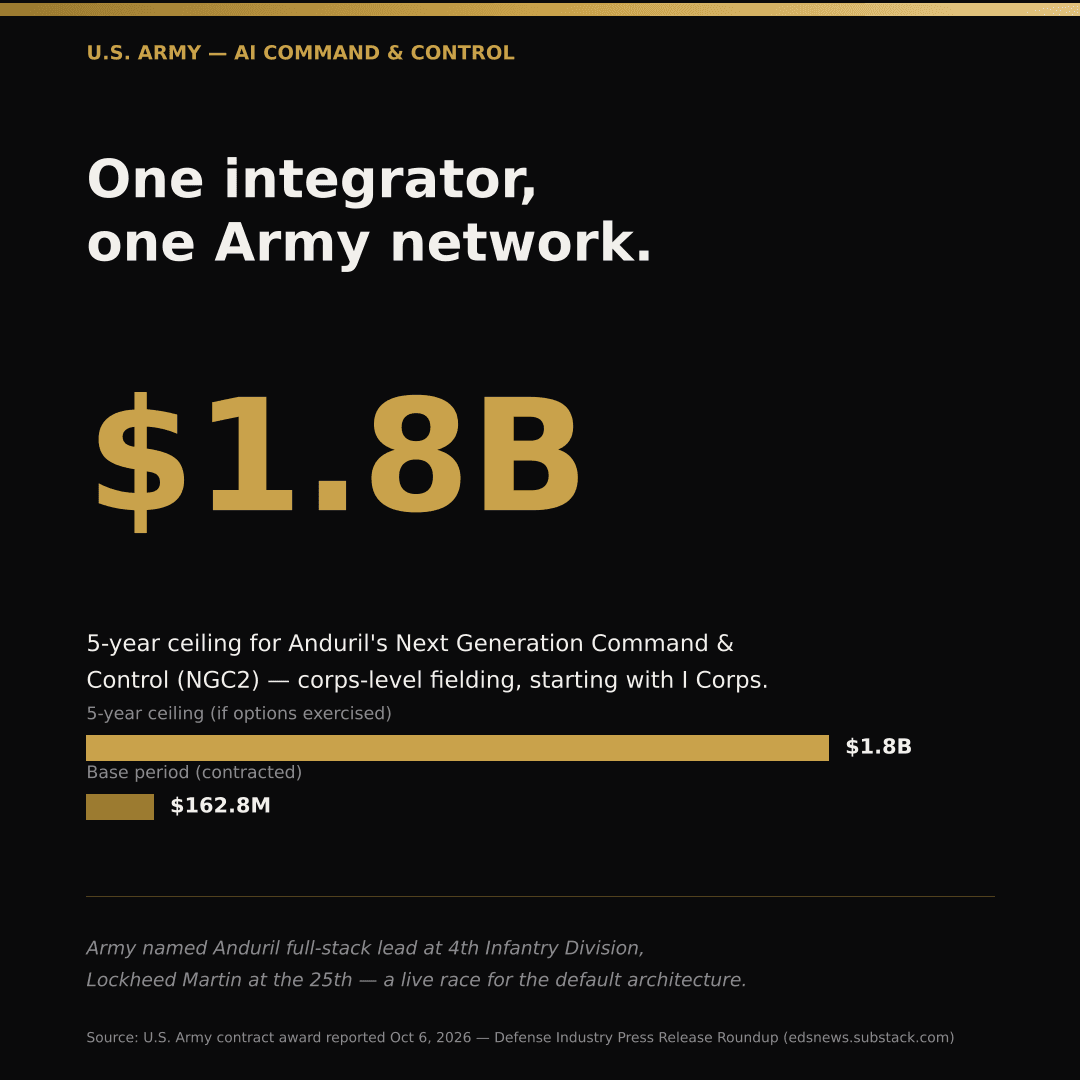
On October 6, the U.S. Army awarded Anduril a contract worth up to $1.8 billion over five years, with a firm $162.8 million base period, to expand the Next Generation Command and Control (NGC2) program from division-level pilots to corps-level fielding, starting with I Corps. NGC2 runs on a common data layer established in June, where Palantir's Foundry platform and Anduril's Lattice system provide the edge-to-cloud data mesh, with Raft supplying data and services registries.
The most telling detail isn't the contract's size, but its structure: the Army named Anduril as full-stack integration lead at the 4th Infantry Division, and Lockheed Martin at the 25th. Two command architectures, built on different technological logics, are therefore being tested in parallel on separate units — a setup the economics of networks has studied extensively, and whose outcome is rarely settled by technical merit alone.
That is the core subject of W. Brian Arthur's foundational paper, "Competing Technologies, Increasing Returns, and Lock-In by Historical Small Events" (The Economic Journal, 1989). Arthur shows that when two competing technologies benefit from increasing returns to adoption — each new user making the technology more efficient or cheaper for the next — the market does not necessarily converge on the better solution. Small, seemingly minor early events (which division gets picked first, the order of awards) can tip the whole system into a locked-in equilibrium that later becomes costly to escape, even when a superior alternative exists.
In NGC2, the increasing returns are concrete: every unit trained on an architecture, every software integration built on its data layer, every command habit formed around its interface raises the cost of switching to the rival system. The $1.8 billion contract is not just payment for a technical rollout — it is an investment in accumulating that installed base, at the exact moment NGC2's operational superiority over the Lockheed Martin architecture has not yet been settled by real corps-level use.
Katz & Shapiro, in "Network Externalities, Competition, and Compatibility" (American Economic Review, 1985), add a complementary piece: when a system's value depends on how many compatible users it has, rational actors anticipate the future size of the installed base and choose accordingly — which can artificially speed up convergence on a standard, including a suboptimal one, simply because everyone prefers joining the camp they expect to win rather than risking technical isolation.
For the U.S. Army, this dynamic creates a precise strategic tension: rigorously document real performance gaps between the Anduril and Lockheed Martin architectures at division level before the next scale-up — otherwise the corps-level choice will be driven more by contractual head start than by operational evidence. The symmetric risk is real too: delaying the decision out of excess caution has its own cost, since increasing returns favor whichever architecture keeps moving while the other waits.
For aerospace and defense companies supplying or integrating software components on programs like this, the economic lesson extends beyond NGC2: in a market with increasing returns, the window to influence which architecture becomes dominant is narrow and early. Once the installed base is built, the negotiation no longer centers on the best solution, but on the cost of migrating out of an equilibrium that has already locked in.
Analysis by
Cardan-AI Intelligence
Our research and analysis unit, dedicated to applied AI for business, industry and regulatory compliance.
Sources
- Defense Industry Press Release Roundup — October 9–15, 2026, edsnews.substack.com
- Arthur, W.B., "Competing Technologies, Increasing Returns, and Lock-In by Historical Small Events", The Economic Journal, 1989
- Katz, M.L. & Shapiro, C., "Network Externalities, Competition, and Compatibility", American Economic Review, 1985
Let's talk about your next competitive edge
Thirty minutes to identify the two or three use cases in your operations that pay for themselves within the first year.