
Allies, Not Equals: What the Gravity Model of Trade Says About ITAR Easing Among AUKUS Countries
Washington is easing ITAR export controls between the US, UK and Australia for defense technology, AI included. The gravity model of trade (Anderson & van Wincoop) explains why this easing, confined to the AUKUS circle, can mechanically worsen the relative position of allies left outside it.
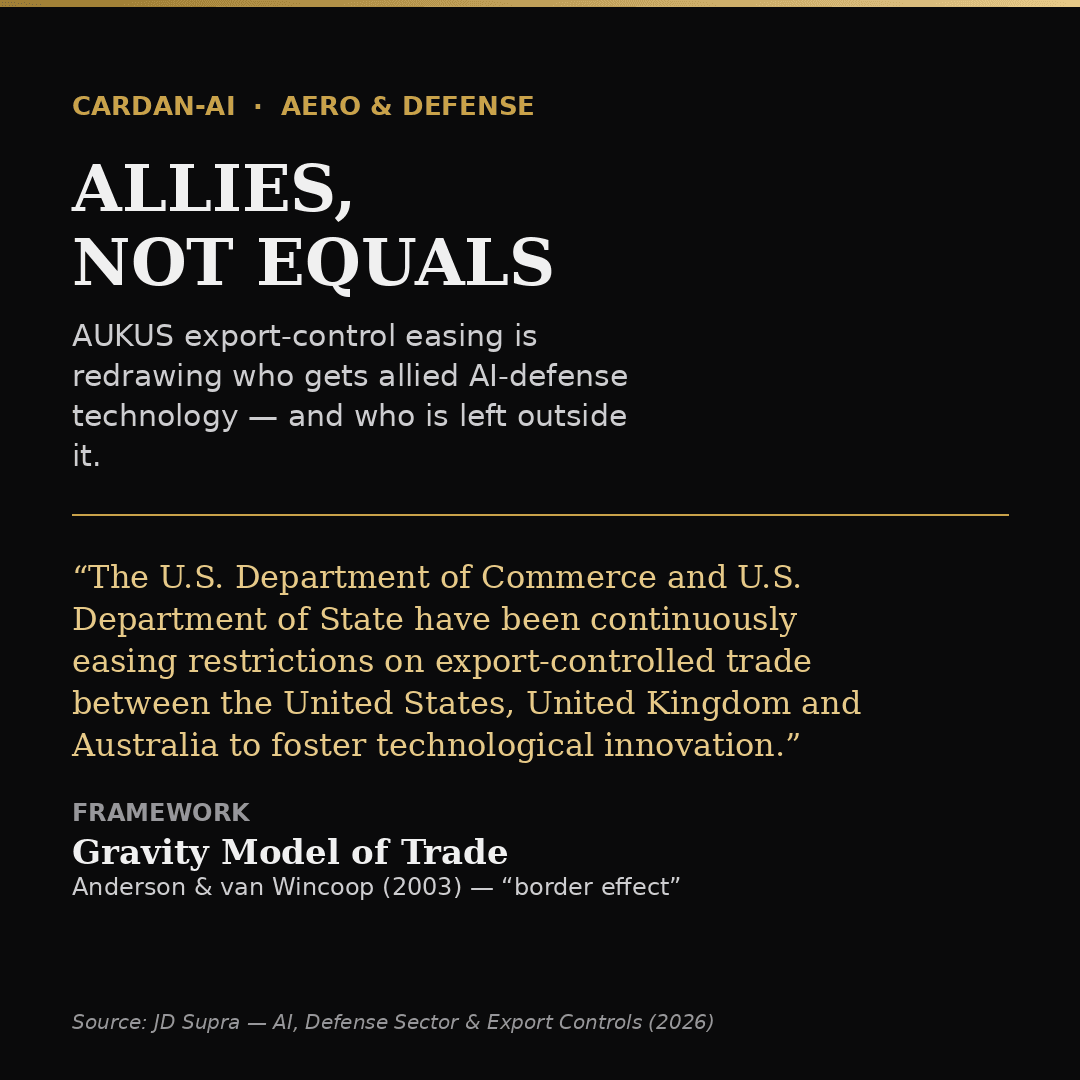
The U.S. Departments of Commerce and State are continuously easing export controls on licensed goods and technology (ITAR) between the United States, the United Kingdom and Australia — a move documented in specialized legal commentary and reinforced by the FY2026 National Defense Authorization Act, which observers note "reflects a continued and deliberate shift" in how Congress uses defense authorization legislation. This sits within AUKUS Pillar II, dedicated to sharing advanced technology among the three countries — autonomy, hypersonics, cyber, and AI applied to defense.
To understand what this easing actually produces, international trade economics offers a precise framework: the gravity model. In its simplest form, popularized as early as the 1960s, the model predicts that bilateral trade between two countries grows with the size of their economies and shrinks with the distance and barriers separating them — a direct analogy to Newton's law of gravitation. It remains, to this day, one of the most robust empirical tools in all of international economics for predicting bilateral trade flows.
Canadian economist John McCallum made waves in 1995 by showing that this model, applied to trade between Canadian provinces and U.S. states, revealed a massive "border effect": at equal size and distance, two Canadian provinces traded far more with each other than a Canadian province did with a comparable U.S. state — a result later revised downward by subsequent work (notably by John Helliwell) as North American integration deepened, but whose order of magnitude remained durably significant. The border, even absent a tariff, behaves as a real economic barrier.
It was James Anderson and Eric van Wincoop who, in 2003, formalized why: a border acts as an implicit tax on trade, and its effect on the flow between any two given countries depends not only on the bilateral barrier itself but also on "multilateral resistance" — the average barrier each country faces across all its trading partners. The counterintuitive but well-established consequence: lowering a barrier between two countries doesn't just affect their bilateral trade — it also mechanically shifts the relative position of every third country that doesn't benefit from it, a trade-diversion effect built into the model itself, independent of any change in their own barriers.
Applied to ITAR and AUKUS, the logic is direct. ITAR functions, for defense-technology trade (AI and autonomy included), exactly like McCallum's Canada-U.S. border: a regulatory barrier that dampens flows far more than any distance-related cost alone would justify. By easing it specifically among the three AUKUS countries — rather than universally across all U.S. allies — Washington lowers bilateral resistance within the trio, but, through the very multilateral-resistance mechanism Anderson and van Wincoop described, mechanically raises the relative resistance faced by third countries: France, the rest of the European Union, Japan, South Korea.
Concretely, this means a French or European aerospace and defense contractor doesn't just face an unchanged ITAR in absolute terms — it faces an ITAR that has become relatively more restrictive, since its British and Australian competitors see their access to U.S. AI and autonomous building blocks improve. This isn't a rhetorical effect: it's a structural, near-mechanical consequence of the gravity model, which redistributes relative competitiveness even when no rule changes for the third country at all.
Two caveats apply. First, the quantitative scale of this 2026 easing isn't yet publicly itemized in detail — the FY2026 NDAA is a legislative signal, not yet a full implementing text, and the diversion effect described here will remain hard to measure until the U.S. Munitions List (USML) and related general licenses are actually republished. Second, France has its own bilateral levers (industrial reciprocity agreements, joint programs such as the FCAS/SCAF) that can partly offset the diversion effect — but those levers operate outside the ITAR framework itself, rather than neutralizing it directly.
For industrial decision-makers in Cardan-AI's target sectors — aerospace and defense first, but also energy and O&G for dual-use technology — the practical takeaway is to watch less the text of the AUKUS easing itself than its amended USML implementing lists, and to document precisely in which technology segments (embedded AI, autonomy, cyber) the access gap with AUKUS partners is actually widening, rather than assuming it is uniform across the entire defense portfolio.
Analysis by
Cardan-AI Intelligence
Our research and analysis unit, dedicated to applied AI for business, industry and regulatory compliance.
Let's talk about your next competitive edge
Thirty minutes to identify the two or three use cases in your operations that pay for themselves within the first year.