
Joby's autonomous flight and the economics of span of control: what Garicano says about remote supervision
Joby's transcontinental autonomous flight, supervised from 2,323 miles away, shifts the binding economic constraint on aerial autonomy away from piloting and toward the design of supervision hierarchies — a problem the economics of organization, via Garicano (2000), lets us formalize.
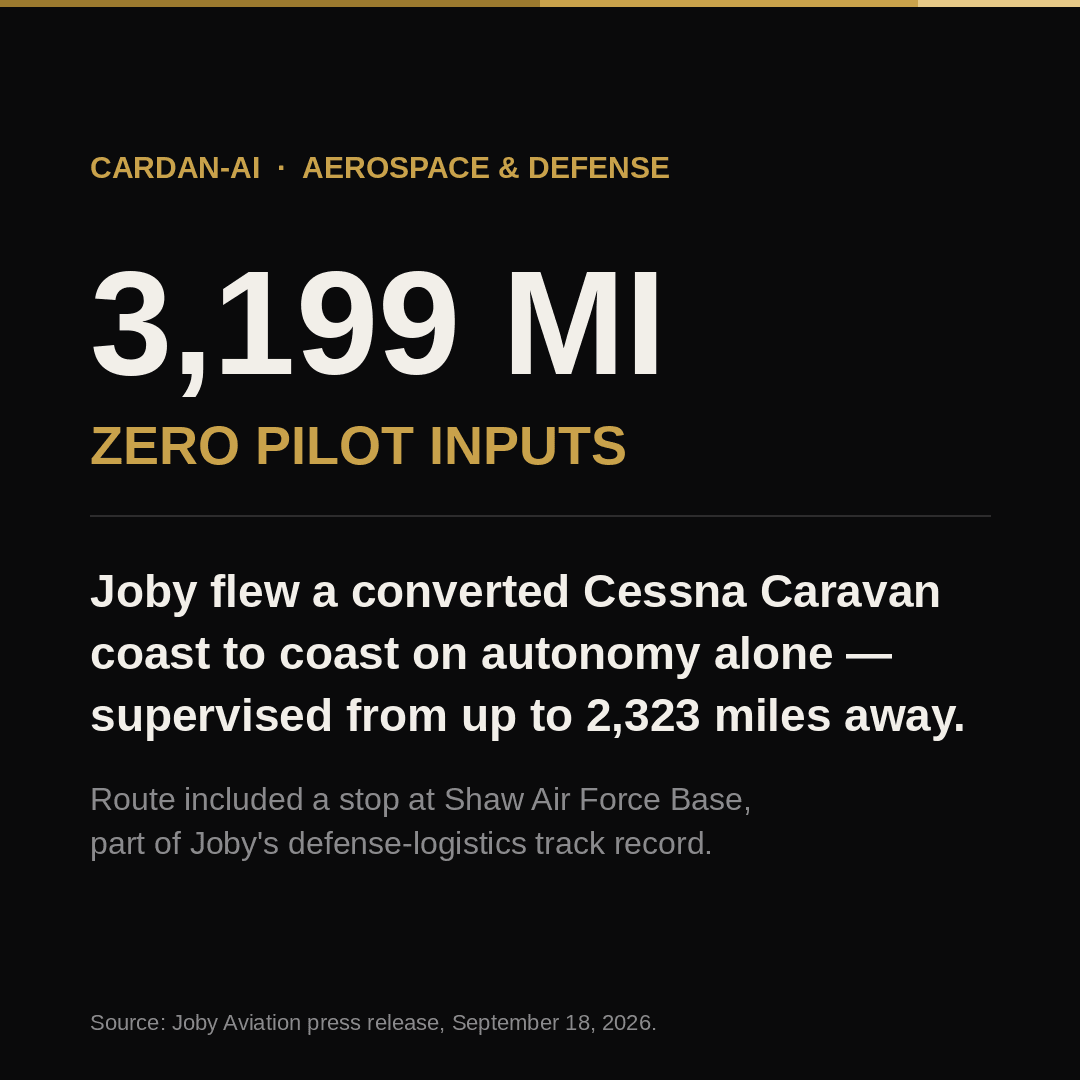
On September 18, Joby Aviation flew a converted Cessna Caravan 3,199 miles from California to North Carolina with zero control inputs from the onboard safety pilot. The aircraft was supervised from remote posts up to 2,323 miles away, with a stop at Shaw Air Force Base. Joby cites more than 400 autonomous flights and 800 automated flight hours, with the underlying technology tracing back to its 2024 acquisition of autonomous-cargo startup Xwing.
The most immediate read is technical: a flight of this distance with no direct human intervention on the controls is a genuine autonomy-maturity milestone. But the question that matters to an industrial decision-maker isn't just 'can the machine fly itself?' — that has been demonstrated repeatedly over shorter distances for years. The question is: how many aircraft can a single remote supervision post cover, at what cost, and with what degradation in decision quality as that number rises?
That is precisely the problem Luis Garicano formalizes in 'Hierarchies and the Organization of Knowledge in Production' (Journal of Political Economy, 2000). The model starts from an organization that must process a stream of problems of varying complexity. Front-line agents — here, onboard sensors and the autopilot — resolve routine cases; exceptional cases escalate to a supervisory layer holding more knowledge or discretion. Garicano's central result is that the optimal 'span of control' — the number of cases one supervisor can effectively cover — is not a fixed technological given: it depends on the cost of communicating a problem up the hierarchy and the cost of acquiring the knowledge needed to resolve it.
Applied to autonomous aviation, this framework changes how to read Joby's announcement. The 2,323-mile distance between aircraft and supervision post is not, in itself, the interesting fact — satellite links make physical distance nearly free. What matters is the cost of communicating the right kind of problem: an autonomy system that only escalates genuinely exceptional anomalies, with enough context for a fast decision, lets one supervisor cover many aircraft simultaneously. A poorly designed system that escalates too many false positives, or poorly formatted information, saturates the supervisor long before it hits the physical limit of the data link.
That is where the real barrier to entry in commercial aerial autonomy sits: less in the flight algorithm itself — whose difficulty falls with accumulated experience, here 800 hours and three military exercises — than in the filtering-and-escalation architecture that determines the sustainable aircraft-per-supervisor ratio. It is as much an organizational-engineering problem as an aerospace-engineering one, and it is a domain where experience gained in one context (automated cargo at Xwing) transfers directly to another (defense logistics at Shaw), precisely because the hierarchical-supervision problem is structurally identical across use cases.
For an industrial decision-maker weighing an autonomy trajectory — in aviation, though the logic extends to any fleet of tele-supervised systems — Garicano's reading suggests a simple steering metric: don't just track accumulated autonomous flight hours, track how the escalation ratio (how often the system hands a decision back to a human) evolves as the fleet grows. That ratio, more than the supervision distance quoted in a press release, determines whether autonomy actually lowers the unit cost of operation or merely moves the bottleneck from the cockpit to the control room.
The stop at Shaw Air Force Base, tied to U.S. Air Force exercises, adds a further dimension: the same supervision architecture serving civilian healthcare logistics in North Carolina also serves defense logistics. The transfer is not merely shared hardware — it is a transfer of the organizational structure of knowledge itself, which, in Garicano's terms, is the hardest resource to replicate and therefore the most strategically defensible for a company like Joby against its competitors.
Analysis by
Cardan-AI Intelligence
Our research and analysis unit, dedicated to applied AI for business, industry and regulatory compliance.
Let's talk about your next competitive edge
Thirty minutes to identify the two or three use cases in your operations that pay for themselves within the first year.