
Guardian 3: Powerus isn't automating a job, it's automating one task — and that distinction matters
Across three generations, Powerus handed AI exactly one task — the final engagement decision on a counter-drone interceptor — while leaving the rest of the task chain untouched. Autor, Levy & Murnane's (2003) task-based automation framework shows why that granularity reframes the lethal-autonomy debate, and where tomorrow's real value battle will sit.
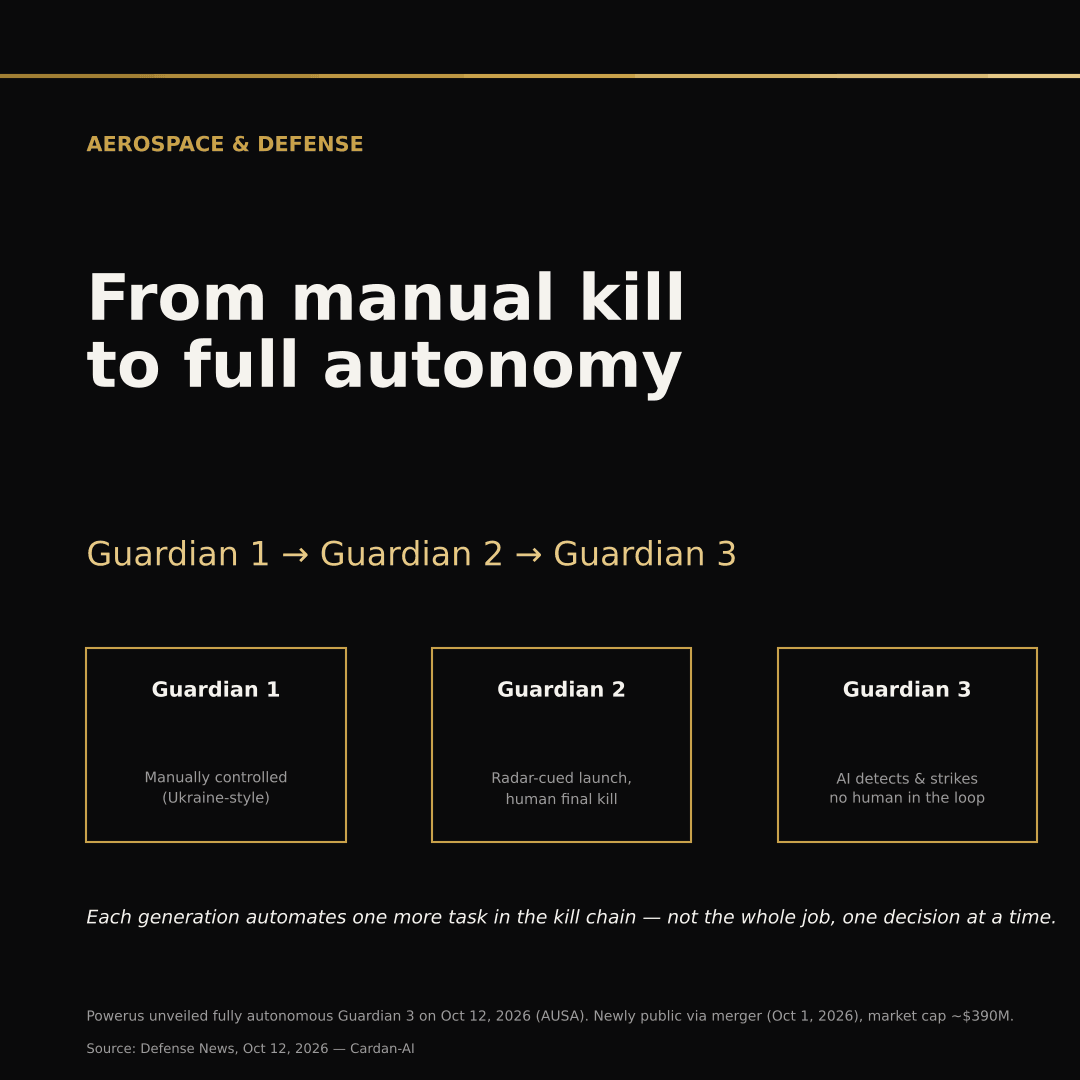
On October 12, Powerus unveiled Guardian 3, a counter-drone interceptor that detects and strikes its target with no human sign-off on the final kill. The announcement sits inside a three-step progression the company itself frames explicitly: Guardian 1, manually controlled end to end like Ukrainian-style interceptors; Guardian 2, which automates navigation to the target but leaves the firing decision to the operator; Guardian 3, which automates that last decision too. Co-founder Brett Velicovich sums up the shift in one line: "you kind of take the human error out of it."
This three-generation breakdown is more than a marketing narrative: it is close to a textbook illustration of the framework David Autor, Frank Levy and Richard Murnane laid out in their 2003 Quarterly Journal of Economics paper, "The Skill Content of Recent Technological Change: An Empirical Exploration." Their central claim is that automation never replaces a job wholesale — it replaces tasks, one at a time, starting with whichever are most codifiable (reducible to explicit rules), while leaving intact tasks that require contextual judgment, adaptation, or non-routine problem solving.
Applied to Guardian, the framework immediately explains why the progression unfolded in this exact order. Navigating toward a radar-cued target (Guardian 2) is a highly codifiable task — trajectory, speed, and course correction follow stable physical rules, ideal for an algorithm. The final engagement decision (Guardian 3) is less so — it requires distinguishing a genuine threat from a false positive in a noisy environment — but it remains a bounded, binary decision made on a structured data stream: still codifiable, provided one accepts some error rate. The tasks that remain human in Powerus's ecosystem — deployment choices, maintenance, doctrine, the strategic call on when and where to position these systems — are precisely the ones Autor, Levy and Murnane classify as non-routine, and therefore resistant to near-term automation.
The economic consequence is direct: value does not shift wholesale to AI, only the automated slice of the task chain does. Powerus itself illustrates this — the company carries roughly $390 million in market capitalization since going public on October 1 via its merger with Aureus Greenway Holdings, yet no contract value, production rate, or unit price was disclosed at the Guardian 3 unveiling. At this stage, that valuation reflects a market bet on the company's ability to industrialize this one automated task at scale — not validated revenue already on the books.
The Autor-Levy-Murnane framework has a second, less comfortable implication specific to defense. In a civilian job, the remaining non-automated task (judgment, exception-handling, creativity) becomes the reclassified worker's new role. In a lethal strike chain, the non-automated task that is now receding — the final engagement decision — is precisely the one that public debate and bills such as the AI Guardrails Act (covered by Cardan-AI on October 16) are trying hardest to keep human, for reasons of accountability and control rather than technical performance. For the first time in the Guardian trajectory, the economic logic of task codifiability and the ethical-regulatory logic of human-in-the-loop point in opposite directions: the task easiest to automate (the shot) is also the one regulators most want to keep human.
For any industrial company watching this kind of transition — in defense as much as in energy or civil aerospace — the lesson is not "AI replaces the operator," a framing that overstates the real scope of change, but "AI absorbs, task by task, the codifiable segments of the decision chain, leaving the rest — judgment, exception-handling, doctrine — as the new core of human value." That residual fraction is what now needs staffing, training and protecting — not the one Guardian 3 has just made technically redundant.
Analysis by
Cardan-AI Intelligence
Our research and analysis unit, dedicated to applied AI for business, industry and regulatory compliance.
Let's talk about your next competitive edge
Thirty minutes to identify the two or three use cases in your operations that pay for themselves within the first year.