
Aerospace & defense AI benchmark: the gap is scale and talent, not experimentation
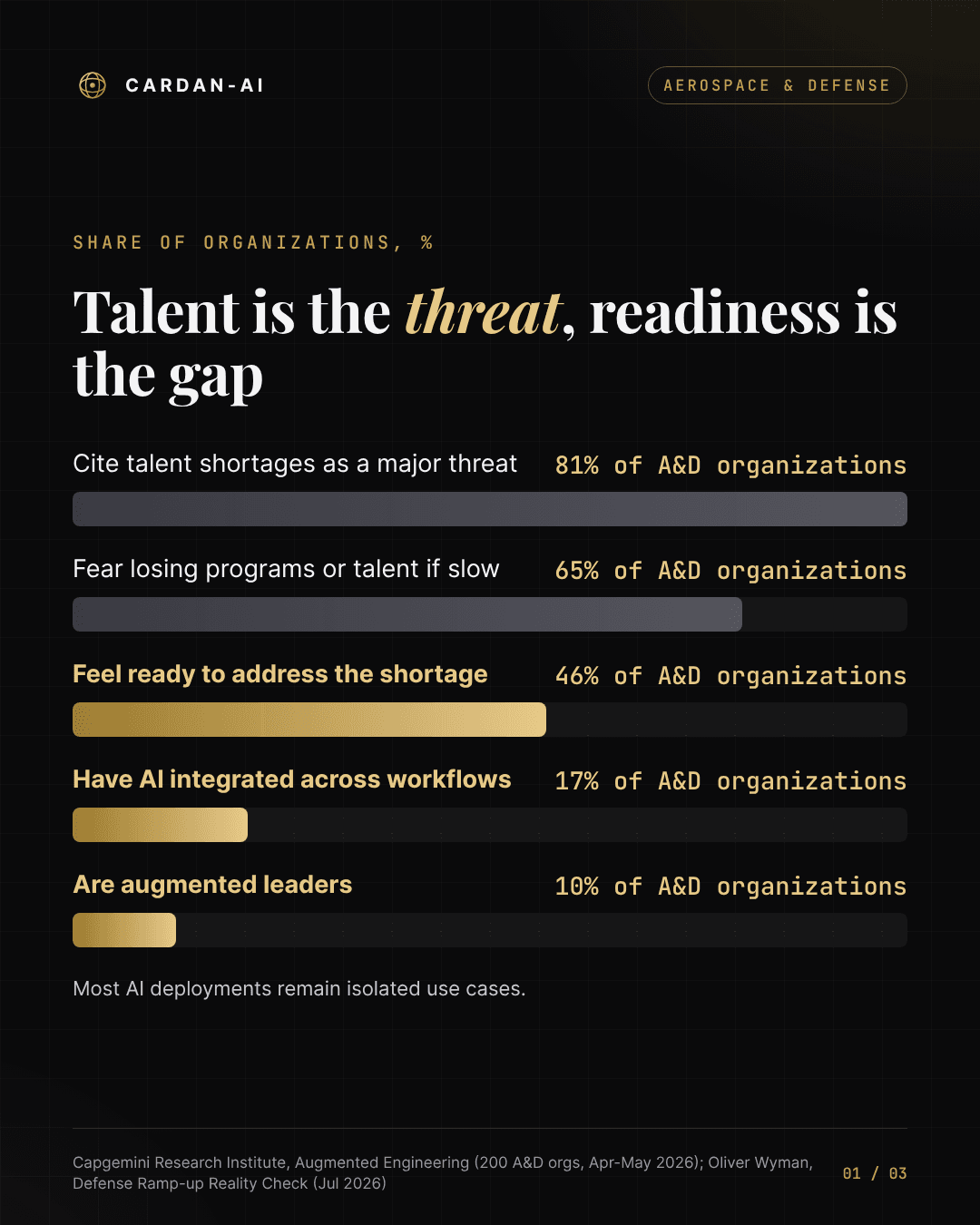
Only 17% of aerospace and defense organizations have integrated AI across workflows, and 10% are augmented leaders. With 81% citing talent shortages and 46% feeling ready, the decision is where to industrialize first.
Key takeaways
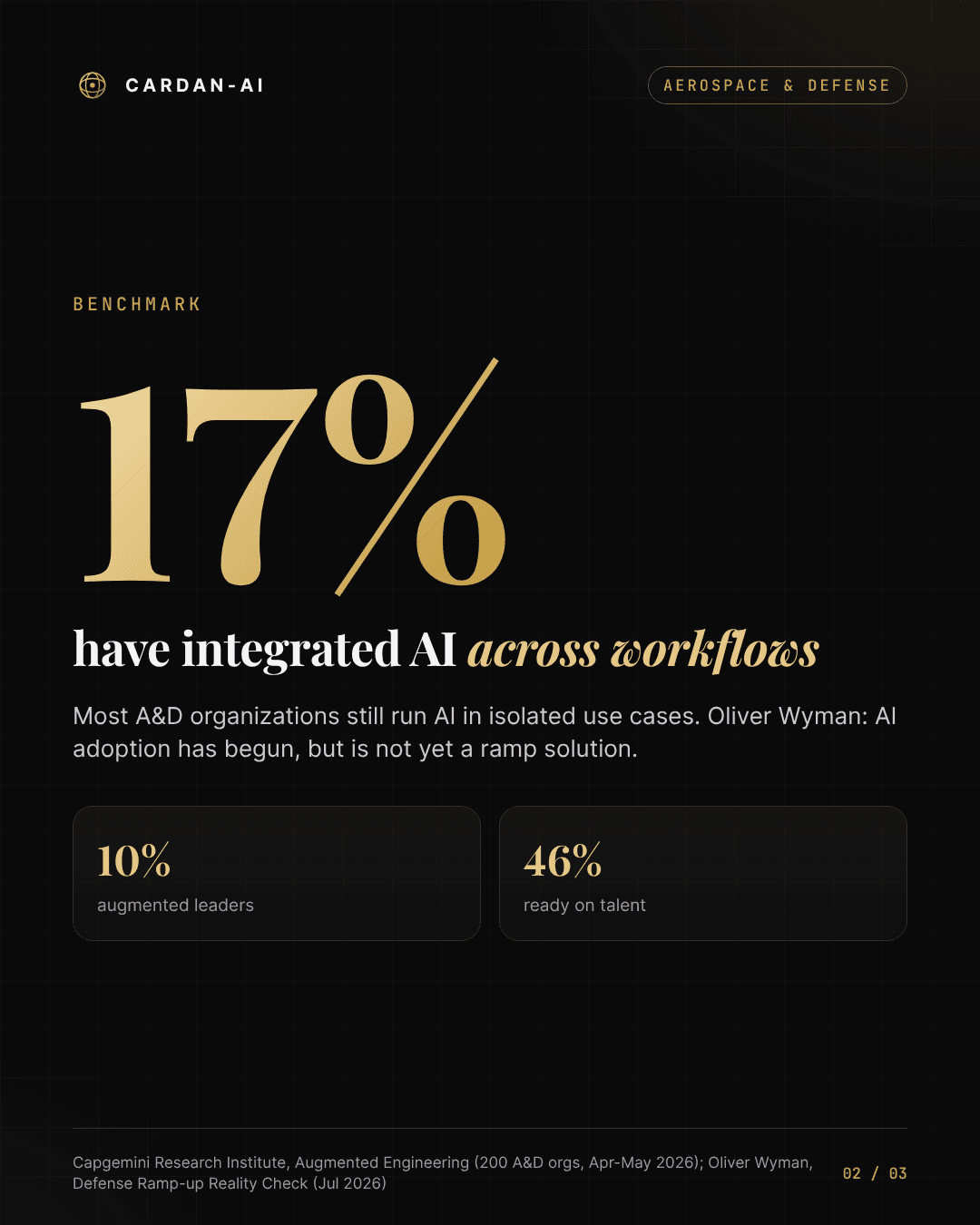
- 17% of A&D organizations have integrated AI across workflows; most use cases remain isolated (Capgemini, 2026).
- Only 10% combine digital continuity and scalable engineering AI.
- 81% cite talent shortages as a major threat; 46% feel ready to address them.
- Oliver Wyman: AI adoption has begun but is not yet a ramp solution.
Capgemini Research Institute's 2026 study covers 200 aerospace and defense organizations, surveyed in April and May 2026, with two respondents per organization (one on digital continuity, one on AI) and ten expert interviews. It is one of the broadest recent public benchmarks of how far AI has actually spread in the sector.
The headline is a scale gap. Only 17% have integrated AI across workflows, and most deployments remain confined to specific use cases such as predictive maintenance, simulation and analysis, production planning and fault diagnosis. Only 10% are 'augmented leaders' combining advanced digital continuity with scalable engineering AI.
The economic reading: an isolated use case captures a local saving, while a workflow-level integration changes cycle time across programs. Value compounds only when data, roles and accountability are connected, which is why leaders are defined by digital continuity as much as by models.
Talent is the binding input. 81% cite talent and skill shortages as a major threat to operations, but only 46% feel ready to address them, and about 68% of workers need reskilling. 65% fear losing future program positions, workshare or access to top engineering talent if they fail to adapt quickly.
The defense supply base shows the same pattern. Oliver Wyman's May 2026 survey of more than 160 OEMs, Tier 1 and sub-tier suppliers says AI adoption has begun but is not yet a ramp solution: early adopters see marginal benefits and deployment is too uneven to offset wider constraints. It suggests practical uses such as digitized work instructions to train less experienced workers faster, captured expert decision logic and AI copilots for quality, maintenance and production engineering.
Implications differ by actor. OEMs should treat supplier data continuity as a program risk, not an IT topic. Tier 1 and sub-tier suppliers should pick one workflow that shortens onboarding or rework and prove it on a baseline. MRO and aftermarket operators should start where in-service data can feed back into engineering.
Limits: these are self-reported surveys, definitions of 'integrated across workflows' vary, and Capgemini's own materials present other digital-continuity figures that differ by page, so we use only the figures stated in its research summary. Cross-survey comparisons are indicative, not causal.
Our recommendations
- 1
Count workflows, not pilots
Within 30 days, list every AI use case in production and mark which ones touch more than one function. Report that share to the executive committee quarterly; the benchmark is 17%.
- 2
Industrialize one repeatable workflow
Pick a workflow that is repeatable and measurable, such as quality documentation or maintenance troubleshooting. Record cycle time and error rate before deployment, and review at 90 days.
- 3
Fund reskilling with the tool
Put training in the same budget line as the software. With 46% feeling ready, a tool without an adoption plan leaves value unused. Name an operations owner, not an IT owner.
- 4
Make supplier data part of the program
For Tier 2 and 3 flows, require structured data exchange in the next contract round, starting with the supplier that causes most schedule slips.
Analysis by
Cardan-AI Intelligence
Our research and analysis unit, dedicated to applied AI for business, industry and regulatory compliance.
Let's talk about your next competitive edge
Thirty minutes to identify the two or three use cases in your operations that pay for themselves within the first year.