
AI and break-even: why large producers expect gains and small ones don't
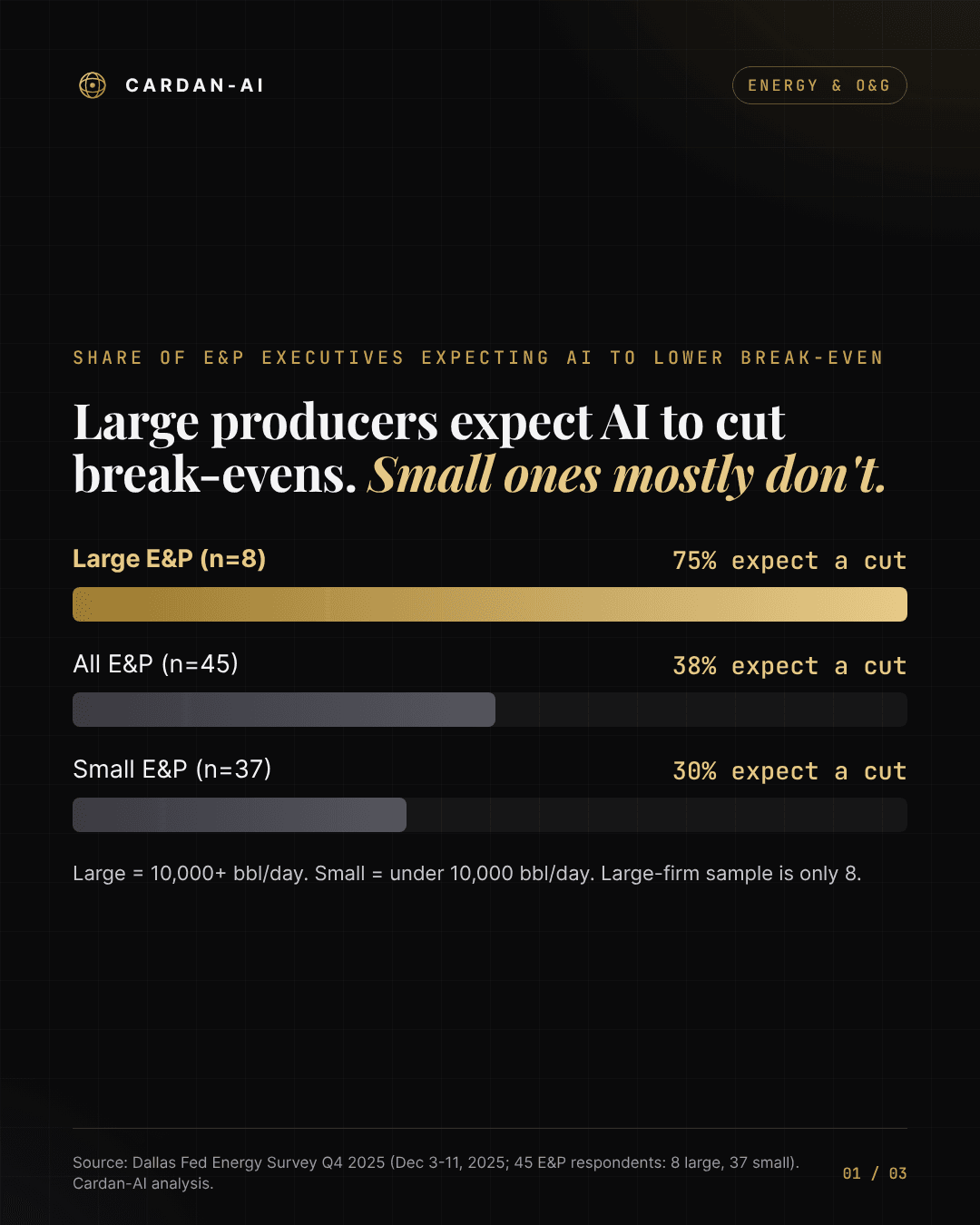
The Dallas Fed's Q4 2025 survey shows a sharp size gap: 75% of large E&P executives expect AI to lower break-evens, against 30% of small ones. Executives should decide whether AI is a scale game before committing budget.
Key takeaways
- 75% of large E&P executives (n=8) expect some AI-driven break-even reduction, against 30% of small E&P executives (n=37).
- Across all 45 E&P respondents, 62% expect no reduction at all within five years.
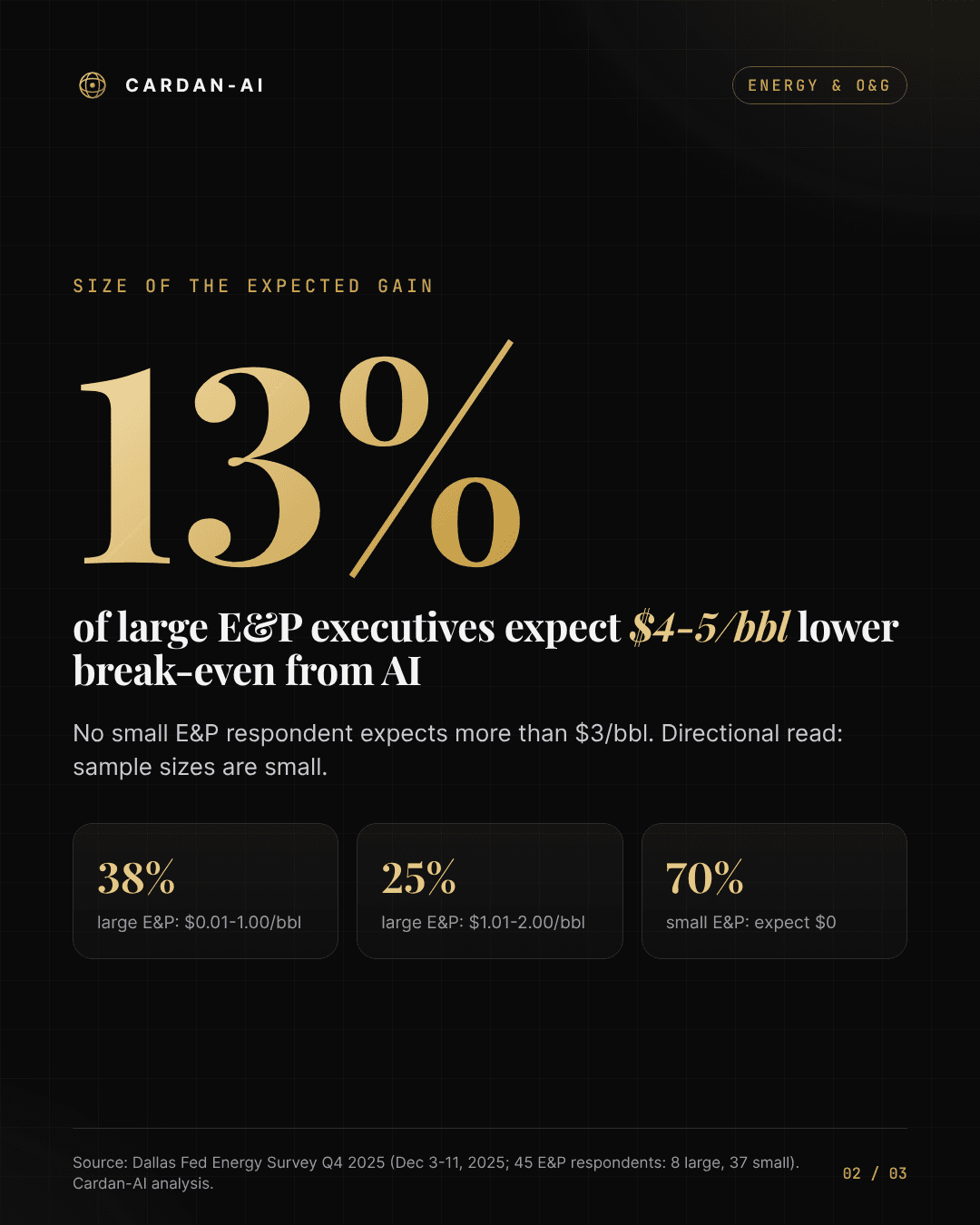
- Only large producers report expectations above $3 per barrel (13% expect $4-5).
- The sample is small and measures expectations, not realized savings.
Every producer is told that AI will lower costs. The useful question for a board is who expects it to, and by how much. The Dallas Fed's Q4 2025 Energy Survey, collected December 3-11, 2025 from 131 energy firms, asked E&P executives exactly that: by how much will AI lower your firm's break-even price for new wells over the next five years?
45 E&P firms answered: 8 large (10,000 barrels per day or more) and 37 small. The headline is not the average. It is the gap between the two groups.
Large producers: 25% expect no reduction, 38% expect $0.01-1.00 per barrel, 25% expect $1.01-2.00 and 13% expect $4.01-5.00. So 75% expect some gain. Small producers: 70% expect none, 11% expect $0.01-1.00, 8% expect $1.01-2.00 and 11% expect $2.01-3.00. So 30% expect some gain. Across all 45 respondents, 62% expect zero.
Economic reading, ours and not the survey's: AI in drilling and production carries heavy fixed costs: data engineering, integration with field systems, scarce talent. A firm with more wells and more rigs spreads those costs over more barrels. That is a scale economy, and it would explain why expectations rise with size.
A second mechanism is access. Large producers can negotiate with service companies and software vendors, and can run pilots on several assets at once. A small producer often meets AI as a feature inside someone else's product, where the gain accrues partly to the vendor or to the service company that drills the well.
Implications by type of actor. Large producers: expectations are high, so the risk is overpromising; fix a measurable target per asset. Small producers: expecting little may be rational, but 30% do expect gains, and those firms probably found a narrow use case. Service companies: the survey suggests small clients are skeptical, so selling on a priced outcome beats selling on a platform.
Limits and counter-arguments. The large-firm group is 8 executives, so one answer moves the result by 12 points. Expectations are not savings: executives may be optimistic or cautious. The question covers new-well break-evens, not operating cost or uptime, where gains may be easier to show. And a single respondent comment in the survey says AI already lowered effective well costs through general productivity gains, which a break-even question does not capture.
So what should an executive do? Treat AI as a scale question first. If you are large, set dollar-per-barrel targets. If you are small, buy a narrow capability, demand a measured baseline, and refuse multi-year platform contracts.
Our recommendations
- 1
Set a dollar-per-barrel target
CFO and head of operations, within 60 days: translate each AI initiative into expected break-even impact per asset. Drop any initiative that cannot be priced.
- 2
Choose scale-fit use cases
If under 10,000 barrels per day: start with one narrow decision (downtime or well-cost control), bought as a service, with a baseline measured before launch.
- 3
Negotiate outcome-linked terms
Procurement, at next contract renewal: tie part of vendor and service-company fees to a measured cost or uptime result, and keep your data rights.
- 4
Pool data where you cannot scale
Small producers, within 6 months: explore shared datasets or operator partnerships to reach the data volume large producers hold alone.
- 5
Track expectation versus result
Board, quarterly: compare the break-even gain promised at approval with the gain measured, and publish the gap internally.
Analysis by
Cardan-AI Intelligence
Our research and analysis unit, dedicated to applied AI for business, industry and regulatory compliance.
Let's talk about your next competitive edge
Thirty minutes to identify the two or three use cases in your operations that pay for themselves within the first year.