
Airbus–Mistral AI: coopetition as a sovereignty strategy
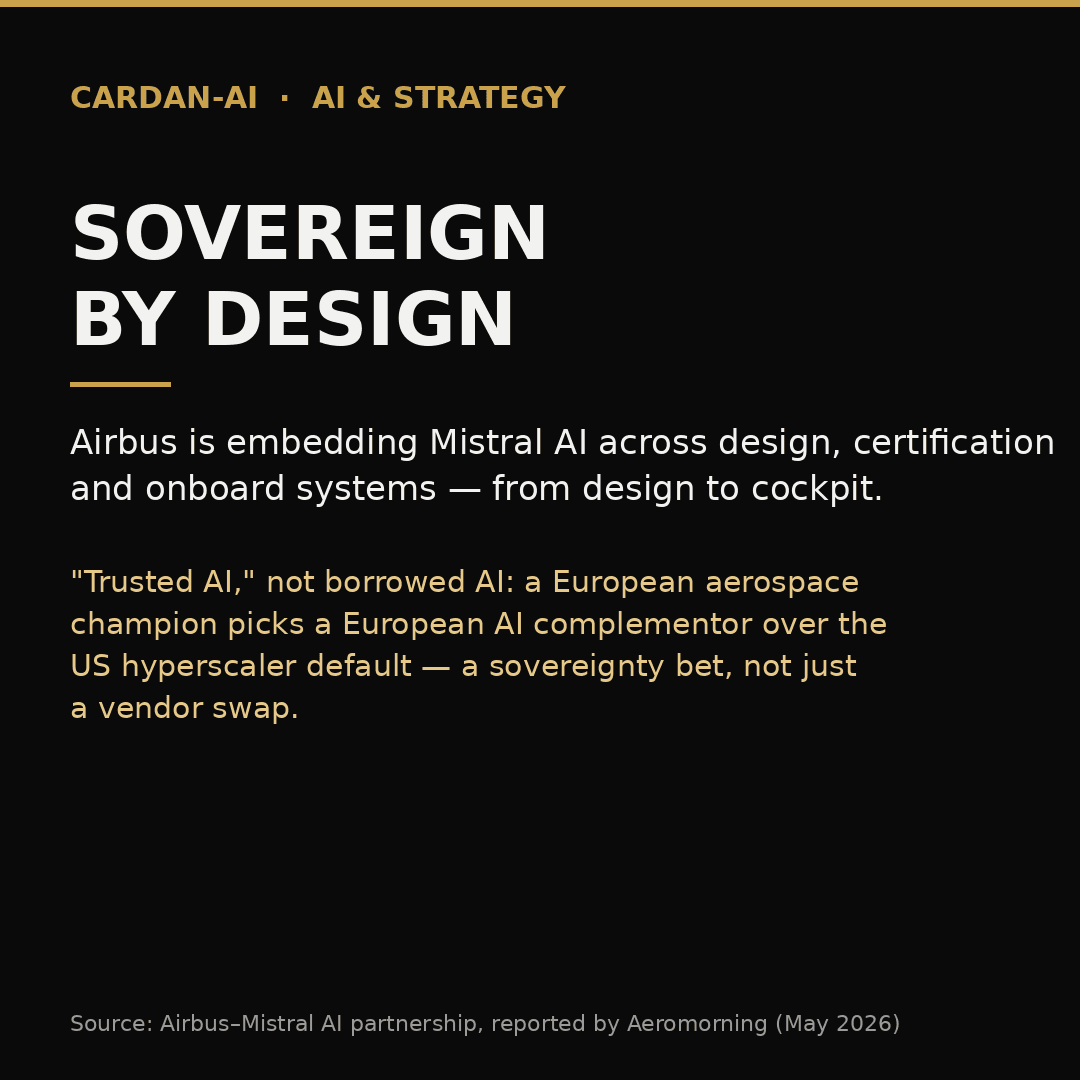
By choosing Mistral AI over a US hyperscaler to deploy "trusted AI" from design to cockpit, Airbus isn't just making a technology choice — it's redrawing its value net. Brandenburger & Nalebuff's coopetition theory (1996) explains why picking a European complementor can be worth more than a simple vendor swap.
Airbus has announced a partnership with Mistral AI to embed "trusted AI" across its operations — from design and certification to onboard systems. The announcement is light on numbers: no investment figure or detailed timeline has been publicly disclosed. But the choice of partner itself carries strategic weight, and it rewards being read through a precise theoretical lens: coopetition.
The concept, formalized by Adam Brandenburger and Barry Nalebuff in Co-opetition (1996), starts from a simple observation: a company's strategy isn't just about confronting direct competitors. It plays out within a "value net" that also includes customers, suppliers, and crucially, complementors — players whose success increases the value of your own offering without competing against you. A console maker and a game publisher are complementors; an aircraft manufacturer and a trusted AI model provider are another textbook example.
Within this framework, Airbus's choice makes full strategic sense. The manufacturer could have, like nearly all of its Western peers, relied on the AI infrastructure of US hyperscalers (AWS, Microsoft Azure, Google Cloud), already firmly established in aerospace. That would have been rational in the short run: proven technology, immediate scale, lower integration costs. But Brandenburger and Nalebuff emphasize a point often overlooked in classical competitive analysis: the value a player captures within a value net also depends on its relative bargaining power vis-à-vis its complementors — not just the technical efficiency of the partnership.
Facing a US hyperscaler, Airbus would be structurally a price-taker and terms-taker: data governance rules, extraterritorial clauses (the CLOUD Act), product development priorities are set elsewhere, by a player whose revenue and market power dwarf those of any European industrial partner, Airbus included. Facing Mistral AI — younger, smaller, but French and therefore subject to the same legal framework and strategic interests as Airbus — the balance of power partially reverses: Airbus becomes a structuring customer, able to shape the product roadmap, certification priorities, and model access terms.
That is the essence of coopetition applied to technological sovereignty: the goal isn't to pick the complementor that is technically most advanced in absolute terms, but the one with which the relationship of mutual dependence maximizes captured value — and minimizes the risk of reverse capture. For an industry as regulated and strategic as defense aerospace, where design and certification data are themselves sovereign assets, this calculation goes beyond pure technical performance: it factors in jurisdictional risk, the risk of regulatory extraterritoriality, and the probability that a foreign partner might one day impose access terms incompatible with national industrial interests.
This reasoning isn't unique to Airbus: it illuminates a broader trend among strategic European industrials — energy, defense, healthcare — who are starting to weigh their AI supplier choices not only on model performance, but on the power structure each partnership implies. The risk, naturally, is that Europe's AI ecosystem remains too narrow to absorb this demand: Mistral AI, however advanced, lacks the compute scale and capital depth of US hyperscalers, and will itself need to forge complementary alliances to meet the demands of an industrial customer as exacting as Airbus.
For an executive weighing AI suppliers today, the coopetition lesson is direct: the question isn't only "which partner is technically best?" but "with which partner is my relative bargaining power, my control over my own strategic data, and my exposure to regulatory risk optimized?" — a question that matters even more in sectors where data itself is a sovereign asset.
Analysis by
Cardan-AI Intelligence
Our research and analysis unit, dedicated to applied AI for business, industry and regulatory compliance.
Let's talk about your next competitive edge
Thirty minutes to identify the two or three use cases in your operations that pay for themselves within the first year.