
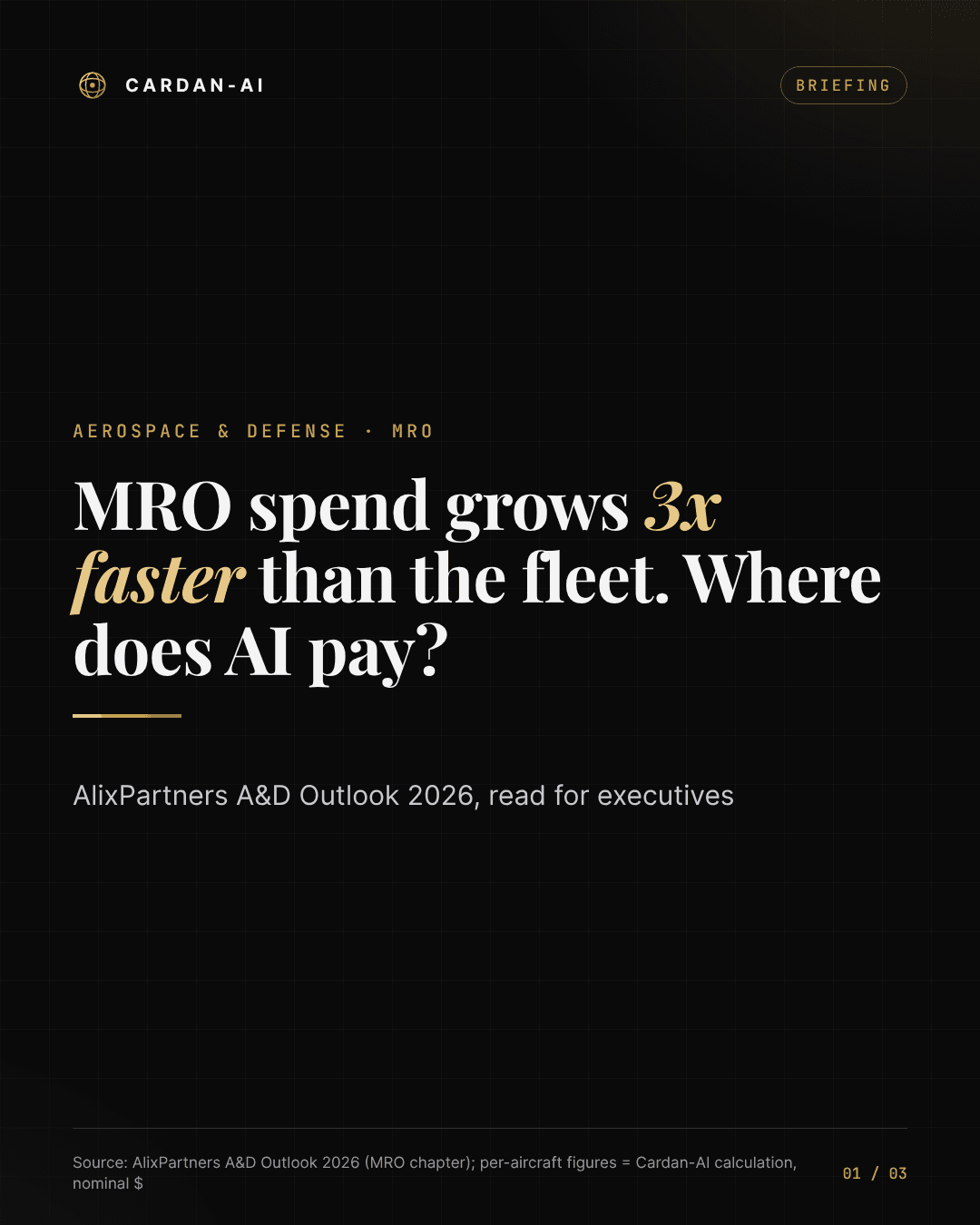
MRO spend will outgrow the fleet: fund AI where it shortens time-to-part
AlixPartners expects global MRO spend to grow about 10% a year in 2025-27 against a fleet growing about 3%. For airlines, lessors and MROs, the decision is where AI shortens the wait for parts rather than where it predicts failures best.
Key takeaways
- Global MRO spend: $126B (2025), $147B (2026F), $196B (2035F) per AlixPartners.
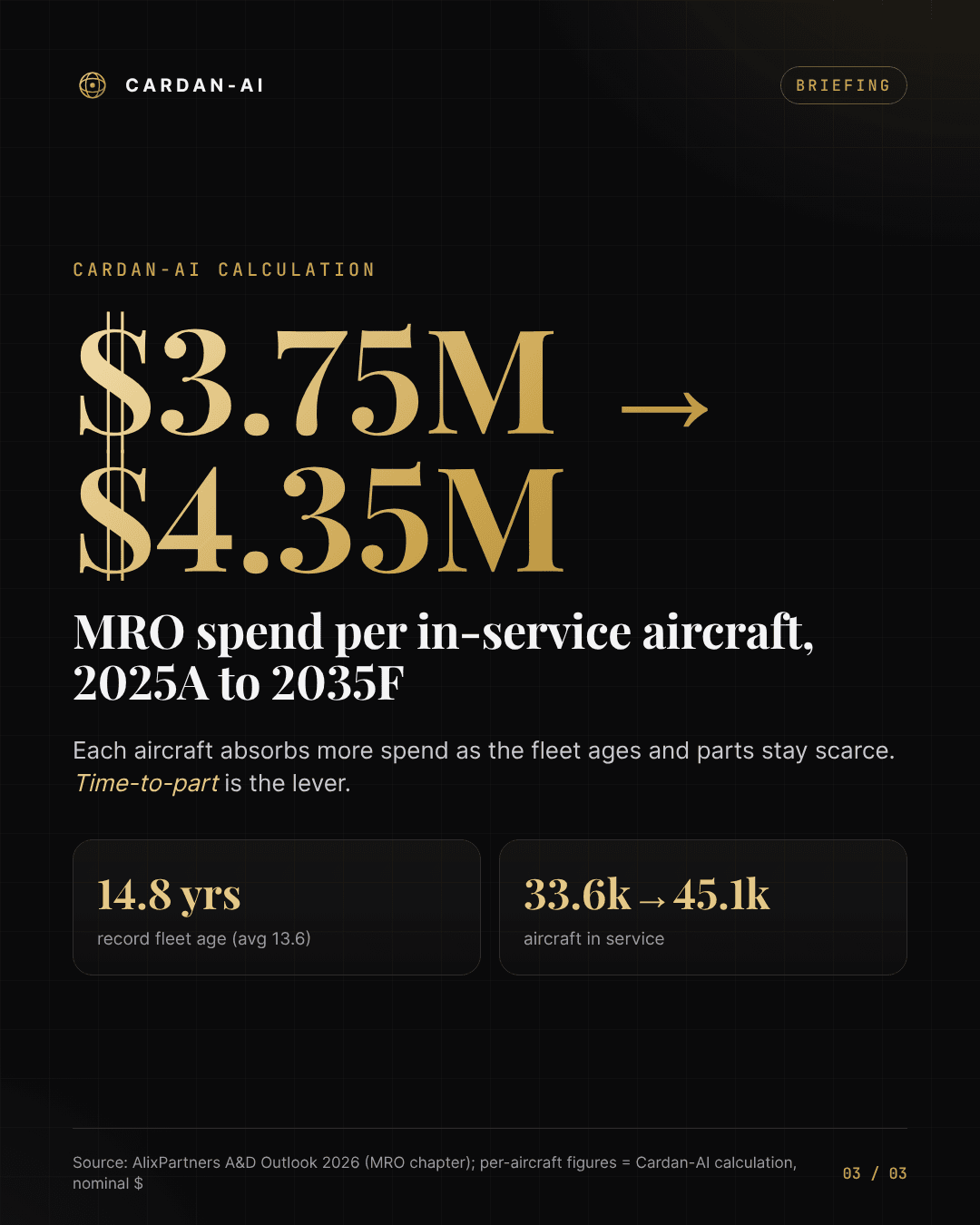
- Fleet grows from 33.6k to 45.1k aircraft, about 3% a year; spend per aircraft rises from about $3.75M to $4.35M (Cardan-AI calculation, nominal).
- Fleet age is a record 14.8 years versus a 13.6-year average.
- The report names time-to-part and the cost of grounded assets as the focus, and gives no AI savings figures.
AlixPartners' A&D Outlook 2026 gives a clear picture of aftermarket demand. Global MRO spend is $126B in 2025, forecast at $147B in 2026 and $154B in 2027, then $167B in 2030 and $196B in 2035. Growth is about 10% a year over 2025-27 and about 3% a year from 2027 to 2035.
The fleet does not grow at that pace. The in-service fleet moves from 33.6 thousand aircraft in 2025 to 45.1 thousand in 2035, about 3% a year. Dividing spend by fleet gives about $3.75M per aircraft in 2025 and about $4.35M in 2035. This is our calculation on nominal figures, so it mixes volume, price and mix, but the direction is clear: each aircraft absorbs more maintenance money.
The report explains part of the reason. Global fleet age is a record 14.8 years against a 13.6-year historical average. Engine scarcity keeps older assets flying longer. Pressure is expected on semiconductors and specialty materials, which affects spares and repairs, and defence requirements take priority over shared commercial supply.
The economic mechanism is scarcity. When parts, engine slots and skilled labour are inelastic in the short run, extra demand turns into higher prices and longer waits, not into more output. The value of any tool then depends on how much it shortens the wait. The report says as much: the focus has moved to time-to-part and the opportunity cost of grounded assets.
AlixPartners lists three AI areas in MRO: predictive maintenance, an augmented workforce, and digital twins with demand planning. It gives no AI-related figures. Trade press also stays qualitative: Aviation Week (October 2024) describes simulation for spares planning, MRO contract comparison and deciding when to remove a failing component, and cites only Airlines for America's figure of more than $100 per minute for aircraft delays in the US.
For an airline or lessor, the implication is to measure AI against aircraft-on-ground hours and time-to-part. A predictive model that flags a failure two weeks early adds little if the part takes eight weeks to arrive. Demand planning, pooling and repair-loop forecasting act on the binding constraint.
For an MRO provider or component supplier, the implication differs: the scarce asset is shop capacity and skilled technicians. AI that raises first-pass yield, routes work by skill and shortens teardown-to-release times is worth more than dashboards. Defence priority also means commercial customers face supply shocks that suppliers can partly anticipate with better demand signals.
Limits: the forecasts are projections, the per-aircraft figure mixes price and volume, and the report offers no evidence on AI payback. A single sourced outlook cannot replace a local baseline. Executives should treat the numbers as a reason to measure, not as a promise of savings.
Our recommendations
- 1
Set the baseline first
Before funding any AI use case, measure time-to-part, aircraft-on-ground hours and repair turnaround for your fleet or portfolio over the last 12 months. Owner: head of maintenance with finance. Deadline: before the next budget round.
- 2
Rank use cases by hours recovered per euro
Score predictive maintenance, demand planning and workforce tools on grounded hours avoided per euro. Fund the top one or two, not all three.
- 3
Start where the constraint binds
If waits come from parts, begin with demand planning and spares pooling. If they come from shop capacity, begin with work routing and first-pass yield.
- 4
Contract for outcomes
Ask vendors to commit to a measured change in time-to-part or turnaround, with the baseline written into the contract.

Analysis by
Cardan-AI Intelligence
Our research and analysis unit, dedicated to applied AI for business, industry and regulatory compliance.
Let's talk about your next competitive edge
Thirty minutes to identify the two or three use cases in your operations that pay for themselves within the first year.