
California's "robo-boss" ban: a Brussels Effect without Brussels
California's SB 947, which bars employers from firing or disciplining a worker based solely on an automated system, reproduces a requirement the EU AI Act already imposes on worker-management AI. Anu Bradford's "Brussels Effect" explains why a standard regulates beyond its home territory — and why, here, the convergence happens without any formal export mechanism.
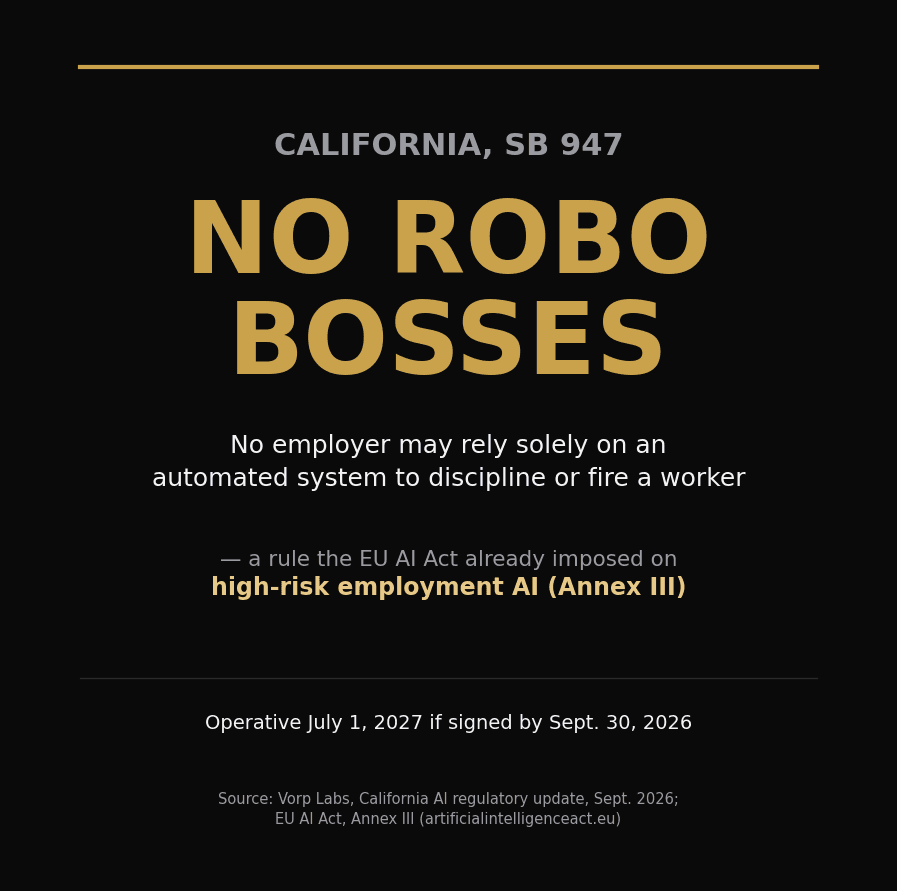
On September 2, 2026, California's Senate sent SB 947, the "No Robo Bosses Act," to the governor's desk: if signed before September 30, no employer will be allowed, from July 1, 2027, to base a disciplinary or termination decision solely on the output of an automated system. Genuine human oversight — able to review, override or block the machine's recommendation — becomes a legal requirement. Taken alone, the episode reads like one more item in the churn of US state legislation. Set next to the EU's AI regulation (Regulation (EU) 2024/1689), it says something more interesting: California has just written into its labor law a principle the EU had already established, through an entirely different legal route, for worker-management AI systems classified as high-risk under Annex III — hiring, performance evaluation, promotion, termination.
Legal economist Anu Bradford named this phenomenon the "Brussels Effect" (*The Brussels Effect*, 2012, later the 2020 book of the same name): the EU's capacity to have its regulatory standards adopted well beyond its own borders, without needing a treaty, a trade negotiation, or even an explicit intention from its partners. Bradford distinguishes two mechanisms. The de facto Brussels Effect operates when a global company, forced into compliance to sell into the European market, chooses — for cost reasons — to apply the same standard everywhere rather than maintain two production lines or two information systems. The de jure Brussels Effect operates when a foreign legislature explicitly imports a substantive standard of European origin into its own law, with no market mechanism forcing it to do so.
SB 947 clearly belongs to the second mechanism, which is what makes it instructive. No California company had to lobby for this law on grounds of regulatory economies of scale: the California Senate chose, for domestic political reasons — job protection, reaction to publicized cases of poorly explained algorithmic terminations — to codify a requirement substantively identical to the EU's Annex III. Yet there is no formal export mechanism linking the two texts: no mutual-recognition clause, no transatlantic negotiation, not even a cross-reference in SB 947's preparatory materials reviewed at this stage. The convergence happens through informal imitation of the conceptual framework — "meaningful human oversight" as the minimum response to the risk of high-impact automated individual decisions — more than through diffusion of an actual text.
The underlying common thread is an information-economics problem that contract theory has long formalized: costly state verification (Townsend, 1979). An automated HR management system produces a signal — a performance score, an absenteeism flag, a termination recommendation — whose internal validity neither the affected employee nor, often, the employer itself can easily verify: which variables were entered, what weight they carry, what measurement errors crept in. The human-oversight requirement does not solve this verification problem; it relocates its cost: it forces an authorized human to formally assume responsibility for the final decision, restoring a form of recourse and traceability that the pure algorithm did not provide.
This framing carries a direct implication for European industrial groups active in aerospace, energy and luxury that operate US subsidiaries or sites, particularly in California, where a significant share of these sectors' engineering, R&D and premium retail functions is concentrated. The issue is no longer a purely local compliance matter to monitor from a distance: it signals a deeper shift in which the American exception on HR flexibility — *employment at-will* — is being chipped away, state by state, precisely where automation is advancing fastest. A performance-scoring or HR anomaly-detection system deployed today without a documented human-review procedure will need, in California as in the EU, to be requalified before the applicable deadline — 2027 on one side, already-current deadlines on the other.
The convergence has limits that would be unwise to ignore. The EU's Annex III comes with a full compliance apparatus — conformity assessment, registration in an EU database, a documented risk-management system — that California's SB 947, as currently drafted, does not impose with the same procedural density. The two texts converge on the principle of human oversight; they still diverge sharply on the intensity of documentary proof required, on applicable penalties, and on which authority enforces the rule — national market-surveillance authorities on the EU side, California's Civil Rights Department on the other. Calling this full convergence would be premature; calling it convergence in principle is, today, hard to dispute.
For an industrial decision-maker, the economic lesson fits in one sentence: regulatory arbitrage — routing automated workforce-management decisions through the group's most permissive jurisdiction — is losing value faster than most legal departments typically anticipate. That is not a reason to abandon HR automation; it is a reason to build, at the design stage, a documented human-oversight procedure that satisfies both frameworks at once rather than treating each jurisdiction as an independent compliance silo — a choice that, on this specific question, now costs more than it saves.
Analysis by
Cardan-AI Intelligence
Our research and analysis unit, dedicated to applied AI for business, industry and regulatory compliance.
Let's talk about your next competitive edge
Thirty minutes to identify the two or three use cases in your operations that pay for themselves within the first year.