
The club good: what Buchanan's theory says about NATO-anchored cyberdefense platforms
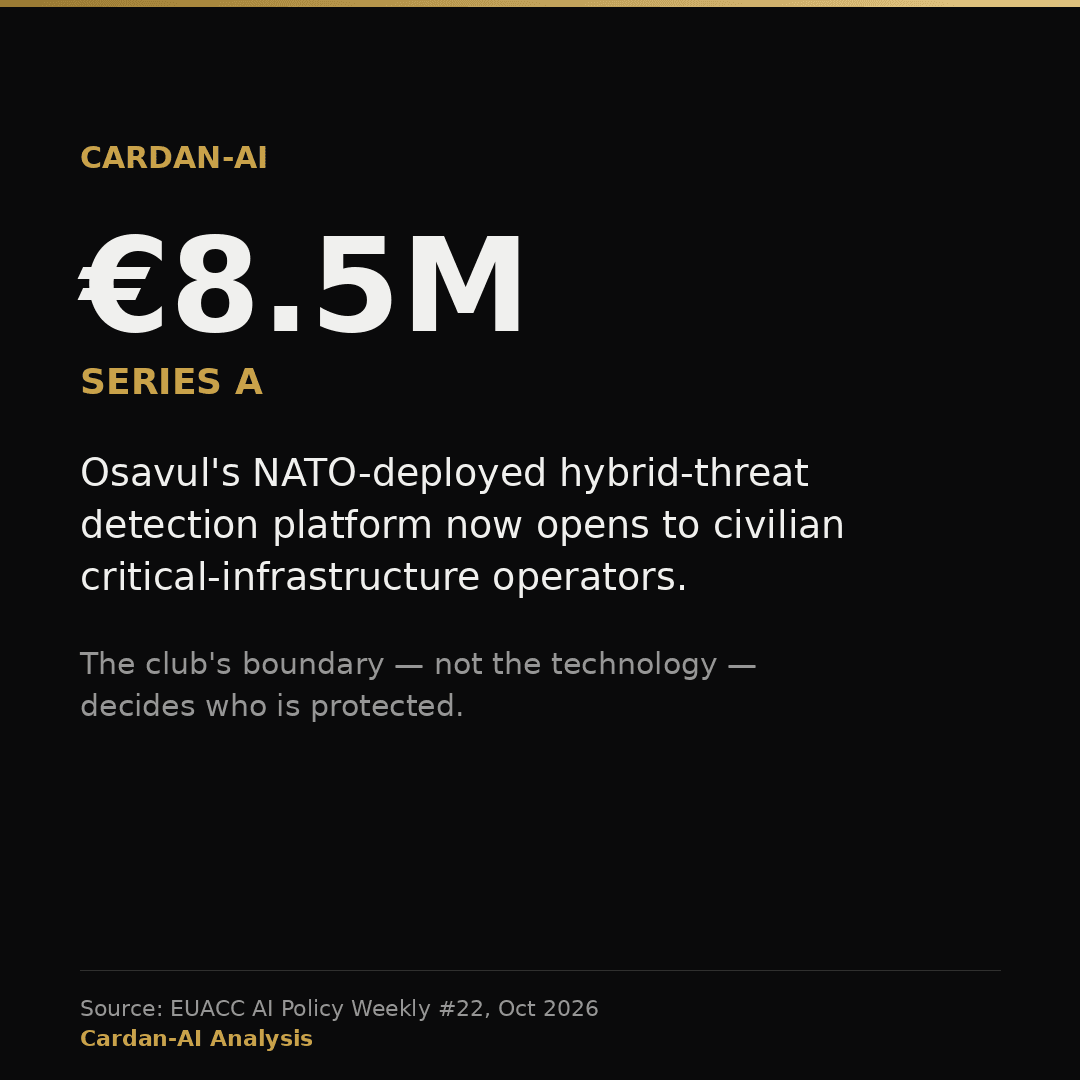
Osavul raises €8.5M for a hybrid-threat detection platform deployed by NATO, now eyeing civilian critical-infrastructure operators. James Buchanan's club-goods theory (1965) explains why this kind of good stays structurally under-shared — and what that means for firms left outside the circle.
Osavul's €8.5M raise, reported by the EUACC AI Policy Weekly for the week of September 28 to October 5, 2026, concerns an AI-driven hybrid-threat detection platform, currently deployed by NATO and about to be offered to civilian critical-infrastructure operators. The fact itself looks modest — one Series A among many in European defense deeptech — but it raises a classic public-economics question: who should benefit from a threat-detection capability, and on what terms of access?
James Buchanan formalized in 1965, in "An Economic Theory of Clubs" (Economica), the category of club goods: excludable — non-members can be kept out — yet non-rival within the circle, meaning one more member's use does not reduce what others get. A threat-intelligence platform shared among allies is a textbook case: one NATO member consulting an alert about a detected threat does not reduce another member's ability to benefit from the same alert. The good is not scarce once produced — it is made scarce only by construction, through the club's boundary.
This distinction changes the nature of the economic problem. For an ordinary rival good, limiting access avoids congestion and protects the incentive to produce. For a club good like threat intelligence, restricting access protects no scarce resource — it only protects the strategic value of the informational edge held by the circle. Buchanan already noted that a club's optimal size balances congestion costs against sharing benefits — but for a non-congestible good, that balance structurally favors expansion, unless another logic — here, military strategic confidentiality — counterbalances it.
Hybrid-threat intelligence has a feature that classic club theory only partly captures: infrastructure left outside the circle is not a passive non-beneficiary. A power grid, an airport logistics chain, or a non-member telecom operator becomes, in an interconnected system, exactly the entry point an attacker will choose because it is less defended. Excluding a node from the network does not protect the other nodes — it simply shifts vulnerability to the weakest point, a negative externality the closed circle imposes on the rest of the system, ultimately including its own members.
This is precisely the tension Osavul is exploiting commercially by turning to civilian critical-infrastructure operators: widening the club is not only a growth strategy, it is a partial correction of a market failure that Buchanan's framework names precisely. But expansion carries a price for the late buyer: access terms — pricing, service level, sector exclusivities — are set at the moment the club opens, not afterward. The first civilian operators to join this kind of scheme negotiate from a position of strength; those who follow inherit terms already standardized around the first entrants' needs.
For firms in aerospace, defense, energy and O&G, the operational recommendation follows directly: map, now, the threat-sharing consortia and platforms built around a military or regulatory core, and assess the case for entering early — not only for the product's standalone value, but for the negotiating weight that comes with being the first civilian member. Waiting for the market to standardize means accepting terms set by others.
The Osavul case is small in size — €8.5M, one round among dozens in 2026's European deeptech — but it illustrates a mechanism that extends well beyond this one company: shared cyberdefense is now structuring itself as club goods, and the boundary of those clubs, more than their underlying technology, will determine who is protected and who remains exposed.
Analysis by
Cardan-AI Intelligence
Our research and analysis unit, dedicated to applied AI for business, industry and regulatory compliance.
Let's talk about your next competitive edge
Thirty minutes to identify the two or three use cases in your operations that pay for themselves within the first year.