
A gas storage operator: pilot predictive maintenance on two compressors, not the fleet
Poor maintenance can cost an asset 5% to 20% of capacity, and mature predictive programs report 30% to 50% less downtime. A mid-size gas storage operator should start on two critical compressors with a baseline, not on the whole fleet.
Key takeaways
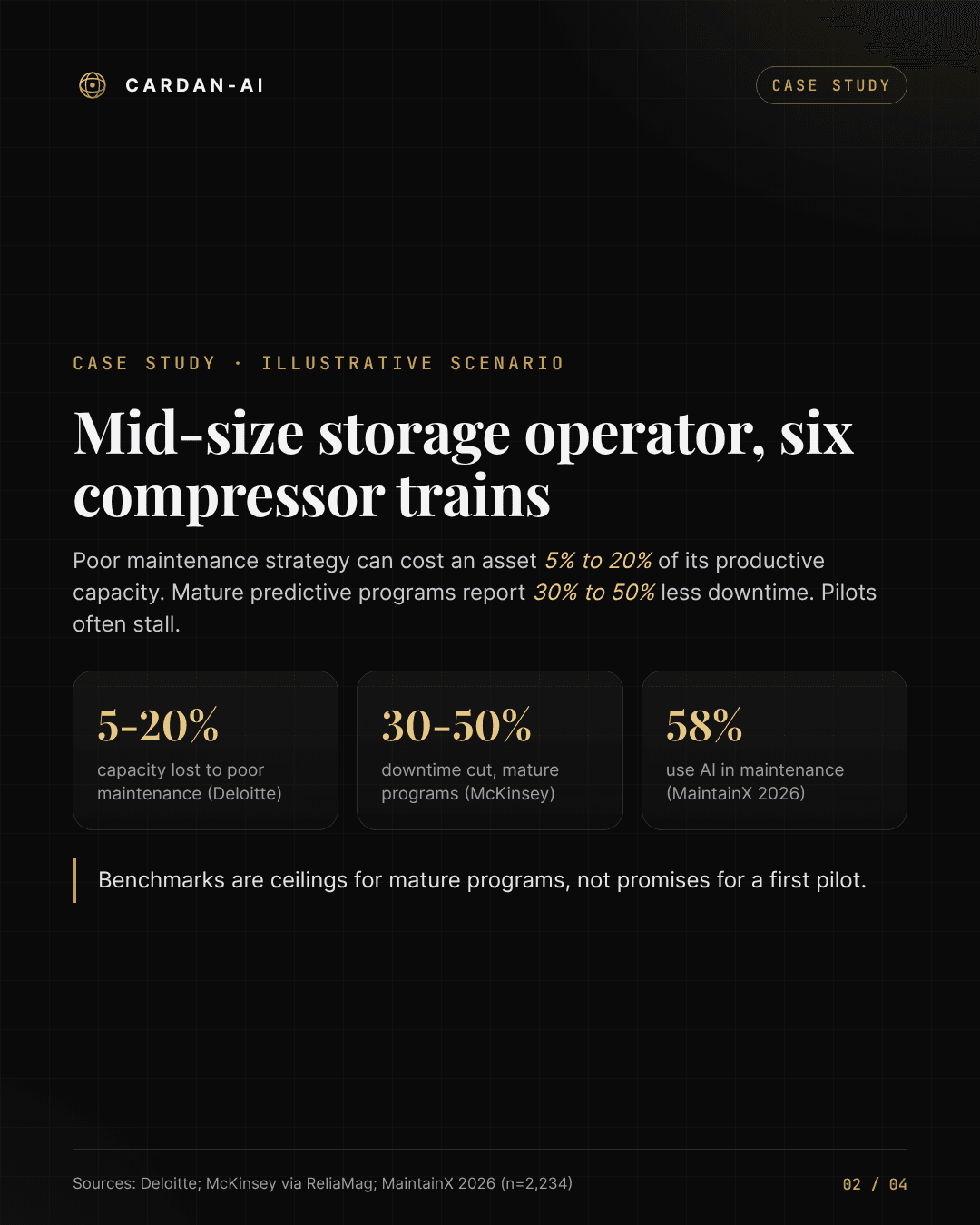
- Poor maintenance strategy can cut an asset's productive capacity by 5% to 20% (Deloitte).
- Mature predictive programs report 30% to 50% less downtime (McKinsey, via ReliaMag); early pilots fall short of that.
- 58% of 2,234 surveyed maintenance leaders already use AI (MaintainX, 2026): adoption is not the constraint.
- Success depends on one owner, one baseline and staged decision rights.
Gas storage and compression sites run a small number of high-value rotating machines. When a compressor train stops unplanned during an injection or withdrawal window, the cost is lost capacity, not only repair spend. This scenario describes an illustrative operator with six compressor trains; it is not a real company.
Deloitte states that poor maintenance strategies can reduce an asset's productive capacity by 5% to 20% and that unplanned downtime costs industries an estimated $50 billion a year. That gives the order of magnitude of what is at stake for a capital-intensive asset.
Benchmarks compiled by ReliaMag report that mature predictive programs typically reduce machine downtime by 30% to 50% (McKinsey, 2017), and cite 5% to 10% lower maintenance costs and 10% to 20% higher uptime (Deloitte). The same review notes that early pilots with noisy models generally fall short, and that some widely repeated figures trace back to vendor material.
The economic mechanism is the cost of being wrong in both directions. A missed failure costs capacity and possibly safety; a false alarm costs a planned intervention and engineer time. A model creates value only if its alert quality beats the current preventive schedule, and that can be measured only against a recorded baseline.
Adoption is not the bottleneck. MaintainX's 2026 survey of 2,234 maintenance and operations leaders reports 58% use AI in maintenance, with 75% of adopters reporting ROI in under six months. The same coverage names staff shortages, legacy integration and cultural resistance as the main obstacles.
For the operator, the sequence matters more than the tool. Deloitte recommends starting with basic preventive and reliability-centred maintenance, then piloting on one or two assets that are integral to operations and have enough run time to build a baseline. Pilot assets should be the ones where one avoided stop pays for the program.
Implications differ by actor. Plant managers need a weekly decision rule, not a dashboard. Reliability engineers must own alert triage and keep the right to override. Finance should sign off the baseline before the pilot starts, so gains are not argued afterwards. IT must secure operational data flows; the vendor is chosen last.
Limits: the 30% to 50% range comes from mature programs and a 2017 source, and one review rates some breakdown-reduction claims as low confidence. A first pilot may deliver a fraction of it, or nothing, if data quality is poor. Treat the benchmarks as a ceiling to test, not a forecast to commit.
Case study
Illustrative mid-size gas storage operator with six compressor trains, serving seasonal injection and withdrawal demand.
Challenge: Unplanned compressor stops during peak windows cost capacity, and scheduled maintenance is calendar-based, so some interventions come too early and others too late.
5-20%
capacity lost to poor maintenance (Deloitte)
30-50%
downtime cut in mature programs (McKinsey via ReliaMag; ceiling, not promise)
58%
of maintenance leaders already use AI (MaintainX 2026)
Approach
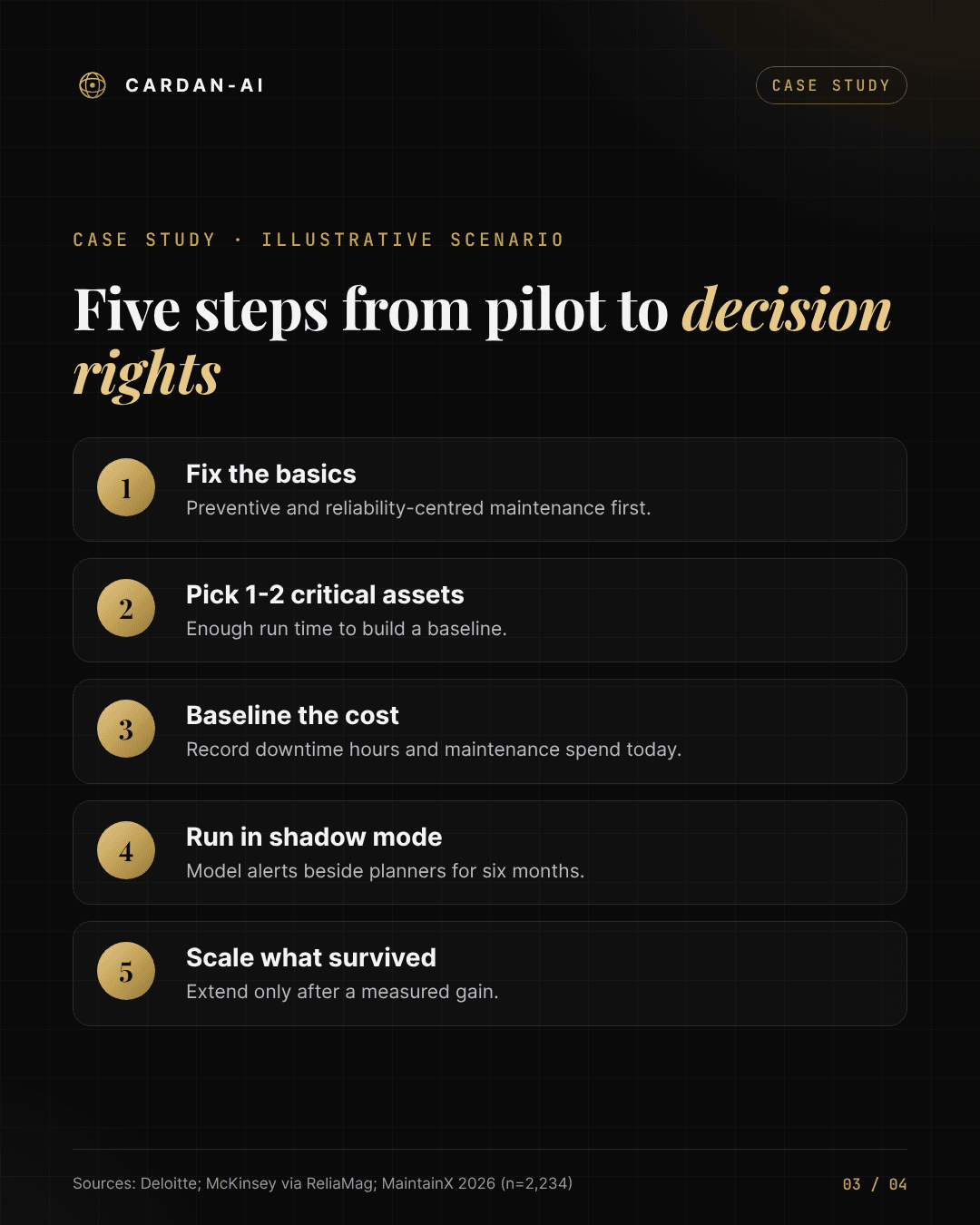
- 1.Fix preventive and reliability-centred basics on the pilot units first.
- 2.Select one or two critical compressors with long run histories.
- 3.Record 12 months of downtime hours and maintenance spend as the baseline.
- 4.Run the model in shadow mode beside planners for six months.
- 5.Grant alert-triggered actions in stages and extend only after a measured gain.
The pilot succeeds or fails before any model runs: one owner, one baseline, shadow mode, and decision rights granted only after measured gain.
Case study built from public benchmarks and Cardan-AI's sector experience; orders of magnitude are sourced below.
Our recommendations
- 1
Name one asset class and one owner
Pick the two compressors with the costliest unplanned stops and name one reliability owner. Write the decision as a weekly question: which unit needs intervention in the next 30 days?
- 2
Fix preventive basics first
Deloitte advises starting with preventive and reliability-centred maintenance. Close open work orders and sensor gaps on the pilot units before any model is trained.
- 3
Record the baseline
Capture unplanned downtime hours, maintenance spend and spare-parts consumption for 12 months. Without it, no gain can be measured.
- 4
Run in shadow mode for six months
Let the model flag risk beside planners' judgment. Compare hit rate and false alarms with the baseline; change no process yet.
- 5
Stage decision rights
Allow alert-triggered interventions only after shadow results beat the baseline. Keep safety and release decisions with qualified engineers.
Analysis by
Cardan-AI Intelligence
Our research and analysis unit, dedicated to applied AI for business, industry and regulatory compliance.
Let's talk about your next competitive edge
Thirty minutes to identify the two or three use cases in your operations that pay for themselves within the first year.