
Why creating one more command can fix a military-autonomy problem: the common agency lesson
The U.S. Army just created FASCOM, one more command for military autonomy, in a landscape that already has several. Common agency theory (Bernheim & Whinston, 1986) explains why stacking principals dilutes an agent's effort — and why consolidation, not addition, is the rational response.
On October 1, 2026, the U.S. Army created the Futures and Autonomous Systems Command (FASCOM), tasked with prioritizing, by fiscal year 2028, the acquisition of autonomous capabilities across six formation areas and seeing a dedicated Portfolio Acquisition Executive (PAE) designated. The announcement came one day after Defense Secretary Pete Hegseth unveiled a new combatant command for autonomous warfare. On paper, this is one more structure. What makes the episode interesting for an economist is that the Army itself frames the creation as a response to an already-diagnosed organizational problem — not as a capability innovation.
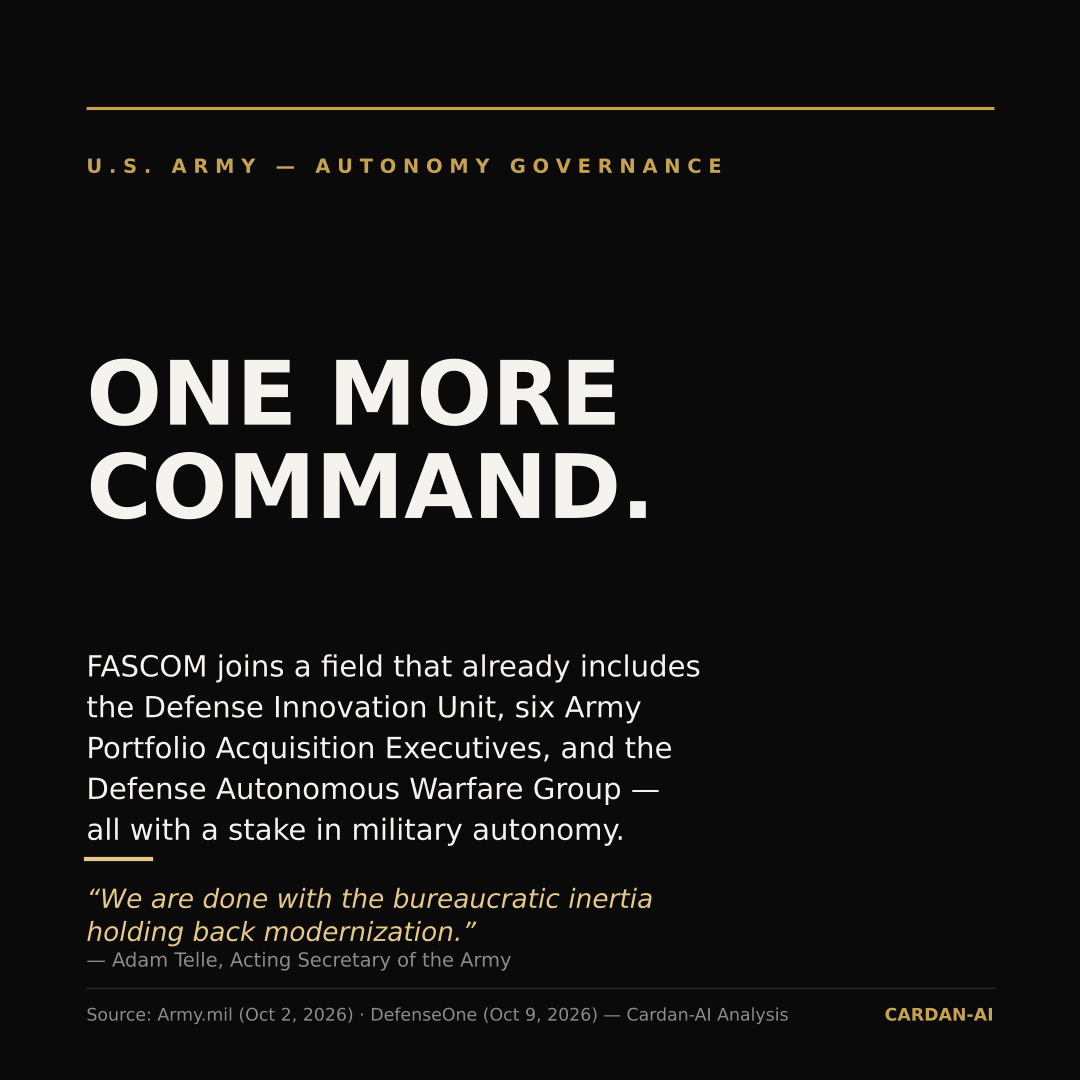
The institutional landscape FASCOM is joining is already dense: the Defense Innovation Unit, six existing Army Portfolio Acquisition Executives, and the Defense Autonomous Warfare Group all hold, to varying degrees, a mandate over military autonomy. Budget analyst John G. Ferrari described the new combatant command as 'an admission that the current organizational structure isn't going to deliver in a timely manner.' Acting Army Secretary Adam Telle was equally direct: 'we are done with the bureaucratic inertia holding back modernization.'
Organizational economics offers a precise framework for this kind of situation: the common agency problem, formalized by B. Douglas Bernheim and Michael Whinston in 1986. Its starting point: when a single agent (here, an acquisition program manager, or more broadly the autonomy-acquisition apparatus) serves several distinct principals — each with its own priorities, incentives, and partial power to reward or sanction — the agent under-invests in actions whose benefits accrue to all the principals jointly but whose cost it alone bears. Each principal, rationally, funds only the share of effort that directly serves its own objective, and none funds coordination itself.
Applied to U.S. military autonomy before FASCOM: a single autonomy program answers, informally, to the Defense Innovation Unit's 'commercial-first' doctrine, to the priorities of its parent PAE, and now to the expectations of a cross-cutting combatant command. No single principal bears the full cost of this fragmentation; each captures only part of the value produced. The outcome the theory predicts is not an absence of investment in autonomy — the budgets exist — but dispersed, poorly coordinated investment that ends up slower than what each principal, taken alone, would claim to want.
Consolidation — a single PAE, a command that aggregates existing efforts — is exactly the response the theory predicts: by reducing the effective number of principals, it reduces the share of coordination effort that no one funds. This reading is consistent with the Army's own language ('bureaucratic inertia,' an 'admission' of organizational failure): this is not about adding capability, it is about correcting an organizational externality.
The risk, documented in the common agency literature itself, is that consolidation relocates the problem rather than resolving it: a single principal under-resourced in authority, funding, or qualified staff can become a bottleneck in place of a diffuse coordination problem. That is precisely the uncertainty left open by the October 1 announcement — FASCOM's funding largely depends on a reconciliation bill still under discussion; absent it, the Army will wait for the fiscal year 2028 budget cycle. The 15X and 390A specialist career fields needed to staff these new functions must also be expanded — a personnel prerequisite, not just an org-chart one.
For aerospace-defense clients, the practical lesson extends beyond the U.S. case: in any autonomy program co-funded or co-steered by multiple sponsors — agencies, integrators, separate business units — the same mechanism applies. The most reliable predictor of a program's likelihood of advancing is not its headline budget, but the number of effective principals the purchase decision depends on: the fewer there are, the more likely coordination effort actually gets funded.
Analysis by
Cardan-AI Intelligence
Our research and analysis unit, dedicated to applied AI for business, industry and regulatory compliance.
Let's talk about your next competitive edge
Thirty minutes to identify the two or three use cases in your operations that pay for themselves within the first year.