
Backlog or option on a budget? What BigBear.ai reveals about budget constraints in defense AI
BigBear.ai reports $225M in federal AI contracts since July, but only 29% of its backlog is funded. János Kornai's soft budget constraint theory, inverted, illuminates a market where it isn't the vendor that gets bailed out without limit — it's the public buyer that imposes a hard constraint, quarter after quarter.
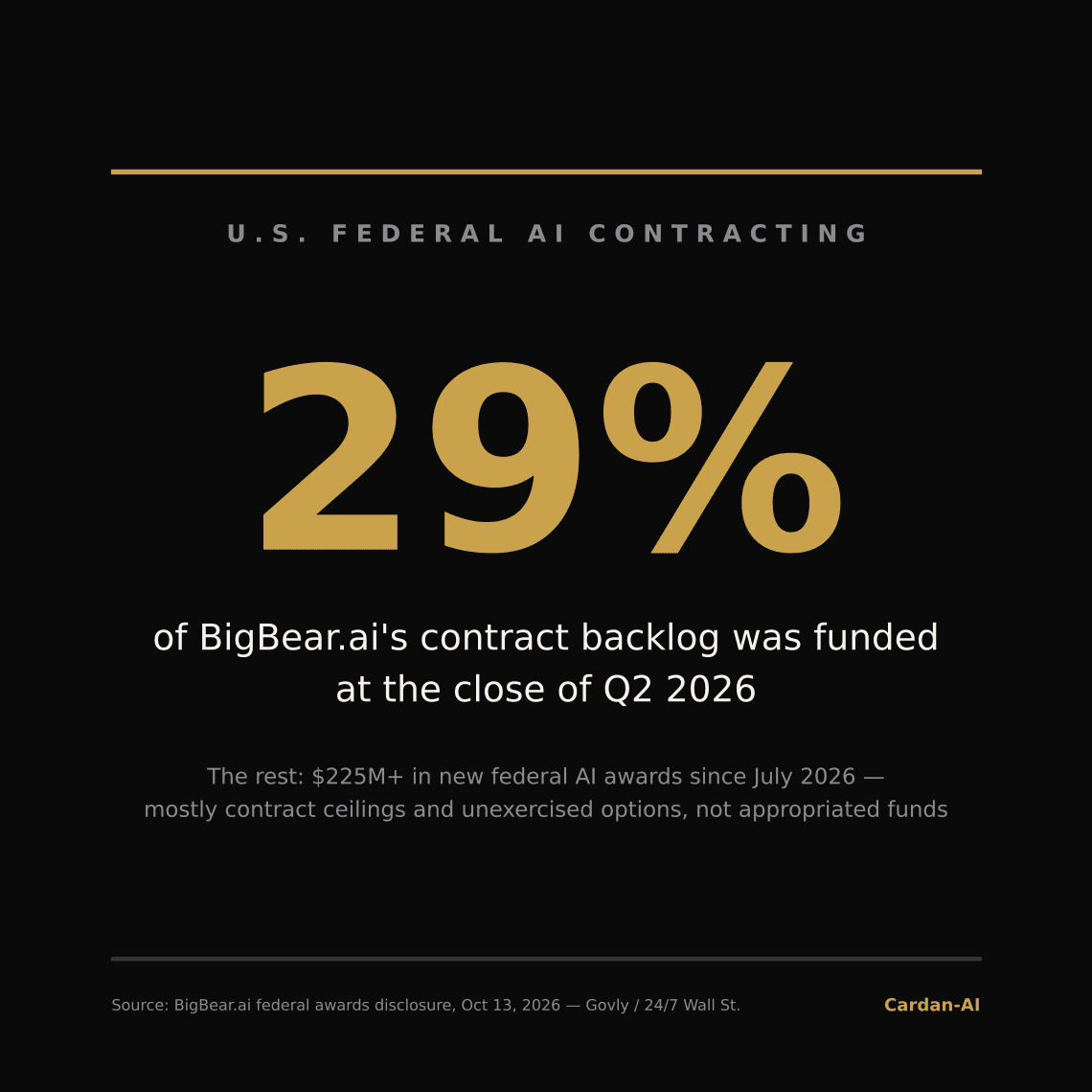
$225 million in new federal AI contracts since July 2026, with a growing share of generative AI work for defense, homeland security, intelligence, and civilian agencies: on paper, BigBear.ai is showing solid commercial momentum. One line in the same October 13 release changes how the number should be read — only 29% of the company's contract backlog was actually funded at the close of the second quarter of 2026.
Hungarian economist János Kornai formalized the concept of the soft budget constraint in 1986: certain entities — typically state-owned enterprises in socialist economies — anticipate that a deficit will be covered ex post by the state, which distorts their incentives to discipline costs and commitments. The U.S. federal defense-AI market displays an inverted configuration, which is precisely what makes it a useful case study: here, it is the public buyer — Congress, through the appropriations cycle — that imposes a hard constraint on the vendor, not the other way around.
The contractual mechanism producing this gap is the IDIQ vehicle (Indefinite Delivery, Indefinite Quantity), dominant in U.S. federal procurement. At signing, the agency notifies a ceiling on potential orders — the figure that makes headlines. But that ceiling is only an authorization to order, not an obligation to pay: each tranche must subsequently be covered by budget authority actually appropriated and obligated, agency by agency, quarter by quarter. The gap between the two is structurally an option — in the financial sense — held by the sponsoring agency, not the vendor.
What makes this option particularly uncertain in 2026 is the federal budget regime itself: continuing resolutions have multiplied over recent fiscal years in the absence of appropriations bills passed on schedule, capping spending at prior-year levels and delaying the exercise of many contract tranches. A backlog funded at 29% at the close of Q2 is therefore not merely an internal management metric — it is a direct measure of the company's exposure to the uncertainty of Congress's budget calendar.
For a backlog reported at $225M, a 29% funding rate brings firm budget commitment down to just under $65M. The rest — roughly $160M — is a potential claim on future, unguaranteed appropriations, whose exercise depends on political decisions largely external to the commercial relationship between agency and vendor. Valuing this type of company, or assessing an AI partner positioned on U.S. defense, on gross backlog alone conflates a call option with a firm sale.
The lesson extends beyond BigBear.ai. Any AI vendor building its value proposition on the scale of its federal contracts — a common commercial rhetoric in the sector since 2025 — should be assessed on a simple, rarely volunteered indicator: the funded-to-awarded ratio of its backlog. A high ratio signals a mature client relationship where budget has already followed intent; a low one, as here, signals dependence on a federal appropriations cycle that remains, in 2026, one of the most fragile links in the U.S. defense-AI value chain.
For European buyers and partners forming alliances with AI vendors positioned on the U.S. federal market — a natural temptation given the scale of headline budgets — Congress's hard budget constraint should become a due diligence criterion in its own right, on par with technological soundness or regulatory compliance.
The defense-AI market does not escape a rule older than itself: in public contracting, the gap between what is announced and what is budgeted is never an accounting footnote — it is information about the real balance of power between buyer and vendor.
Analysis by
Cardan-AI Intelligence
Our research and analysis unit, dedicated to applied AI for business, industry and regulatory compliance.
Let's talk about your next competitive edge
Thirty minutes to identify the two or three use cases in your operations that pay for themselves within the first year.