
Talk without commitment: what Crawford-Sobel cheap talk says about defense-AI budget announcements
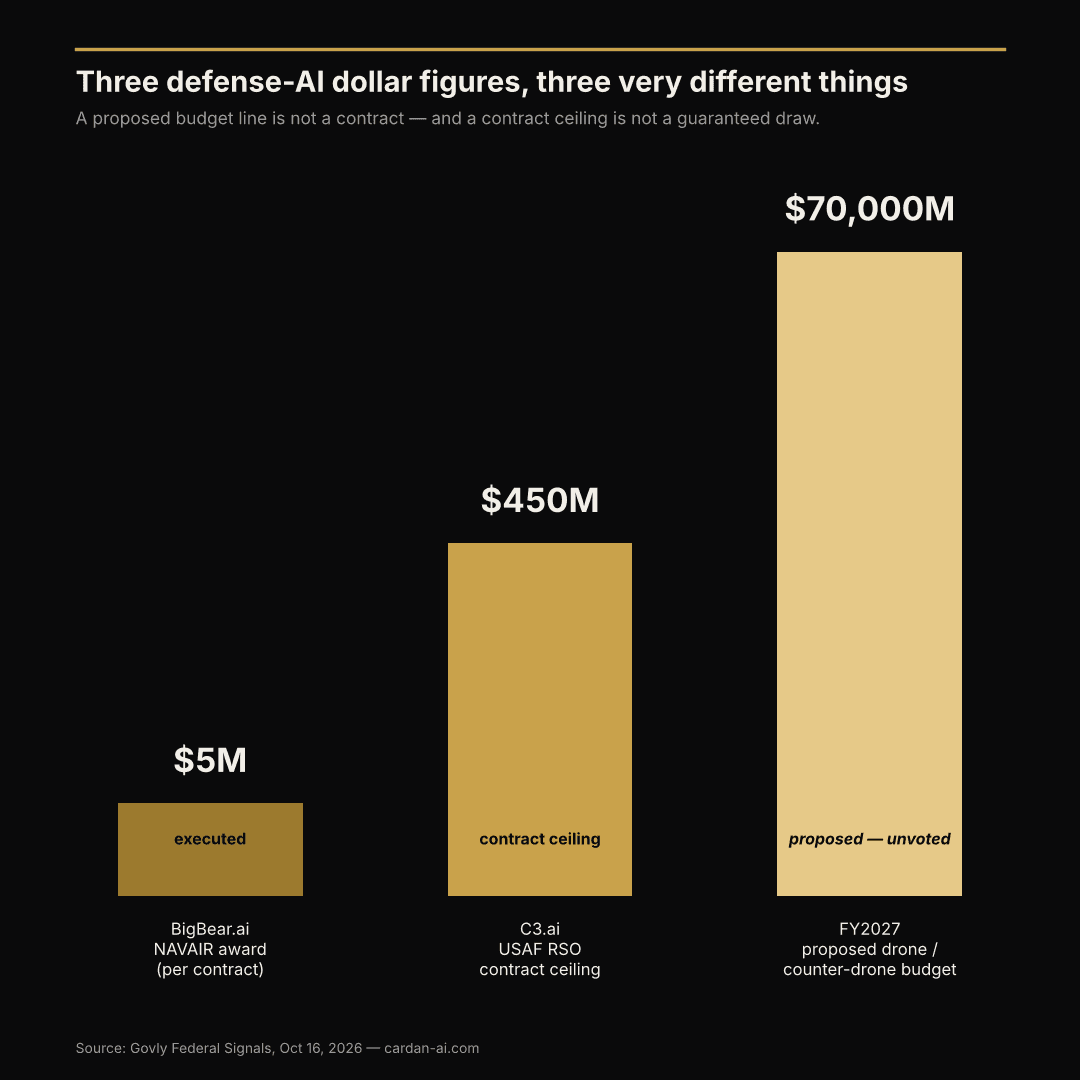
An October 16 Govly signal blends three defense-AI figures of radically different natures: executed contracts, a contract ceiling, and an unvoted FY2027 budget proposal. Crawford & Sobel's (1982) cheap-talk theory explains why that last figure — informative but non-binding — should be weighted very differently by contractors.
The signal published on October 16, 2026 by Govly on US defense agencies' AI contracting blends, in a single document, three figures that do not commit to the same thing at all: more than 20 NAVAIR contracts notified to BigBear.ai in Q2 2026 (up to $5M each), a $450M ceiling on C3.ai's predictive-maintenance contract with the US Air Force, and more than $70 billion in proposed spending on drones and counter-drone systems in the FY2027 budget — this last figure explicitly flagged by Govly as a proposal, not an appropriated line.
This heterogeneity is not an editorial detail: it maps onto a precise economic distinction, the one Vincent Crawford and Joseph Sobel formalized in 1982 in "Strategic Information Transmission" (Econometrica). Their cheap-talk model describes a situation where an informed sender — here, a federal agency or administration — sends a costless, non-binding message to a receiver — here, the defense-AI contractor market — who must then take an action based on it, such as an R&D or production-capacity investment.
Crawford-Sobel's central result is that the precision of information actually conveyed in equilibrium depends on how aligned the two parties' interests are. The more interests diverge, the more the informative message collapses into coarse categories — a so-called pooling equilibrium — rather than revealing a precise value. An administration announcing a $70 billion proposal has a structural interest in signaling strong demand: to mobilize Congress, reassure allies, signal intent to suppliers, and deter strategic competitors — while bearing no cost if the final appropriated amount turns out far lower.
This figure contrasts sharply with the other two. C3.ai's $450M ceiling rests on a legally binding contract with the Rapid Sustainment Office: even though the amount actually drawn will depend on task orders issued over time, failing to honor that framework carries a real reputational and legal cost for the agency — making it, in Crawford-Sobel terms, a far more costly and therefore more credible signal than a budget announcement. BigBear.ai's 20 NAVAIR contracts, for their part, are not announcements at all but already-notified executions: they do not even belong to the register of strategic communication — they are the action itself.
For a contractor or investor in the aerospace and defense sector, the practical takeaway is to weight these three signals very differently in an investment plan: treat the FY2027 figure as a noisy directional indicator — informative about intent, not about the exact amount — and reserve the other two figures for the more reliable near-term revenue base.
This reading connects to a point Cardan-AI already documented on BigBear.ai (Kornai's soft budget constraint, October 14 analysis): a credible demand signal on the buyer side guarantees nothing about the supplier side's absorption and delivery capacity. Budgetary cheap talk and operational execution constraints are two distinct sources of noise, and conflating them before any strategic pivot grounded in a federal budget line is a mistake worth avoiding.
Analysis by
Cardan-AI Intelligence
Our research and analysis unit, dedicated to applied AI for business, industry and regulatory compliance.
Let's talk about your next competitive edge
Thirty minutes to identify the two or three use cases in your operations that pay for themselves within the first year.