
Industrial AI Cybersecurity: Why the UK Chooses Mandates Over Pledges
The UK is widening its legal duty to report cyber incidents across critical infrastructure and weighing dedicated AI controls. Moral hazard in information economics, network security games, and real-options theory explain why binding regulation, here, beats voluntary commitment.
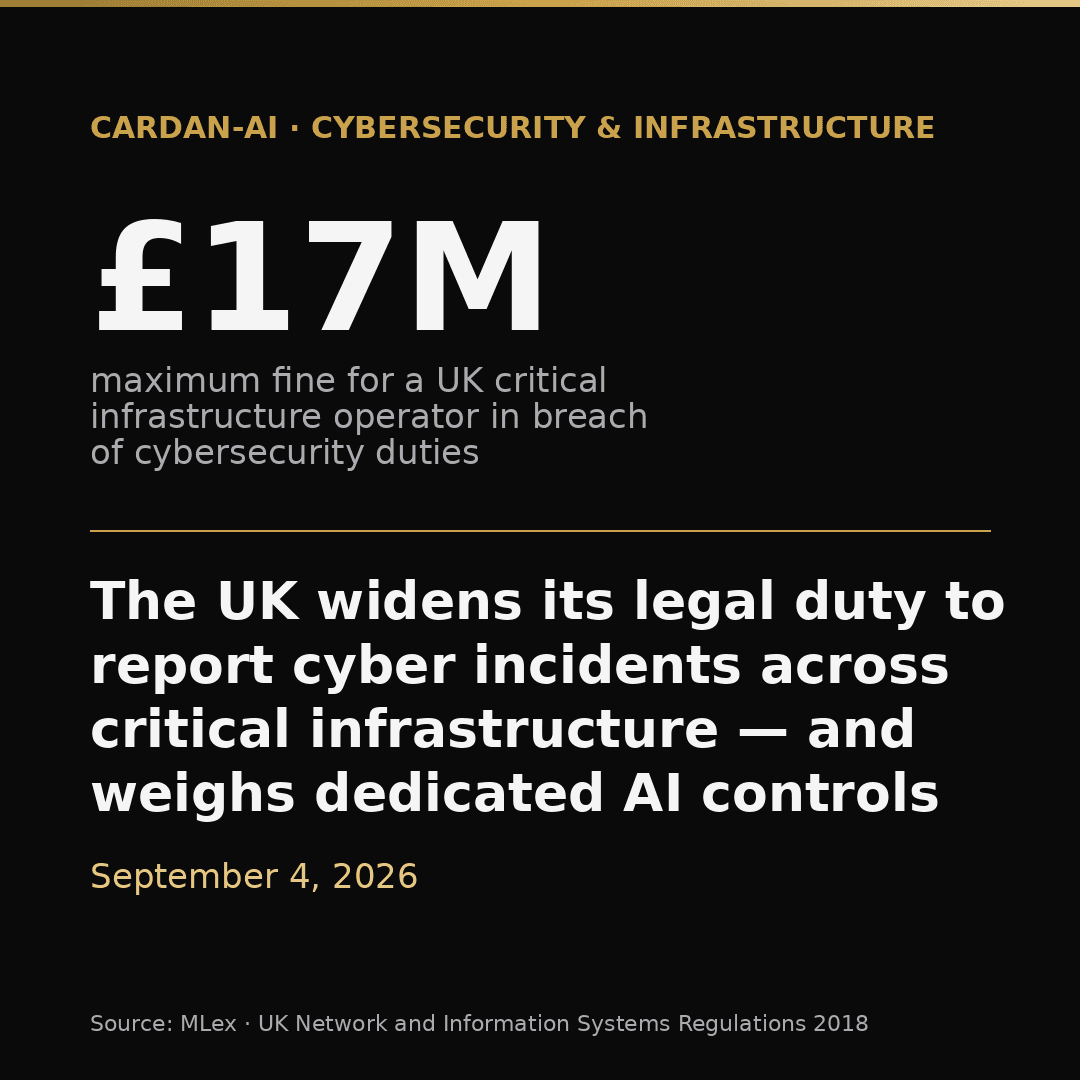
On September 4, 2026, MLex reported that the UK government is widening, via its Cyber Security and Resilience Bill, the scope of mandatory cyber incident-reporting duties inherited from the 2018 Network and Information Systems (NIS) Regulations — now extended to managed service providers and a broader range of essential-service operators in energy, water, transport and health. In parallel, the government is weighing, without having decided, AI-specific controls for these infrastructures.
The reference framework is not a minor one: the 2018 NIS Regulations already expose critical-infrastructure operators to fines of up to £17 million — a ceiling sized to make cybersecurity negligence structurally unprofitable. Widening the covered perimeter mechanically widens the set of actors subject to that financial discipline, including smaller links in the digital supply chain previously out of scope.
A first theoretical lens clarifies the logic of this duty: moral hazard in information economics (Arrow, 1963; Holmström, 1979). The security effort a firm actually devotes to its systems is largely unobservable from the outside — by the regulator, by partners, by insurers. Absent a verification mechanism, the firm is incentivized to under-invest in a costly, invisible effort as long as failures remain rare and hard to attribute. Mandatory reporting acts as a partial monitoring technology: it does not make security effort directly observable, but it makes failures visible and costly, pulling private incentives closer to the social optimum — much as an audit clause or a deductible aligns an insured party's incentives with its insurer's.
A second lens completes the first: network security games (Varian, 2004). In an interconnected infrastructure — a power grid, a digital supply chain — overall security often depends on the weakest link, not the average effort across actors. A large energy company can invest heavily in its own cybersecurity without that protecting the system if a subcontractor or managed-service provider, less exposed to public scrutiny, remains vulnerable. By widening reporting duties to these peripheral actors rather than only the most visible operators, the UK bill targets precisely this weakest-link problem — breadth of coverage rather than depth on a handful of large players.
A third lens explains why the government legislates on reporting but holds back on AI: real-options theory applied to regulatory decisions (Dixit & Pindyck, 1994). A reporting duty is a relatively reversible policy tool — it locks in no technology choice, it only makes incidents visible. A technical AI-specific mandate (audit standards, robustness requirements, criticality thresholds), by contrast, would be a more irreversible commitment, costly to revise once firms have built compliance around it. Facing a technology and failure modes that are still moving targets, deferring that second choice carries real option value: the government preserves future flexibility at the cost of near-term regulatory ambiguity for firms that must plan compliance investment today.
This case extends our September 1 analysis of the voluntary collective call by 116 technology players for action on AI cyber defense. Both episodes address the same problem — interdependent security where individual effort is not enough — through opposite institutional routes: voluntary commitment, with no sanction mechanism, is 'cheap talk' per Farrell & Rabin (1996) and runs, in Ostrom's (1990) framework, into the absence of an enforceable rule; the UK's legal duty carries a credible sanction mechanism (£17 million), but at the cost of narrower scope and slower legislative timing.
An explicit limit: a reporting duty observes a symptom — the incident that occurred — not its cause, the actual quality of security investment; a firm can comply with the letter of the law (report well) without fixing the substance (defend poorly). And as long as AI-specific controls remain under review, operators deploying AI in industrial control systems sit in a zone of regulatory uncertainty close to the Knightian uncertainty described in our September 5 analysis — a real cost, even absent any new rule.
For energy and oil & gas operators reading this: the practical takeaway is not to wait for the AI-controls decision before acting. The widened reporting perimeter is already locked in; budgeting compliance now costs less than discovering the gap after a poorly reported first incident.
Analysis by
Cardan-AI Intelligence
Our research and analysis unit, dedicated to applied AI for business, industry and regulatory compliance.
Let's talk about your next competitive edge
Thirty minutes to identify the two or three use cases in your operations that pay for themselves within the first year.