
MRO: why AI projects are won in the workshop process, not the software
AI adoption in MRO is rising (67% in 2026 vs 58% in 2024), but value depends on reorganising work around the tool. Executives should fund the process before the licence.
Key takeaways
- Adoption is moving fast: 67% in 2026 vs 58% in 2024 (Oliver Wyman, via Aviation Week).
- The bottleneck has shifted: software fails when the business process doesn't change.
- Data and IT are under-invested: the gap between ambition and infrastructure is the main risk.
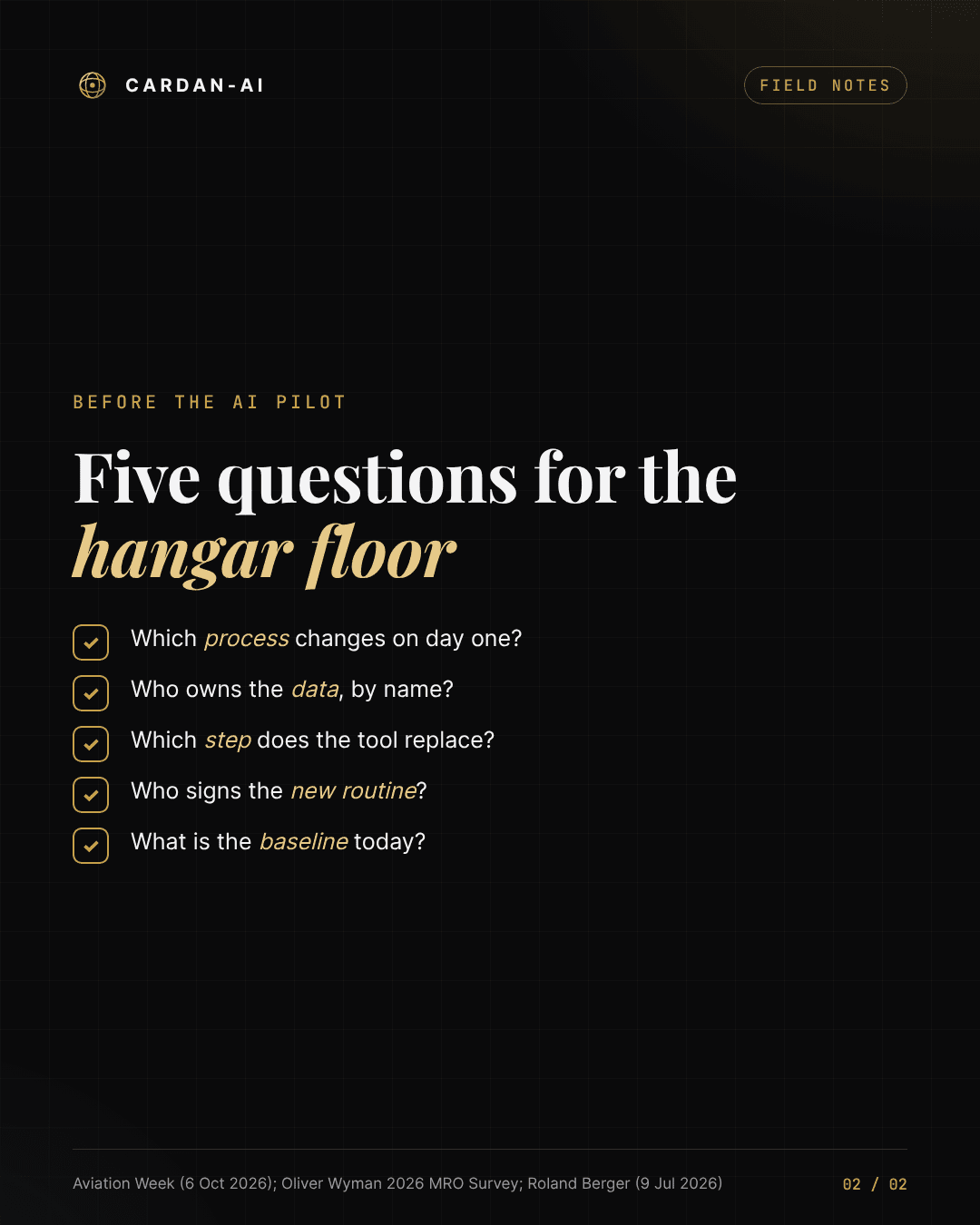
- A successful pilot names the changed process, the data owner and the routine's signatory.
What we observe in maintenance workshops is rarely a spectacular technical failure. It is a convincing demo, then a team that goes back to its habits. Sector figures confirm adoption is no longer the question.
According to Oliver Wyman's 2026 MRO survey, cited by Aviation Week on October 6, 2026, AI adoption reaches 67%, up from 58% in 2024. Two-thirds of respondents say AI delivers as much or more value than expected, and about 75% expect use across most or all MRO activities within five years.
The market is organising accordingly: the author counts at least two dozen vendors of MRO-specific applications, mostly in six families (predictive maintenance, inspections, parts traceability, technician aids, planning, document search). First acquisitions are appearing: Pratt & Whitney acquired Aiir Innovations in July, AAR acquired Aerostrat last year.
The economic mechanism is old. Paul David (1990) showed the dynamo did not raise industrial productivity on installation: gains came when workshops were reorganised to exploit distributed power. The tool is only one factor; value appears when the routine changes.
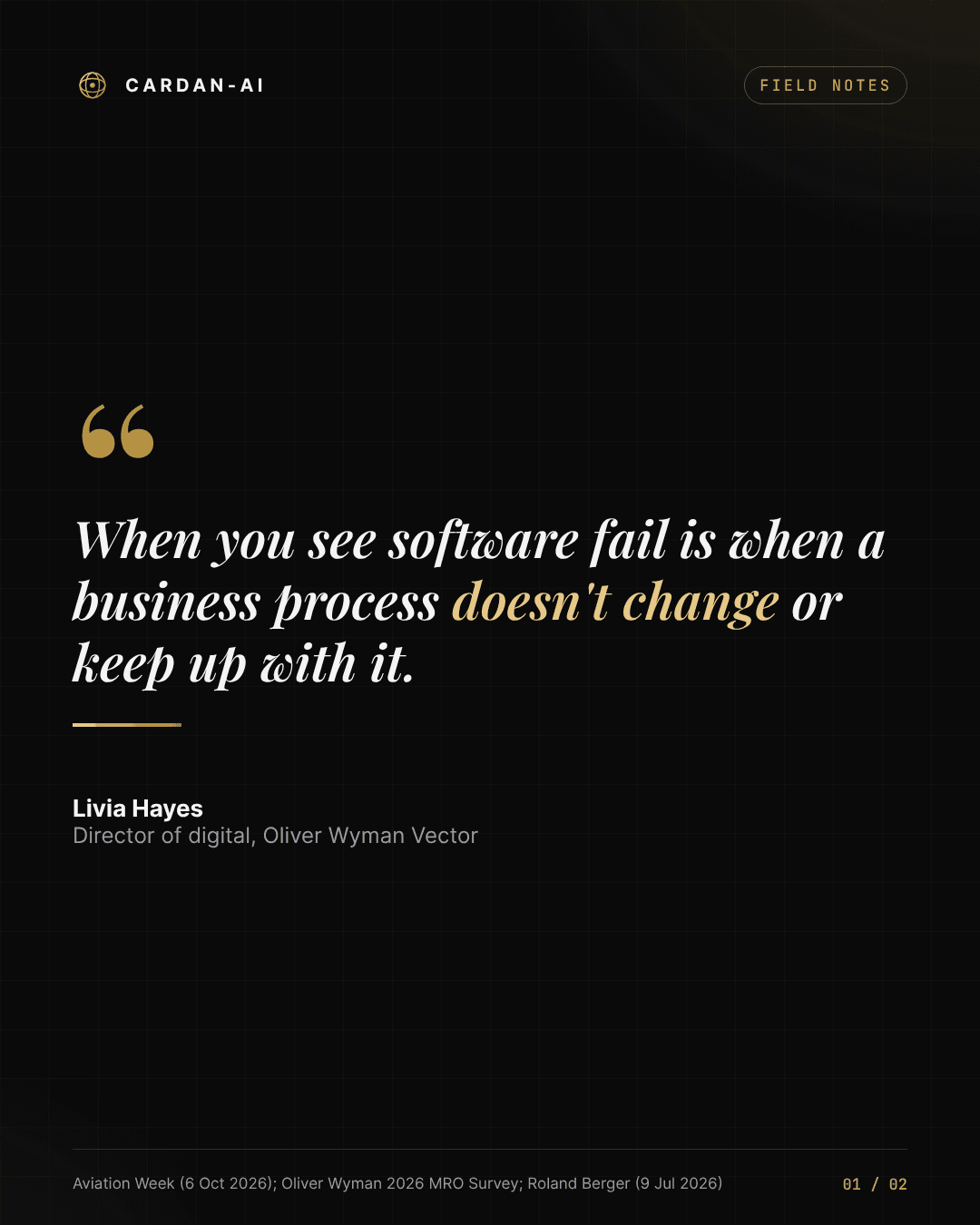
Livia Hayes, director of digital at Oliver Wyman Vector, puts it this way: software fails when the business process doesn't change or keep up. She also notes some clients are wary after unmet promises, which strengthens budget scrutiny of new tools.
Second brake: infrastructure. Oliver Wyman describes a fundamental mismatch between IT investment seen as low and the appetite for AI innovation. For manufacturing at large, Roland Berger (July 9, 2026, 100+ leaders surveyed) ranks data quality as the most cited barrier; nearly two-thirds say significant clean-up is needed before launching AI.
Implications by player: for an independent MRO, the question is which step of the work card disappears. For an airline group, it is whether the tool scales across the group, as Ben Dias (IAG) points out: some tools suit one airline but not a group. For an OEM, it is ensuring data is owned and named.
Limits: these surveys measure declared adoption, not verified return on investment. The Aviation Week article gives no failure rate or measured hangar results, and Roland Berger does not quantify the share of pilots scaled. Our field reading is a working hypothesis, not a statistic.
Our recommendations
- 1
Describe the target process before buying
Chief operating officer, before signing: write a one-page work card as it will be after the tool, with the step removed and the step added.
- 2
Name the data owner
Quality or production director, within 30 days: one named person in Operations signs off extractions and data quality.
- 3
Have the new routine signed
Workshop manager, before go-live: the changed routine is validated by those who run it and by the quality system.
- 4
Freeze the baseline
CFO and production, before the pilot: measure today's situation so any gain reads in euros.
Analysis by
Cardan-AI Intelligence
Our research and analysis unit, dedicated to applied AI for business, industry and regulatory compliance.
Let's talk about your next competitive edge
Thirty minutes to identify the two or three use cases in your operations that pay for themselves within the first year.