
Capital found defense AI. The constraint is that software doesn't melt titanium.
Defense-tech VC put $19.8B to work in one quarter of 2026 — more than the entire 2025 record — yet the binding constraint is the qualified physical base, not capital. An economist's read on where the returns actually accrue.
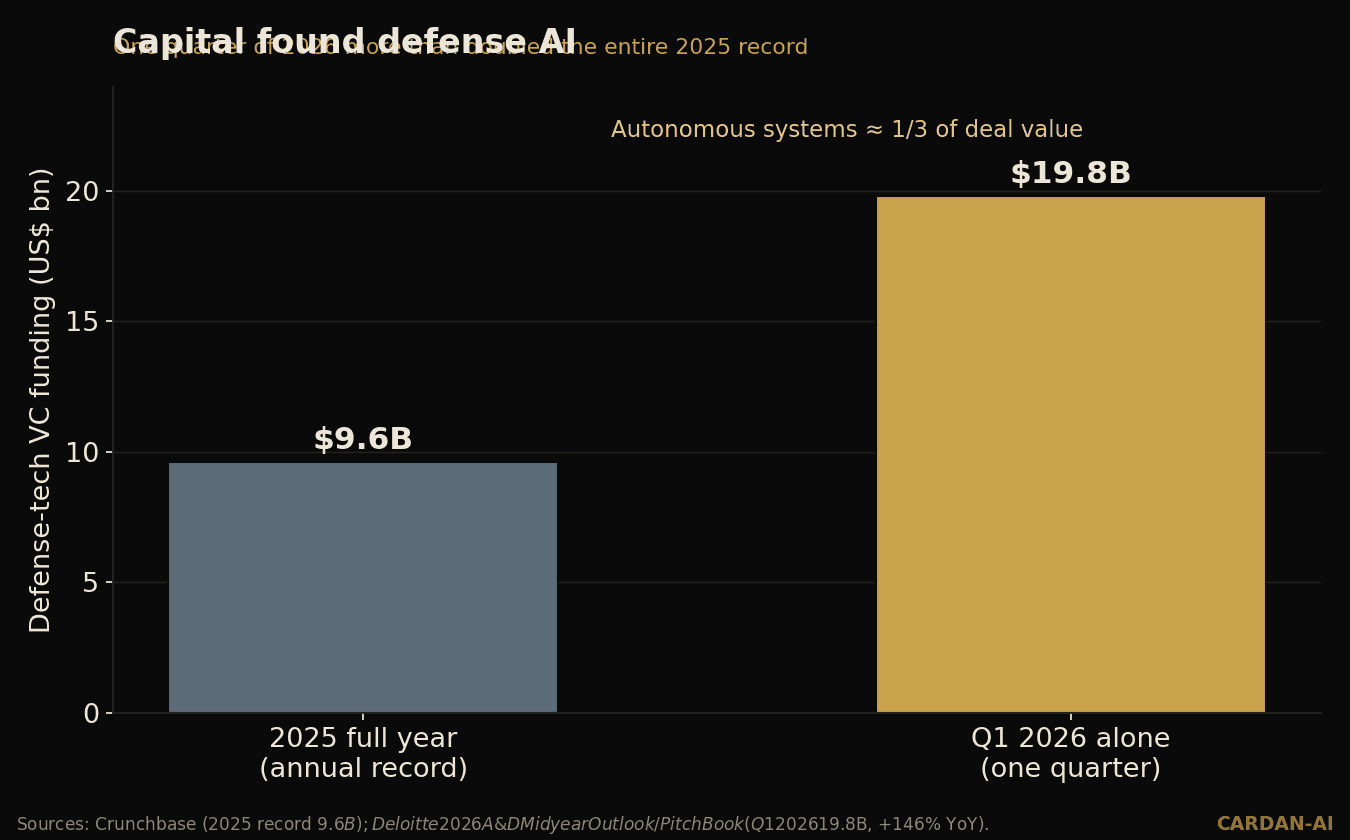
Defense-tech venture capital deployed roughly $19.8 billion in the first quarter of 2026 alone — a 146% jump year over year, with autonomous systems accounting for close to a third of that deal value, per Deloitte's mid-year Aerospace & Defense outlook. To frame the scale: Crunchbase pegged the prior full-year record at $9.6 billion for all of 2025. A single quarter of 2026 more than doubled it. The money has, unambiguously, found defense AI. The interesting question for an operator is not whether the enthusiasm is warranted, but where the returns from it will actually land.
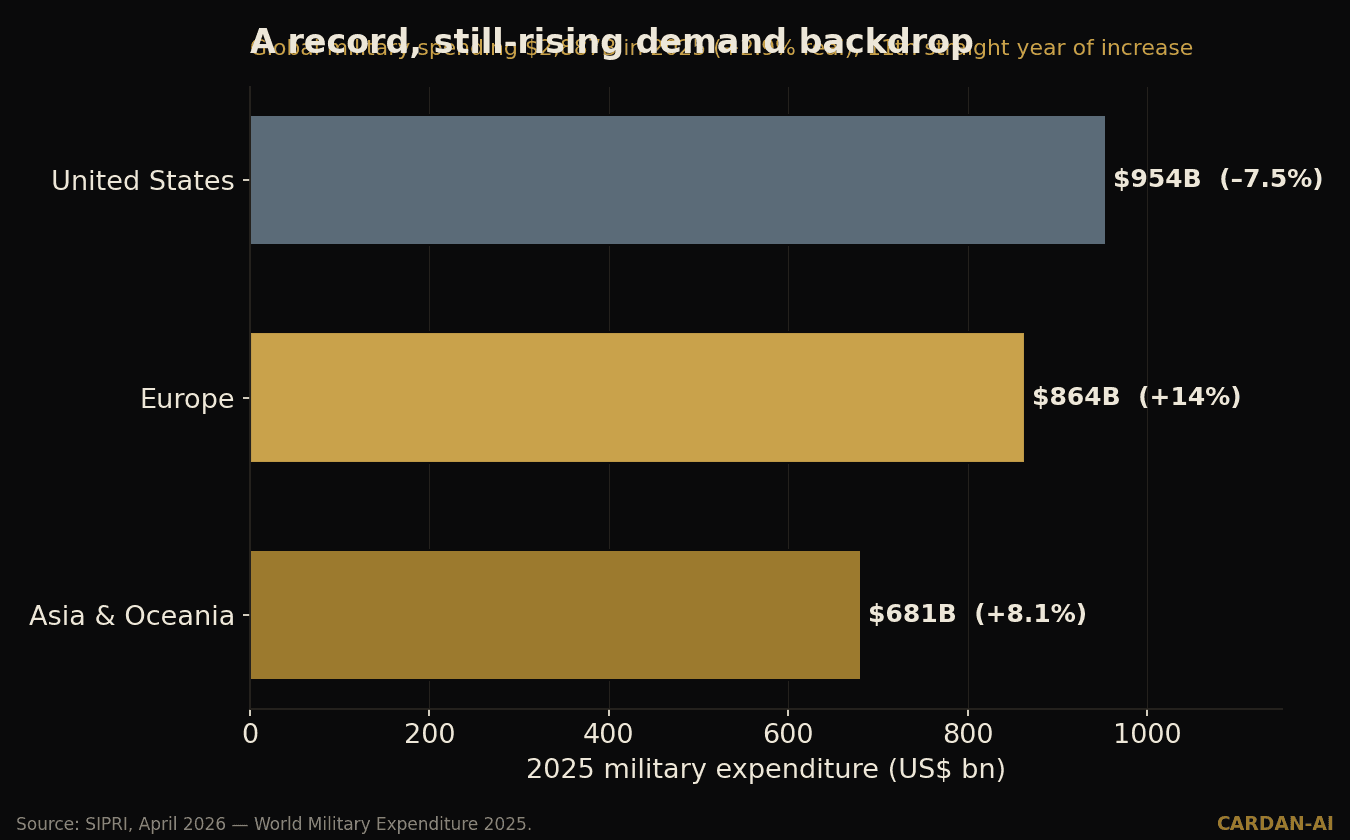
Start with demand, because it is not the scarce thing either. SIPRI's April 2026 figures put global military expenditure at a record $2,887 billion in 2025, up 2.9% in real terms and marking the eleventh consecutive annual increase. The composition matters more than the headline: European spending rose 14% to $864 billion and Asia & Oceania 8.1% to $681 billion, even as reported US outlays edged down. Demand is abundant and, if anything, structurally rising. Capital is abundant. When two inputs are simultaneously plentiful, neoclassical logic says to look for the one that isn't.
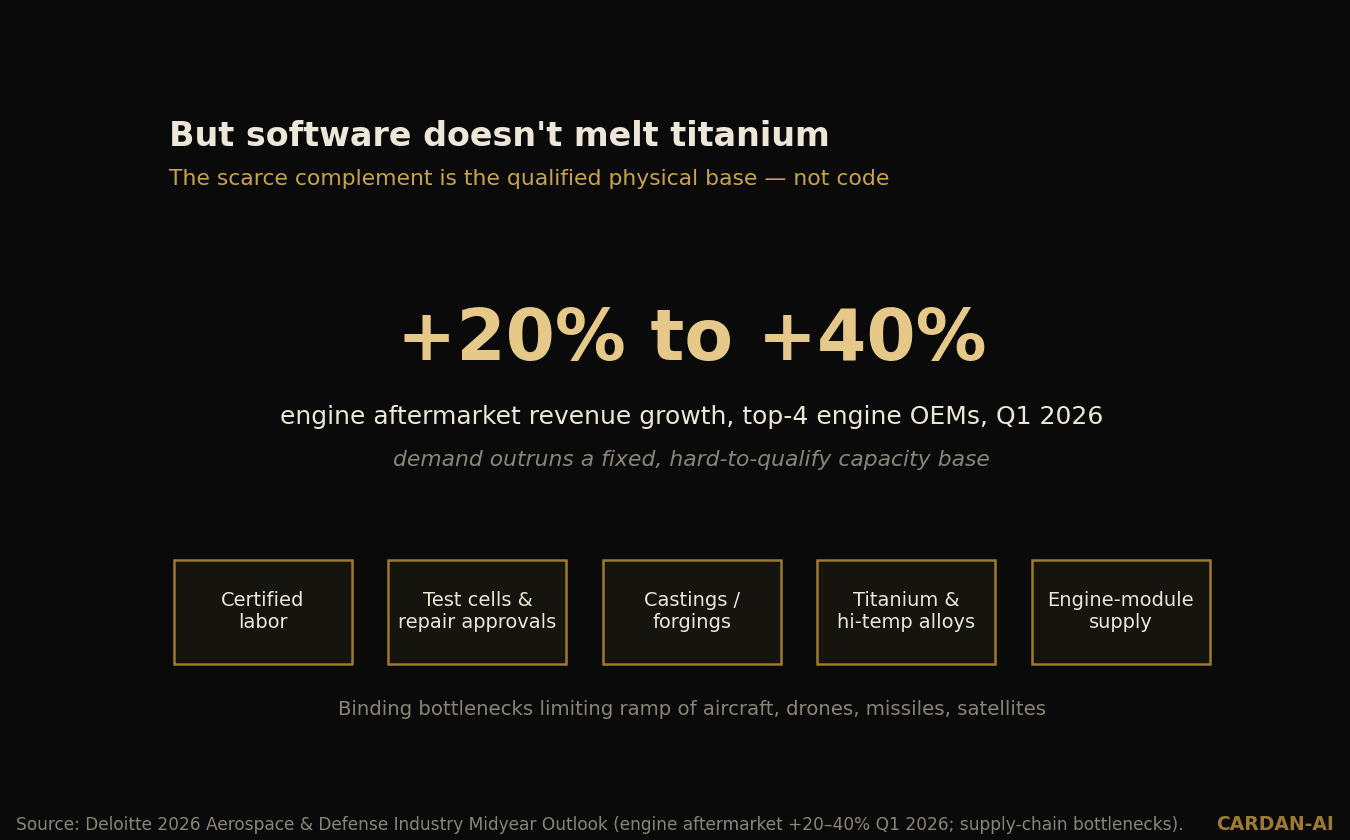
That input is the qualified physical base — the unglamorous industrial capacity that converts an algorithm into fielded capability. Deloitte is explicit about the bottlenecks: engine services, electronics, castings, forgings, titanium and high-temperature alloys, plus insufficient certified labor, test cells, tooling, repair approvals and inspection capacity. The price signal is already visible. Engine aftermarket revenue at the top four engine OEMs grew 20% to 40% in Q1 2026 — not because demand suddenly appeared, but because a fixed, hard-to-qualify capacity base cannot flex to meet it. Scarcity shows up as margin.
This is a textbook complementarity problem. In any production function combining capital, software and physical capacity, the marginal return to flooding in more of an abundant input collapses when its complement is inelastic. You can raise a tenth autonomy round and it will not, that quarter, add a forging line, qualify a new alloy supplier, or certify a test cell. The economic rent therefore migrates away from the abundant factor and toward whoever controls the scarce complement. Software does not melt titanium. The 500th drone demo does not expand the industrial base that has to build, qualify and sustain it.
This reframes the 'is defense AI a bubble?' debate that dominated the summer's headlines. That is largely a financing-side spectacle: it concerns the dispersion of returns across the hundreds of funded startups, most of which will not clear. It says very little about the operator-side question. An incumbent prime, a tier-one supplier or an MRO operator does not capture value by owning the frontier model; it captures value by owning the constraint the model still has to run through. The bubble, if there is one, is priced into venture portfolios — not into the balance sheet of a firm that controls qualified capacity.
So where does AI actually pay in aerospace and defense? Aim it at the bottleneck itself. The highest-return deployments are the ones that compress qualification and certification cycles, lift throughput and uptime from an existing, hard-to-replicate base, and protect the proprietary process data that base continuously generates — the very data an outside software vendor cannot obtain. This is the reverse of the demo economy. It is less visible, harder to fund, and structurally more durable, because it improves the scarce factor rather than adding to the abundant one.
The distributive conclusion is favourable to the operators Cardan-AI works with, with one caution. The advantage accrues to firms that already hold qualified capacity and certification-grade process knowledge — aerospace, defense, energy — whose marginal cost of extending existing governance to AI is far below that of a digital-native entrant. The caution is duration: much of this capacity is financed on long horizons against assets and programs measured in decades, while the AI toolchain layered on top depreciates in two to three years. Match the AI to the constraint, not to the narrative — and buy the base that appreciates, not the model that commoditises.
Analysis by
Cardan-AI Intelligence
Our research and analysis unit, dedicated to applied AI for business, industry and regulatory compliance.
Let's talk about your next competitive edge
Thirty minutes to identify the two or three use cases in your operations that pay for themselves within the first year.