
Defense AI: capital is abundant, trust is not — what Kenneth Arrow explains
$19.8B in defense tech VC in Q1 2026 (+146% year-over-year), yet Deloitte now names "trusted deployment", not technology, as the binding constraint. Kenneth Arrow's economics of trust (1972) explains why abundant capital alone cannot produce it.
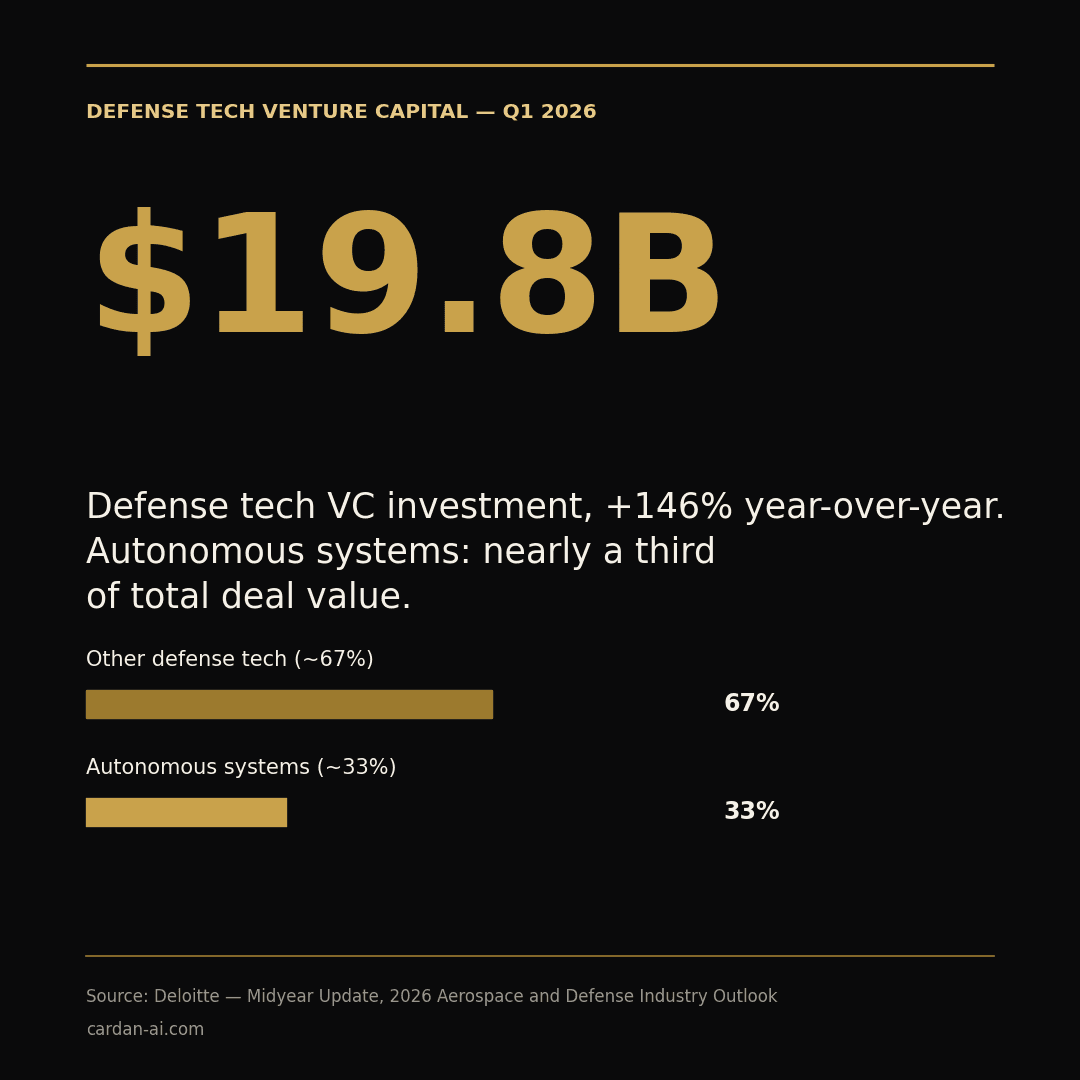
Deloitte's midyear update to its 2026 Aerospace and Defense Industry Outlook delivers a striking figure: $19.8 billion in venture capital flowed into defense tech in Q1 2026, up 146% year-over-year, with autonomous systems alone capturing nearly a third of that total. On paper, every marker of successful technology adoption is present at once: abundant capital, triple-digit growth, and an official doctrine — an "AI-first" force — aligned with private investment.
That is exactly what makes the next sentence in the same report so notable. Deloitte states explicitly that the constraint on AI deployment in defense settings no longer lies in model capability but in "trusted deployment" — the capacity to certify, trace and guarantee the reliability of an autonomous system before entrusting it with a mission-critical task. That is an unusual inversion: most technology waves are capability-constrained first, and only later run into governance friction. Here, the industry is hitting a trust bottleneck even as capital arrives at a historic pace.
Economist Kenneth Arrow formalized exactly this problem in a classic 1972 paper, "Gifts and Exchanges": trust, he argued, is an economic good in its own right — a lubricant without which a large share of productive exchange could not take place — but one that markets structurally under-produce. The reason lies in its largely non-excludable character: a vendor who builds, at its own expense, a verifiable track record of reliability creates a positive externality for the whole ecosystem (future buyers benefit from lower verification costs), without being able to capture the full value of that investment. Venture capital finances bets on technology and market size; it does not spontaneously finance the verification infrastructure that makes that technology deployable with confidence — these are two different production functions, and abundance in one does not guarantee abundance in the other.
This lens speaks directly to two recent Cardan-AI analyses. On September 2, we noted that the standardized evaluation framework created by the NDAA FY2026 — operational by June 1, 2026 but complete only by January 1, 2028 — is, in Akerlof's (1970) terms, the verification instrument that answers the information asymmetry over the quality of military AI models. On September 5, we showed that a federal court's reversal of an arbitrary vendor exclusion (for lack of due process) bounded the DoD's discretionary designation power, the sole competing source of buyer-side trust. Both episodes concern the same scarce resource Deloitte now names explicitly: institutionalized trust, distinct from both capital and technology.
The Air Force's AI talent strategy, approved in April 2026, extends this diagnosis to human capital: its emphasis on proof-of-skill requirements and a mandatory baseline of AI literacy is not simply a recruiting program — it is an investment in verifiability, the ability to certify that an individual's competence is real, mirroring the certification sought for the systems themselves.
One caveat matters. The $19.8 billion figure aggregates heterogeneous "defense tech" categories; Deloitte attributes the roughly one-third share only to autonomous systems specifically, leaving two-thirds of funding in categories less directly tied to the trust problem described here. A venture capital surge is also a leading indicator of anticipated demand, not proof that verification mechanisms are advancing at the same pace — capital can structurally outrun institutions, which is precisely the source of the 19-month gap between operational status and full completion of the NDAA framework flagged on September 2.
The methodological point extends beyond defense. Wherever an AI decision must be delegated in a high-stakes setting — critical energy infrastructure, luxury product authentication, medical diagnostics — Arrow's diagnosis applies just as well: private capital readily finances the technology, far more rarely the verification infrastructure that makes it trustworthy. Distinguishing the two should be a standard diligence reflex for any organization evaluating an AI investment or vendor in a regulated sector.
Analysis by
Cardan-AI Intelligence
Our research and analysis unit, dedicated to applied AI for business, industry and regulatory compliance.
Let's talk about your next competitive edge
Thirty minutes to identify the two or three use cases in your operations that pay for themselves within the first year.