
The winner's curse is bidding for pre-revenue defense AI
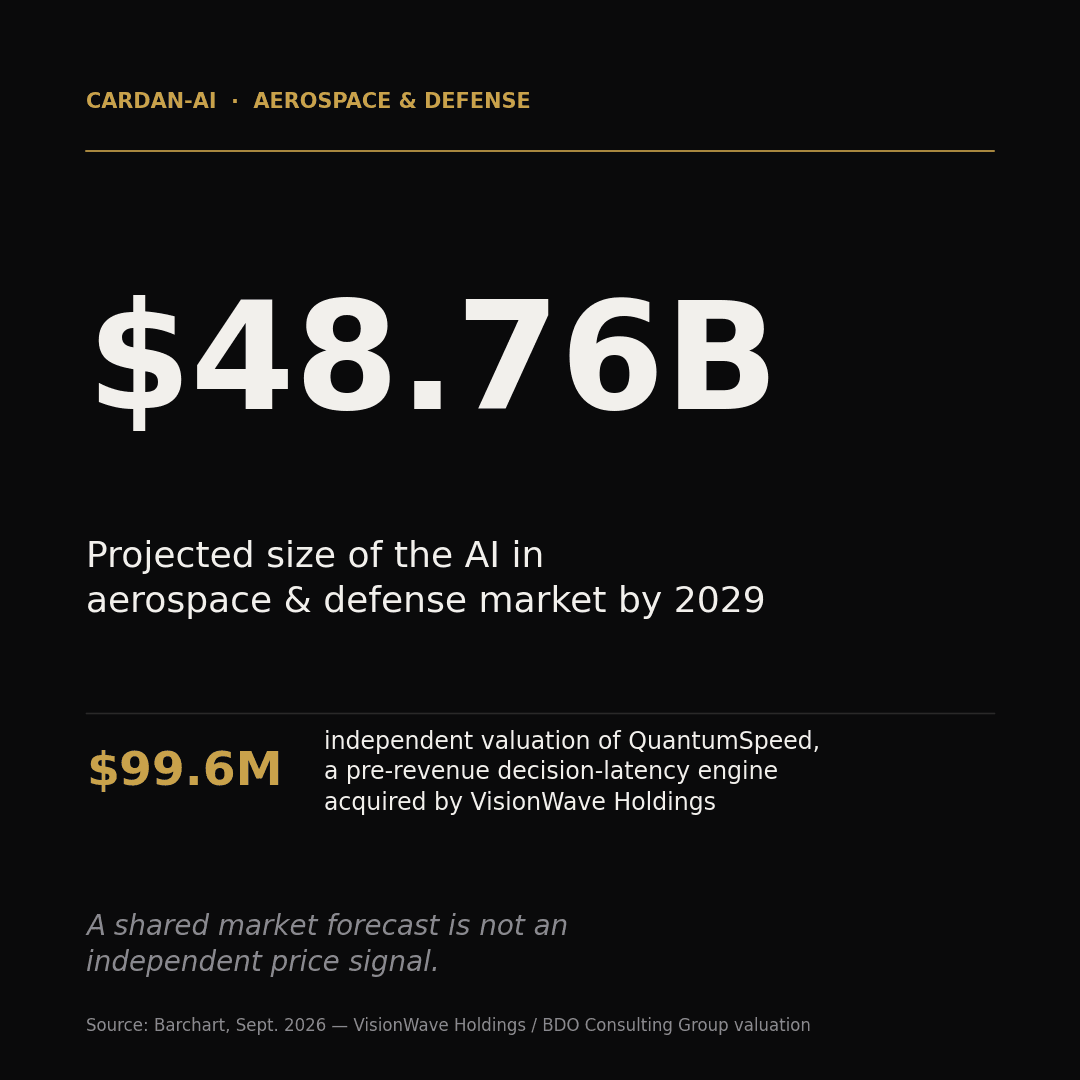
VisionWave's $99.6 million valuation of a pre-revenue decision-latency engine is priced against a $48.76 billion 2029 market forecast, not a track record. Fifty years of auction theory says that is exactly the setup in which buyers systematically overpay.
VisionWave Holdings' acquisition of QuantumSpeed — a computational-acceleration engine that promises to compress military decision latency from minutes to seconds — was priced by an independent appraiser, BDO Consulting Group, at $99.6 million. QuantumSpeed has no disclosed commercial revenue. The valuation is instead a claim about the future: that the AI-in-aerospace-and-defense market will reach $48.76 billion by 2029, and that QuantumSpeed's technology will capture a meaningful share of it. Every dollar of that $99.6 million is a bet on a forecast, not a multiple of anything that has already happened.
This is precisely the structure that auction theorists call a common-value auction, and it has a well-documented pathology. Capen, Clapp and Campbell described it in 1971 in a paper written not about technology but about oil leases: when several bidders independently estimate the value of a tract whose true worth is the same for everyone, each estimate is an unbiased but noisy guess around that true value. The bidder who wins is, by construction, the one whose guess happened to be furthest above the mean — not the one who assessed the asset most accurately. Capen and his co-authors were petroleum engineers who noticed their own industry was chronically overpaying for offshore leases for exactly this reason; the concept later entered mainstream economics as the ‘winner's curse.’
Defense-tech M&A today has the same shape. QuantumSpeed's fair value cannot be checked against comparable transactions with disclosed cash flows, because none exist yet at scale. What every appraiser, acquirer and venture investor in this space is actually estimating is a shared, unobservable parameter — how large the eventual market for decision-latency and autonomy software will really be, and which vendors will capture it. BDO's $99.6 million is one draw from that estimation process. Other appraisers pricing comparable pre-revenue autonomy assets this year are drawing from the same underlying uncertainty, using largely the same public forecasts.
The rest of the September news cycle supplies the corroborating evidence of a crowded field placing correlated bets. Lockheed Martin is nearly tripling annual PAC-3 MSE interceptor production, from 600 to 2,000 units over seven years. AeroVironment and PteroDynamics demonstrated integrated electronic-warfare drone swarms at the Navy's Silent Swarm 25 exercise. The FY2026 NDAA created a $500 million FEMA counter-drone grant program and new federal airspace-shield authorities. None of these announcements independently confirms QuantumSpeed's specific value — but each one is read by the market as evidence that the shared $48.76 billion story is real, which raises every subsequent estimate in the same direction. Capen, Clapp and Campbell observed the identical feedback loop in the Gulf of Mexico lease sales of the 1960s: public signals of a hot play made every subsequent bid more aggressive, not more accurate.
The literature also describes the correction, and it is worth stating plainly because it is not what independent appraisals typically do. Richard Thaler's 1988 survey of the winner's curse recommends that bidders shade their estimates downward in proportion to the number of competing bidders and the variance of the underlying signal — the more uncertain the true value and the more parties chasing it, the larger the discount a rational bidder should apply before bidding. An appraisal that extrapolates from the same public $48.76 billion forecast that every other market participant is already using is not, in the statistical sense, an independent signal; it is correlated with the very consensus that needs correcting, and so it cannot by itself perform the de-biasing function the winner's-curse literature calls for.
It is worth separating two kinds of capital in this same news cycle, because they carry different risk profiles. Lockheed's interceptor capacity expansion is a private-value investment: known unit economics, a specific contracted buyer, a production ramp that can be costed against existing plant and labor. QuantumSpeed's acquisition is a common-value bet on an unobserved future market size. The winner's-curse risk is concentrated in the second category — pre-revenue software and IP acquisitions priced against a shared total-addressable-market narrative — not in physical capacity expansion tied to firm orders. Corporate development teams evaluating targets in this space should treat that distinction as a first-order screen, not a footnote.
For industrial buyers who may end up as customers or partners of vendors like QuantumSpeed rather than acquirers of them, the practical takeaway is the same discipline in a different form: ask what a vendor's valuation is actually conditioned on. A price built on documented, operational performance data from a live deployment is a private signal, hard for competitors to replicate and therefore informative. A price built on the same market-size slide every competitor is citing is not a valuation at all — it is one more draw from a shared, noisy guess, and the guess that wins the deal is, on average, the one that was wrong in the optimistic direction.
Analysis by
Cardan-AI Intelligence
Our research and analysis unit, dedicated to applied AI for business, industry and regulatory compliance.
Let's talk about your next competitive edge
Thirty minutes to identify the two or three use cases in your operations that pay for themselves within the first year.