
Why the Pentagon is forcing open architecture on defense AI: Farrell and Saloner on standards and coordination failure
GA-ASI and Tactical Air Support just showed that two competing companies' aircraft can share a live targeting picture without custom integration — because both comply with a government-mandated open architecture. The economics of technology standards explains why the Pentagon, not the market, had to impose it.
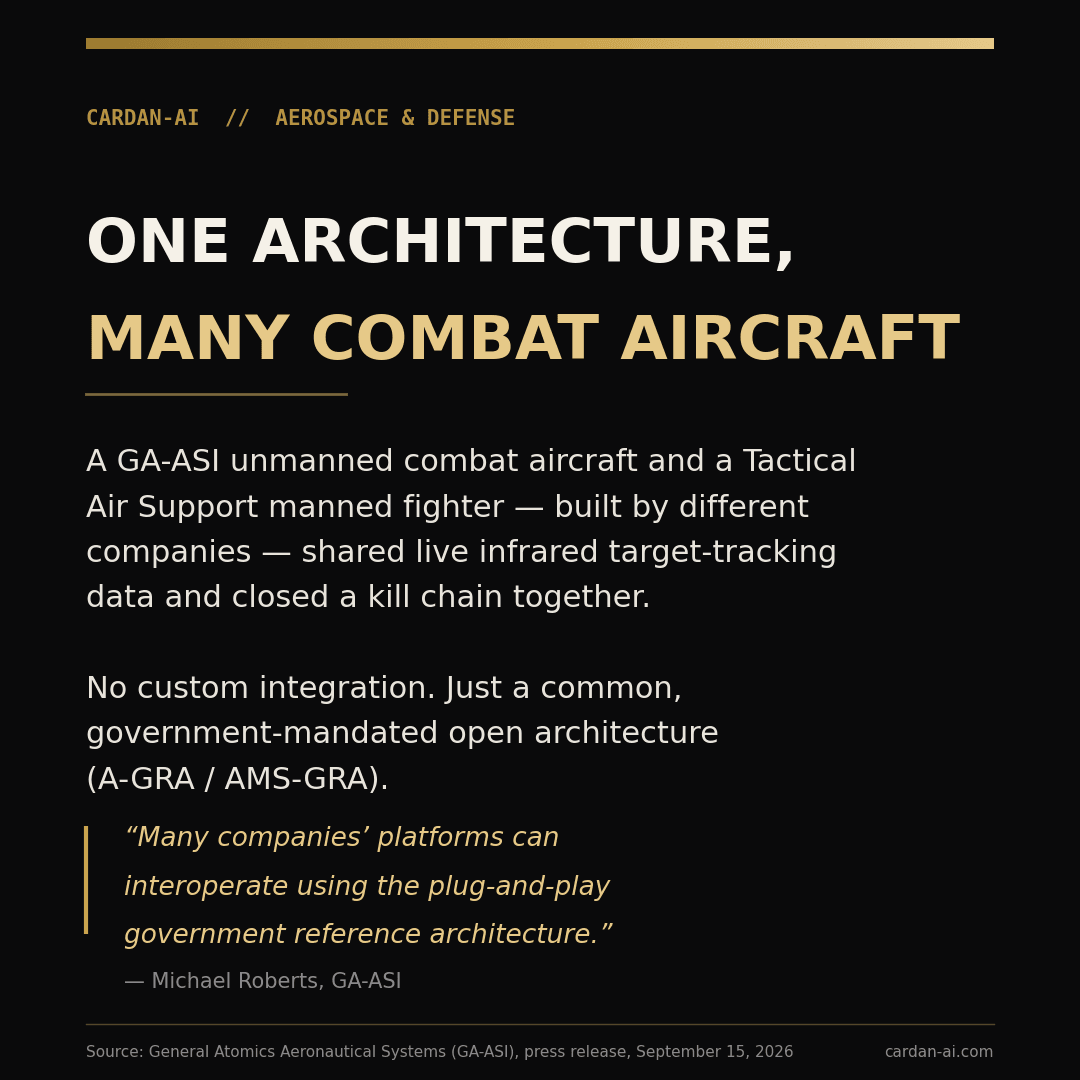
On September 15, GA-ASI and Tactical Air Support announced a July 21 flight test in which a GA-ASI Collaborative Combat Aircraft (CCA) test platform and Tactical Air Support's manned F-5 Advanced Tiger jointly tracked airborne targets using passive infrared sensors and closed a kill chain together, coordinating over a beyond-line-of-sight data link. Both aircraft ran software compliant with the Department of Defense's Autonomy Government Reference Architecture (A-GRA) and Agile Mission Suite (AMS-GRA) — open, published technical interfaces rather than either company's proprietary stack.
The headline claim from GA-ASI's Michael Roberts — that "many companies' platforms can interoperate using the plug-and-play government reference architecture ecosystem" — is worth taking seriously precisely because it should not, in the ordinary run of a competitive market, have needed a government mandate to happen. Interoperability is valuable: an autonomy stack that can plug into any airframe, and an airframe that can accept any vendor's autonomy stack, expands the addressable market on both sides and lets the Pentagon mix and match the best sensor, the best software and the best airframe rather than being locked into a single prime's bundled offering. So why did it take a reference architecture imposed by the buyer, rather than voluntary convergence among suppliers?
This is exactly the coordination problem that Joseph Farrell and Garth Saloner formalized in "Standardization, Compatibility, and Innovation" (RAND Journal of Economics, 1985). Their model shows that when a technology has network effects — value that depends on how many others use a compatible version — rational firms can get stuck in one of two failure modes. "Excess inertia" occurs when every firm would benefit from switching to a common, open standard, but no single firm wants to move first and bear the switching cost alone while rivals wait and free-ride; the market freezes on incompatible, proprietary standards even though everyone would be better off coordinating. The opposite failure, "excess momentum," happens when firms herd too quickly onto an early, possibly inferior standard to avoid being stranded outside the winning network.
Defense autonomy in 2026 was a textbook excess-inertia setup. Each CCA vendor — GA-ASI, but also Anduril, Boeing, and others bidding into the same program family — has a private incentive to keep its autonomy interfaces proprietary: proprietary integration is what lets a prime lock in follow-on sustainment contracts, upgrade cycles and spare-parts revenue once its aircraft is fielded. No individual company wanted to be the first to open its interfaces, because doing so unilaterally would mean handing competitors compatibility with your platform while gaining nothing if they kept theirs closed. That is precisely the situation in which Farrell and Saloner show voluntary coordination fails even when everyone agrees interoperability is efficient overall.
The resolution came from the one actor with both the incentive and the market power to force it: the buyer. The Pentagon is not a neutral bystander hoping vendors converge — it is the near-monopsony purchaser of combat aircraft, and it used that position to write A-GRA and AMS-GRA compliance into the CCA program's contractual requirements. In Farrell and Saloner's own vocabulary, this is a "sponsored" standard: rather than waiting for a decentralized tipping point, a single dominant actor picks the common architecture and makes participation a condition of doing business. It short-circuits the coordination failure at the cost of also determining, by fiat, which architecture wins — a choice the market itself never got to make.
That trade-off carries a real risk the model also flags: excess momentum in reverse. If A-GRA and AMS-GRA lock in technical choices made in 2024-2025 before the most capable AI-driven autonomy techniques matured, the Pentagon may have standardized early and could face costly revisions as the technology moves. This is not a hypothetical concern for industrial suppliers: any company designing a sensor, a datalink or an autonomy module to fit today's reference architecture is making a multi-year bet on a standard whose long-run technical adequacy is not yet proven, only politically settled.
For industrial decision-makers outside the U.S. defense-prime tier — including European suppliers eyeing the American CCA ecosystem, and defense ministries elsewhere weighing whether to import A-GRA-style mandates into their own procurement — the lesson generalizes beyond this one flight test. Whenever a market exhibits the ingredients Farrell and Saloner identify — real network benefits from compatibility, but private incentives that reward staying proprietary — voluntary standardization will systematically under-deliver relative to the efficient outcome, and only a buyer with enough concentrated purchasing power can break the deadlock. Recognizing which market a firm operates in — one where standards will emerge from negotiation, or one where they will be imposed from above — should shape how much a company invests in proprietary lock-in versus open compliance before that decision is made for it.
Analysis by
Cardan-AI Intelligence
Our research and analysis unit, dedicated to applied AI for business, industry and regulatory compliance.
Sources
- GA-ASI — GA-ASI and Tactical Air Support Showcase How Passive Sensing and Semi-Autonomous Aircraft Close Kill Chains Versus Adversaries
- AIAA — GA-ASI Flight Test Validates Open Architecture for Autonomous Drone Missions
- Farrell & Saloner — Standardization, Compatibility, and Innovation (RAND Journal of Economics, 1985)
Let's talk about your next competitive edge
Thirty minutes to identify the two or three use cases in your operations that pay for themselves within the first year.