
Autonomy re-prices force: the Pentagon's swarm milestone, read by an economist
The Pentagon just put Shield AI's Hivemind autonomy inside the LUCAS strike drone — one operator, a whole swarm, no GPS. The capability headline hides a pricing event: an autonomous 'loyal wingman' costs a quarter to a third of an F-35, and the same edge-autonomy cost curve is bending across aerospace, energy and O&G asset operations.
Earlier this month the U.S. Department of Defense integrated Shield AI's Hivemind autonomy software into the LUCAS one-way-attack drone: a single operator now supervises a coordinated swarm that flies and adapts in GPS-denied airspace, with no permanent radio link back to a control station. The defense press read it as a capability milestone. Read as an economist, it is something more useful — a pricing event.
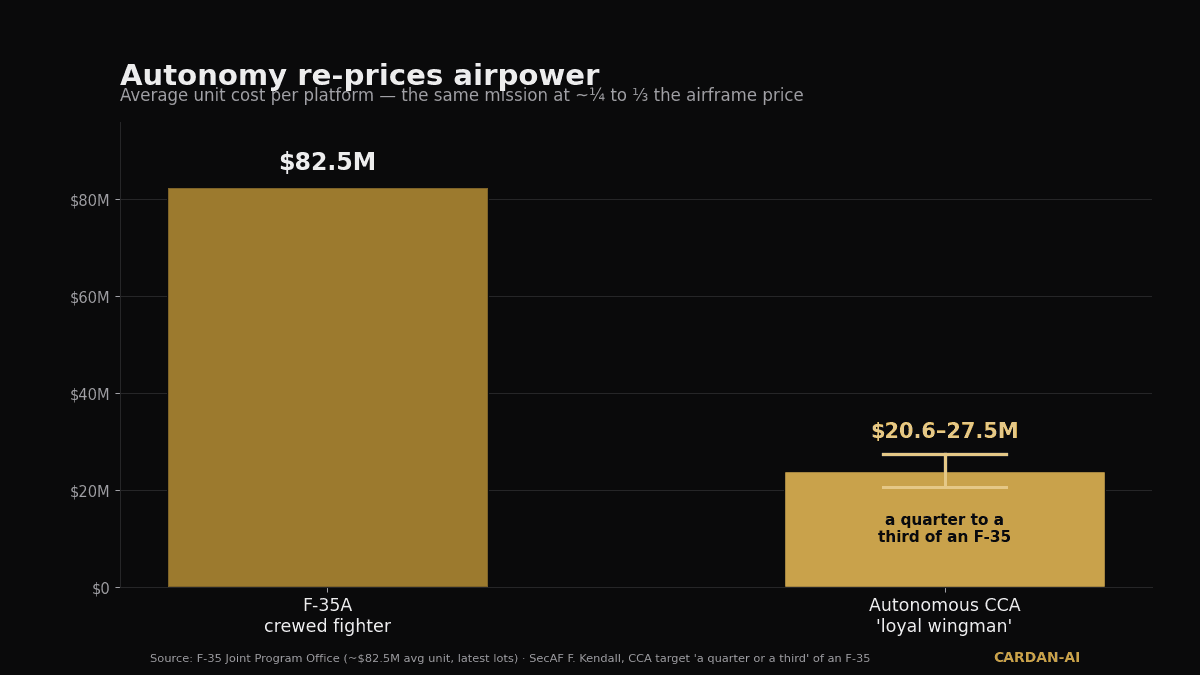
The doctrine driving it is what the U.S. Air Force calls 'affordable mass.' A crewed F-35A now averages about $82.5M per airframe (F-35 Joint Program Office). The autonomous 'loyal wingman' the Air Force is procuring is meant to cost a quarter to a third of that — roughly $20–27M per vehicle. As former Air Force Secretary Frank Kendall put it bluntly, 'you can't afford the Air Force' if you only buy exquisite platforms. Autonomy doesn't merely add a feature; it re-prices force, and it flips the scarce input from the airframe to the software that lets one human supervise many machines.
The technical detail that makes the economics work is the word 'edge.' Hivemind decides on board, locally, without a permanent link — which is exactly why it survives a jammed, GPS-denied environment. That is a different thing from teleoperation or a cloud model: the intelligence travels with the asset. Economically, edge autonomy changes what limits your coverage. Instead of being labour-limited — one operator, one platform, one pass — coverage becomes software-limited, and software scales at near-zero marginal cost.
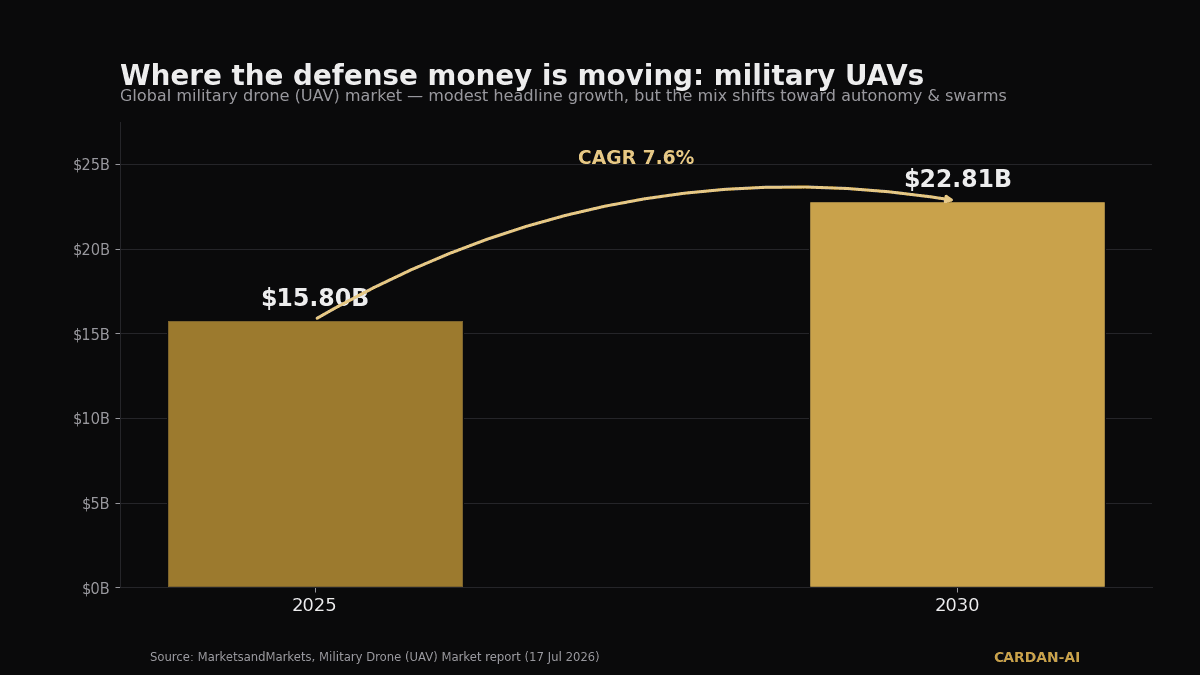
The market numbers understate the shift. The global military UAV market is forecast to grow only from $15.8B in 2025 to $22.81B by 2030 — a modest 7.6% CAGR (MarketsandMarkets). But a headline growth rate hides a change in mix: the spend is rotating from crewed platforms and remotely-piloted drones toward autonomous and swarming systems. The interesting variable isn't the size of the pie; it's which slice compounds.
This is where the story leaves the battlefield. The same cost curve is bending across the civil assets I work on with clients in aerospace, energy and oil & gas. Edge autonomy — a model that inspects, detects and decides locally — is what turns aircraft-engine and airframe inspection, pipeline and offshore-platform surveillance, or substation and grid monitoring from many human-supervised passes into one autonomous fleet. The value was never a sharper sensor; it is replacing labour-limited coverage with software-limited coverage, exactly as in the military case.
None of this removes the hard part, and the military example is instructive precisely because it made the hard part explicit. Pushing decisions to the edge forces a governance question before a technology one: which decisions are safe to delegate to an autonomous system, which stay firmly human-in-the-loop, what acceptance thresholds a model must clear before it flies, and how you version and re-qualify it as it improves. In regulated civil sectors that question maps directly onto safety cases and the EU AI Act's high-risk regime — the discipline of certification these industries already know well.
So the strategic question for a regulated operator is not 'should we adopt autonomy.' It is the mapping problem the Pentagon just solved out loud: recompute your unit economics — cost per inspection, per patrol, per monitored kilometre — for a world in which the platform, the truck or the crew is no longer the binding constraint, then build the governance that lets you deploy that autonomy inside a safety-critical process. The operators who do that arithmetic first won't just cut cost; they will re-price their own operations before their competitors realise the price has moved.
Analysis by
Cardan-AI Intelligence
Our research and analysis unit, dedicated to applied AI for business, industry and regulatory compliance.
Let's talk about your next competitive edge
Thirty minutes to identify the two or three use cases in your operations that pay for themselves within the first year.