
Why an uncrewed freighter is worth more than its standalone reliability: Markowitz and the defense logistics portfolio
Textron and Merlin just unveiled an uncrewed freighter for contested military logistics. Portfolio theory, as formalized by Harry Markowitz, explains why its value shouldn't be judged by its standalone reliability, but by what it adds to the existing mix of supply routes.
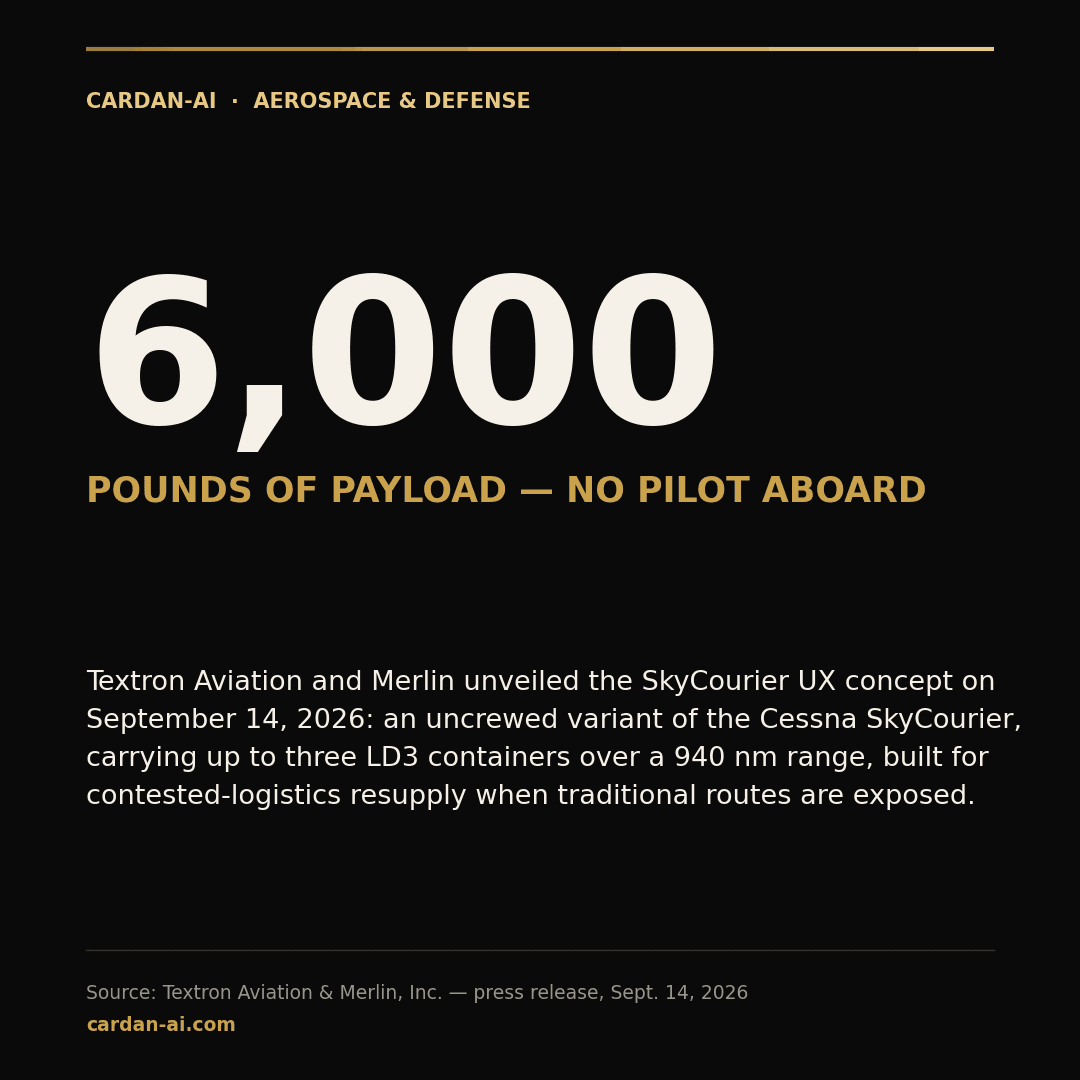
On September 14, Textron Aviation and Merlin unveiled the SkyCourier UX: a pilotless version of the Cessna SkyCourier able to carry roughly 6,000 pounds of cargo over 940 nautical miles and land on austere airstrips. Merlin Pilot, the autonomy software behind it, is described as aircraft-agnostic — the component that turns an already-certified freighter into a platform usable without a crew. The stated use case is explicit: resupplying forward bases, delivering repair parts and medical supplies, and offering an alternative when traditional routes — manned airlift, sealift, ground convoy — are constrained or exposed to an adversary.
The natural temptation is to evaluate this aircraft the way one would evaluate any new mode of transport: by its reliability, its cost per ton delivered, its availability compared to a C-130 or a road convoy. That is exactly the reasoning modern portfolio theory, formalized by Harry Markowitz in "Portfolio Selection" (The Journal of Finance, 1952), asks us to correct. Markowitz showed that a rational investor should not judge an asset by its own risk and return in isolation, but by its contribution to the risk and return of the entire portfolio — a contribution that depends on that asset's covariance with the others held, not on its standalone characteristics alone.
Applied to military logistics, the "portfolio" is the full set of resupply modes available to a deployed force: manned airlift, sealift, ground convoys, host-nation infrastructure. Each of these modes carries a distinct risk profile against contestation — air and surface-to-air defenses for manned aviation, mining and naval interdiction for sealift, ambush and political instability for ground convoys, GPS jamming and cyberattack for the systems all of them depend on to varying degrees. Markowitz's key point is that adding an asset whose risk is weakly correlated with those already held reduces total portfolio risk by more than that asset's standalone reliability would suggest — and this holds even if the new asset is, in isolation, no more reliable than the others.
The SkyCourier UX has a structural property that sets it apart from existing manned freighters, independent of its technical specifications: it removes a factor from the risk portfolio that neither sealift, nor convoys, nor conventional airlift can remove — crew lives. A manned aircraft shot down or captured in a contested zone imposes a political and human cost that, in practice, bounds the missions a command is willing to authorize; an uncrewed aircraft does not impose that same bound, which widens the envelope of missions actually flown rather than merely planned on paper. That is a source of decorrelation from existing modes, not just a source of additional reliability — and it is that kind of decorrelation, more than raw reliability, that Markowitz's efficient frontier rewards.
This reading has a direct consequence for industrial and military decision-makers evaluating this kind of program: the relevant question is not "is the SkyCourier UX more reliable than a C-130 or a road convoy?" but "how much does it reduce the total variance of the resupply system, given its low correlation with the risks already borne by other modes?" An aircraft with an individual failure rate identical to a manned aircraft's can still be worth more to logistics command, precisely because it fails for different reasons, at different times, against different threats.
This logic has a limit that Markowitz himself formalized: diversification only creates value if correlations are genuinely low, not merely assumed to be. If GPS jamming or cyberattack — vectors that already affect modern manned aviation and maritime navigation systems — hit an autonomous aircraft just as easily, the expected decorrelation evaporates and the new asset adds little to the portfolio, despite having no pilot aboard. Evaluating the SkyCourier UX therefore requires documenting precisely which threats its software autonomy remains exposed to, and which it genuinely sidesteps — a question about the resilience of Merlin Pilot itself, not just the absence of a crew.
For industrial suppliers watching this market from Europe or from other contested sectors — energy, critical infrastructure — the lesson extends beyond a single aircraft: a new logistics or production asset shouldn't be sold, or evaluated, on its standalone performance alone, but on its marginal contribution to the resilience of a system that already exists. That is a different, and often more persuasive, commercial argument than simply comparing costs or advertised availability rates on a spec sheet.
Analysis by
Cardan-AI Intelligence
Our research and analysis unit, dedicated to applied AI for business, industry and regulatory compliance.
Let's talk about your next competitive edge
Thirty minutes to identify the two or three use cases in your operations that pay for themselves within the first year.