
Defense venture capital: buying the option, not the technology
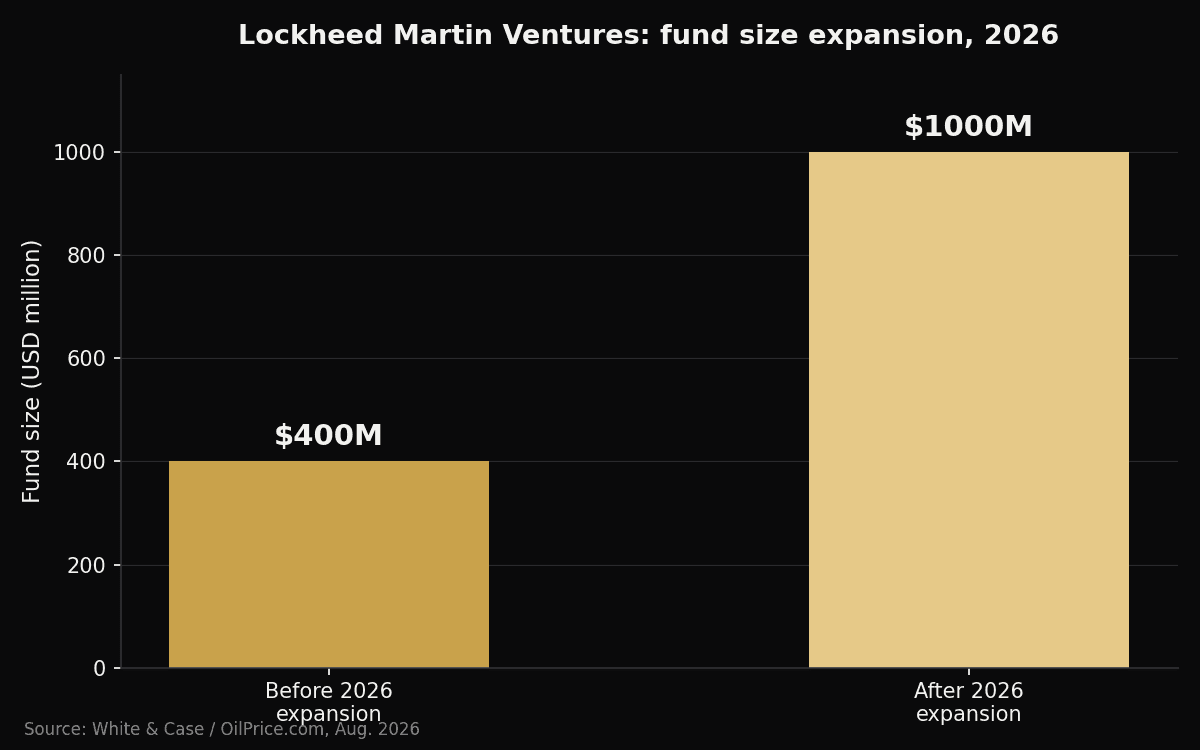
Defense-contractor-led funding rounds hit a record $4.1B in 2026, with Lockheed Martin growing its fund from $400M to $1B. An economist's read: minority corporate venture capital functions as a real option on still-uncertain technology (Kogut, 1991), cheaper than an outright acquisition or full in-house development.
Data cited in early August 2026 by law firm White & Case and analytics firm TMX VettaFi, relayed by OilPrice.com, points to a clear shift in how major defense primes approach AI and dual-use technologies. Defense-contractor-led funding rounds reached a record $4.1B in 2026. Lockheed Martin expanded its internal venture fund from $400M to $1B, earmarking at least $100M for UK and European start-ups. BAE Systems committed €50M to two European venture funds; Airbus is the anchor investor in a new €500M dual-use technology fund.
This capital is flowing into headline downstream raises: German drone maker Quantum Systems raised $1.2B at close to an $8B valuation; UK maritime defense specialist Kraken Technology, backed by Rheinmetall, raised $175M at a $1B valuation. In H1 2026, 42 defense M&A deals were completed globally, up 56% year-over-year — a sign that consolidation isn't limited to minority stakes.
The key point for an economist isn't the headline number but the form primes are choosing: a minority stake through a venture fund, rather than an immediate full acquisition or entirely in-house development. This form maps closely onto what Bruce Kogut formalized in his 1991 Management Science paper on joint ventures and co-investments as "options to expand and acquire": when a technology's future value is uncertain but waiting is competitively costly, a minority stake lets the investor observe, learn, and later exercise the option to acquire outright — or to exit — once technological uncertainty resolves.
For a group like Lockheed Martin, building in-house across the full range of relevant technologies (drones, cybersecurity, autonomous systems, space-based sensing) would mean a heavy, largely irreversible capital commitment on technology paths that are still moving. A minority stake across ten start-ups instead costs, for comparable total outlay, a fraction of the risk tied to a single, committed internal bet on one technical direction. It's a classic trade-off between investment irreversibility and the value of informed waiting — the same logic underlying real-options approaches to R&D (in the tradition of Dixit & Pindyck, applied here specifically to the corporate-venture vehicle rather than to an internal project's timeline).
Axel Belorde's line (TMX VettaFi) — "data is going to win wars" — points to a second mechanism: as value shifts from hardware toward software and data, the nature of the strategic assets primes need to control changes too. Those software assets are typically produced faster and cheaper by single-problem start-up teams than by internal divisions of large groups organized around multi-year programs. Corporate venture capital becomes a partial substitute for classic in-house R&D — a phenomenon the corporate-venturing literature has long documented (Chesbrough, 2002) but which takes on particular intensity in a sector, defense, where the public budget cycle itself remains largely unchanged.
One tension remains unresolved: the simultaneous rise in M&A (+56% year-over-year) suggests that, for some targets, the minority-stake observation phase is already hitting its natural limit — the option is being exercised. Primes that took an early position in start-ups like Quantum Systems or Kraken Technology hold an informational head start on target quality ahead of any acquisition negotiation, an advantage that players without upstream venture exposure don't share. Over time, this asymmetric access to information could further concentrate sector consolidation around the primes that turned their internal funds into a systematic exploration mechanism rather than a mere financial communications line.
Analysis by
Cardan-AI Intelligence
Our research and analysis unit, dedicated to applied AI for business, industry and regulatory compliance.
Let's talk about your next competitive edge
Thirty minutes to identify the two or three use cases in your operations that pay for themselves within the first year.