
Energy: the AI productivity paradox is back — believing in the catalyst without measuring it
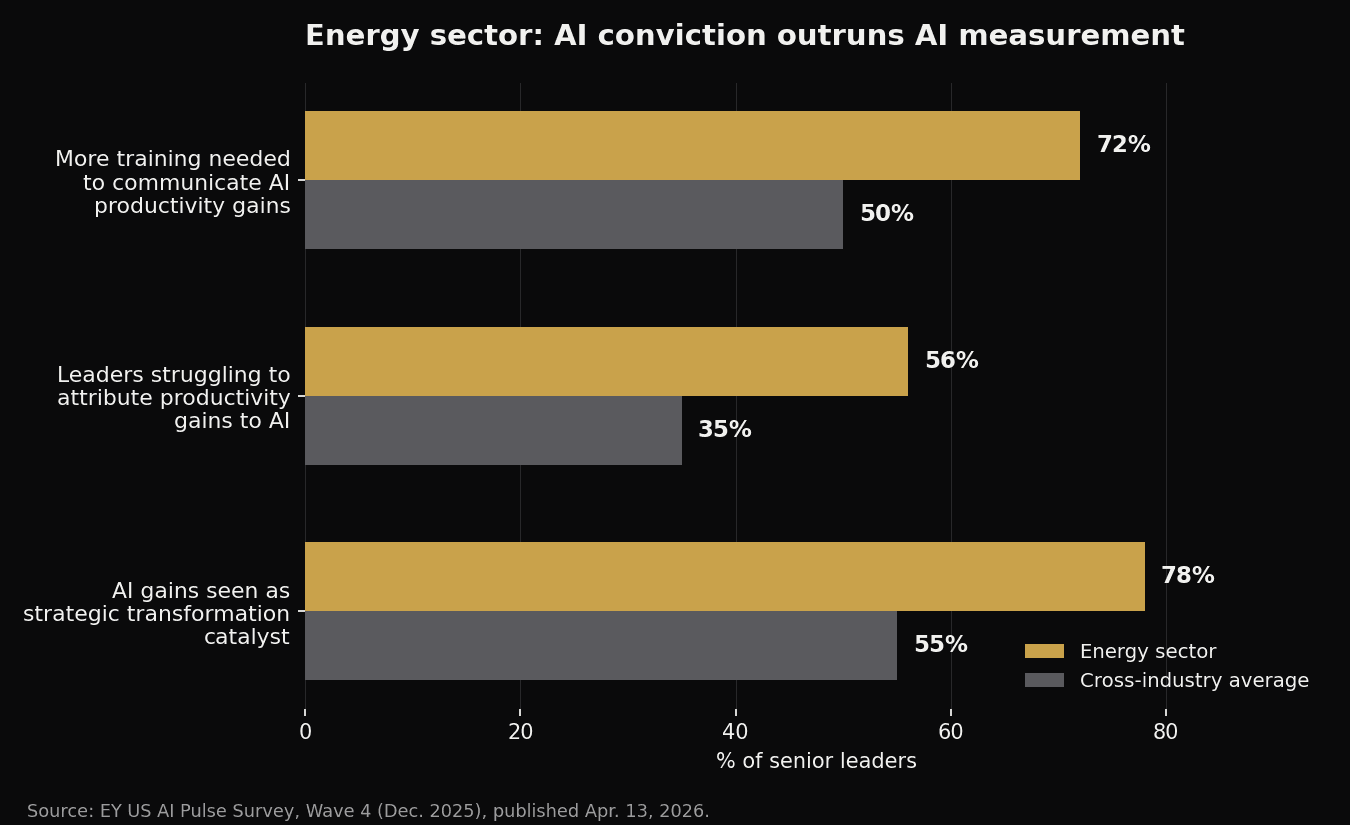
EY's 2026 US AI Pulse Survey puts energy at the top of strategic AI conviction (78% vs 55% cross-industry) and, simultaneously, at the top of the inability to measure its gains (56% vs 35%). Economist's read: this is not an inconsistency — it's Solow's paradox resurfacing in a new form.
EY's US AI Pulse Survey, the fourth wave of its survey of American executives, published April 13, 2026 from data collected in December 2025, sketches a singular profile for the energy sector. On organizational interest in responsible AI, the sector shows the sharpest increase of any industry — up 25 points since July 2024, to 72% — and among leaders who observed AI-linked productivity gains, 78% judge those gains to be catalyzing strategic transformation, versus 55% cross-industry. On this first axis, energy is the most convinced sector in the survey.
The same survey, applied to the same respondents, produces a result that inverts the reading: 56% of energy leaders say they struggle to directly link their productivity gains to their AI investments — versus 35% cross-industry, a 21-point gap. And 72% say they need more training to accurately communicate those gains, versus a 50% average. The sector most convinced of AI's value is, almost term for term, the sector least able to put a number on it.
This pattern is not new in the economics of innovation. Robert Solow stated it as early as 1987 about computing: "you can see the computer age everywhere but in the productivity statistics." Solow's paradox, later documented by Brynjolfsson (1993) as the "productivity paradox," rested on a timing mismatch: the gains of a general-purpose technology take a generation to show up in macroeconomic aggregates, as organizations reorganize their processes around it. What the EY survey reveals is not exactly that timing lag — it is its micro-organizational, present-day version: the inability to isolate, at the firm level, AI's causal contribution within a production system where multiple factors move at once (energy prices, prior automation, the sector's own heavy capex investment cycles).
The energy sector is structurally exposed to this attribution problem for a reason specific to its economics: it is a long-investment-cycle, capital-intensive industry where total factor productivity (TFP) is already blurred by commodity price swings and upstream field-decline effects. Isolating the AI-attributable share of a measured downstream productivity change — refining, distribution, grid operations — requires a counterfactual measurement methodology (before/after comparison with a control group, or a structural model) that few energy organizations put in place before launching their AI pilots.
The implication is not that energy leaders' conviction is unfounded — the fact that 78% of them (versus 55% elsewhere) link observed gains to strategic transformation suggests a real signal, not an artifact of enthusiasm. The implication is that this signal remains, at this stage, uninstrumented: without a causal measurement architecture built ahead of deployment, an organization can neither compare two competing AI projects on like-for-like grounds, nor defend internally the continuation of an investment it "knows" works without being able to prove it.
The governance risk is asymmetric. A leader who over-invests on unmeasured conviction risks having to justify, at the next budget cycle, a spend whose return remains anecdotal — a classic cutting argument for a CFO in a capex-tightening period. Conversely, a leader who under-invests for lack of quantified proof cedes first-mover advantage to a less rigorous but faster competitor. The way out of this dilemma is not to pick a side, but to shorten the lag between deployment and measurement: instrument every AI pilot with a pre-deployment baseline and a comparison group from launch, rather than attempting retrospective attribution once deployment has scaled.
For an AI consulting buyer in energy, the operational conclusion is direct: the near-term spending priority is not accelerating adoption — already the fastest in intent of any sector — but building, in parallel, the measurement infrastructure that will allow the next EY survey wave to distinguish confirmed conviction from merely repeated conviction.
Analysis by
Cardan-AI Intelligence
Our research and analysis unit, dedicated to applied AI for business, industry and regulatory compliance.
Let's talk about your next competitive edge
Thirty minutes to identify the two or three use cases in your operations that pay for themselves within the first year.