
The EU AI Act's energy rules: how a fixed compliance cost reshapes market structure
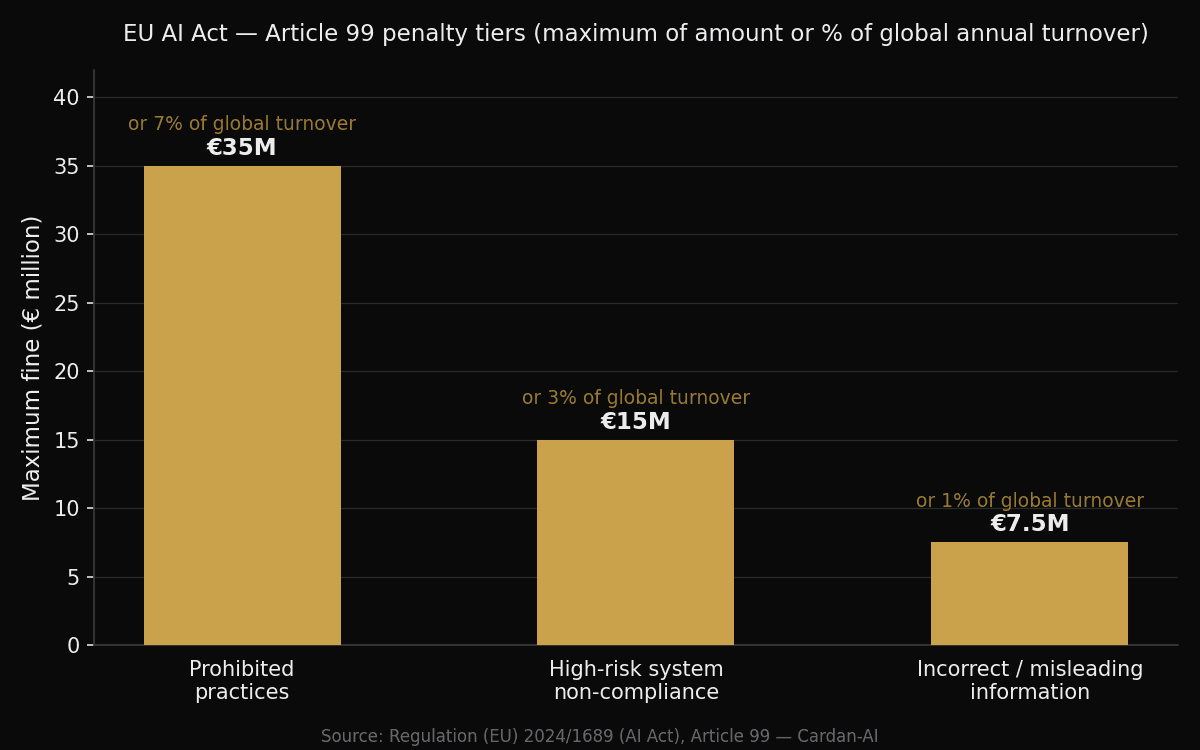
Since August 2, 2026, AI safety systems in critical energy infrastructure fall under the AI Act's high-risk obligations (fines up to €15M or 3% of global turnover). An economist's read: a largely fixed compliance cost that weighs proportionally heavier on mid-sized operators — regulation as a barrier to entry (Stigler, 1971).
August 2, 2026 marks a quiet but structural shift for Europe's energy sector: AI systems acting as safety components in the management of critical infrastructure — automated well control, pipeline SCADA, refinery safety, grid dispatch, fault detection — move from a voluntary declarative regime into the AI Act's high-risk obligations. The list compiled by Baker Botts in March 2026 is broad: it spans the full upstream-to-retail value chain, with the sole exception of systems dedicated purely to cybersecurity.
The economically interesting point is not so much the maximum fine — €15 million or 3% of global annual turnover, whichever is higher — as the nature of the compliance cost itself. A lifecycle-wide risk management system, documented human oversight, data governance, technical documentation, EU database registration: these are, for the most part, fixed costs, incurred once per system and per organization, largely independent of revenue volume or the number of sites involved.
George Stigler's theory of regulation (1971) showed that rules framed as protecting the public interest often function as a barrier to entry that benefits incumbents with sufficient scale. The mechanism is straightforward: a fixed compliance cost of several hundred thousand euros per system is a marginal fraction of an integrated major's revenue, but a material line item for an independent upstream operator or a regional grid operator — precisely the kind of actor the EU is otherwise trying to multiply to diversify supply sources.
This connects to more recent work on economies of scale in regulatory compliance: past a certain threshold, each additional AI system brought into compliance costs less than the first, because the governance infrastructure — risk committees, documentation templates, relationships with the notified body — is largely reusable. A group operating 40 sites amortizes this learning cost far faster than an operator running three.
The vendor contract audit Baker Botts recommends introduces a second asymmetry. Large SCADA integrators and control-system vendors can spread their own compliance costs across their entire installed base, giving them leverage over individual operators who lack the weight to negotiate compliance-warranty clauses — a dynamic close to Williamson's (1979) hold-up problem from asset specificity, here applied not to physical investment but to dependence on an already-installed industrial control software vendor.
The question facing energy operators is therefore not just "are we compliant as of August 2, 2026" but "does our per-system compliance cost fall with scale, and if not, should we pursue sector-wide pooling" — shared audits, a common notified body, a standardized technical documentation library across peer operators. This is precisely the kind of engagement where structured external support changes the cost trajectory rather than simply checking a regulatory box.
Analysis by
Cardan-AI Intelligence
Our research and analysis unit, dedicated to applied AI for business, industry and regulatory compliance.
Let's talk about your next competitive edge
Thirty minutes to identify the two or three use cases in your operations that pay for themselves within the first year.