
The EU AI Act's two-speed calendar: one deadline holds, the rest slipped — don't misprice the slip
On 2 August 2026 the EU AI Act's transparency and GPAI-enforcement obligations go live — with fines up to €15M or 3% of turnover — while the Digital Omnibus pushes the high-risk deadlines out to 2027-2028. Read as an economist, that postponement is a mispriced option, not relief — and regulated sectors already own the discipline to exploit it.
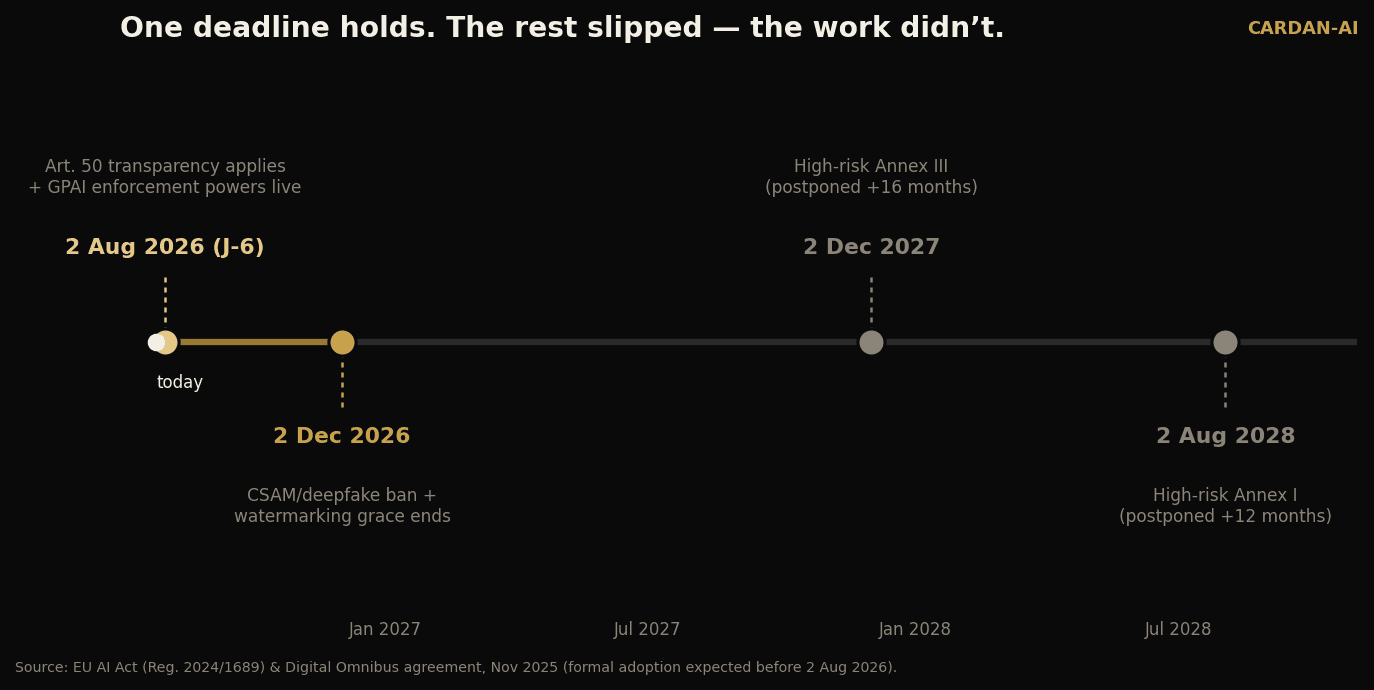
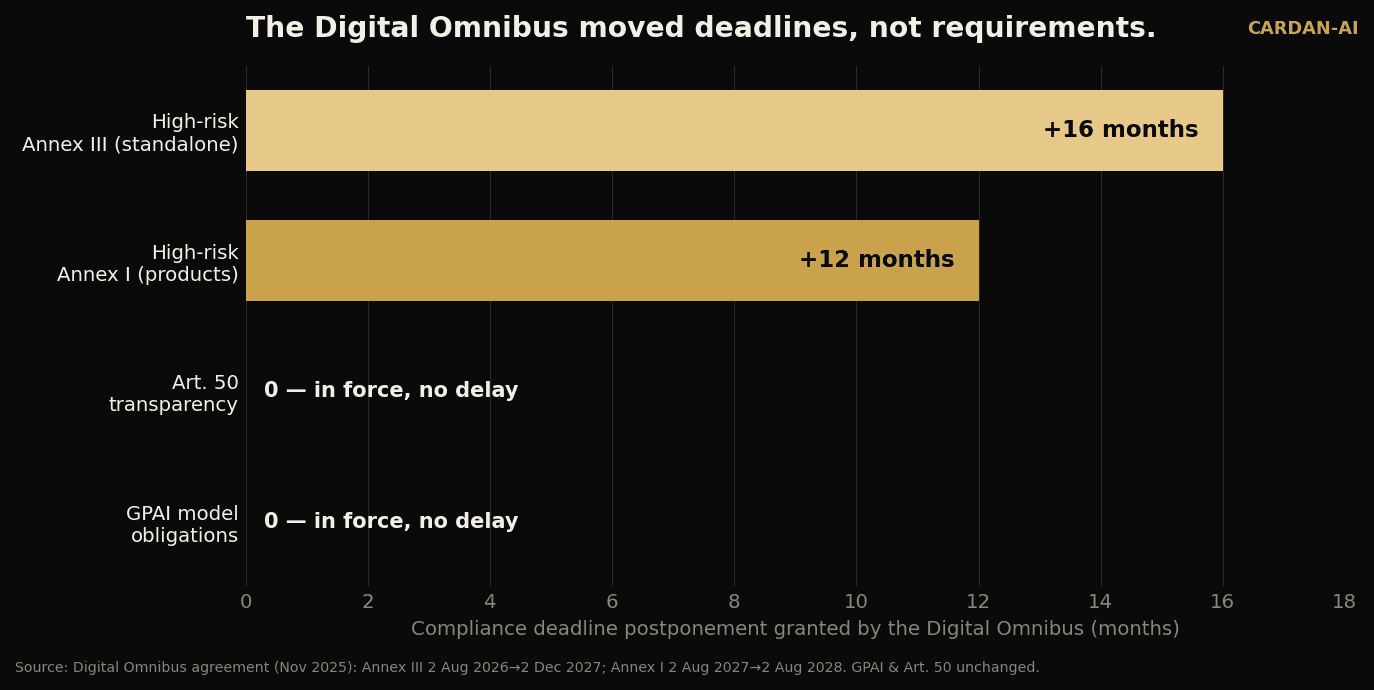
On 2 August 2026 — six days from now — the EU AI Act reaches its first hard enforcement milestone, and it is not the one most executives are watching. The high-risk deadlines everyone feared have just been pushed back by the Digital Omnibus agreement: standalone high-risk systems (Annex III) move from 2 August 2026 to 2 December 2027, and product-embedded high-risk systems (Annex I) from 2 August 2027 to 2 August 2028. The coverage has been almost uniformly one word: relief. Read as an economist, that reading is a mistake — and an expensive one for capital-intensive, regulated sectors.
Start with what does not move. From 2 August 2026, Article 50 transparency obligations apply: users must be told when they are interacting with an AI system, AI-generated images, audio and video must be machine-readable and labelled, and deepfakes depicting real people or events must be disclosed. On the same date, the Commission's enforcement machinery for general-purpose AI (GPAI) becomes fully operational — information requests, model access and recall powers — backed by fines of up to €15 million or 3% of global annual turnover, whichever is higher. The substantive GPAI obligations have applied since August 2025; what arrives now are the teeth.
So the first thing a board should notice is that the near-term obligations were never postponed. Any firm whose AI touches a customer interface, produces synthetic content, or is built on a general-purpose model — which now describes most deployments in aerospace, energy and oil & gas support functions — faces a live obligation in days, not years. The Omnibus relief applies to a different category of system than the one most enterprises are actually shipping first.
Now the postponement itself. Moving Annex III by sixteen months and Annex I by twelve is real, and it is not trivial. But a deferred deadline is not a reduced requirement. The conformity work — risk-management systems, data governance, technical documentation, human oversight, post-market monitoring — is unchanged. What changed is only when it must be finished. In finance terms, the Omnibus did not cut the liability; it extended the exercise date on an option the firm still has to fund.
And options get mispriced — systematically in one direction. The natural corporate response to 'the deadline moved' is to reallocate the budget elsewhere and revisit later. That treats postponement as a discount. It is not. It is time, and time has a value that depends entirely on what you do with it. Build the governance capability now, while there is no deadline pressure, and its marginal cost is low while its by-products — cleaner data pipelines, documented models, auditable decisions — start paying immediately. Build it in 2027 under a hard date, with scarce specialists and a compressed timeline, and you pay the classic deadline premium.
This matters more for aerospace & defence, energy and oil & gas than for almost anyone else, for a reason usually treated as a burden and in fact an advantage. These sectors already run exactly the discipline that high-risk AI conformity demands: safety cases, certification dossiers, traceability, version control, acceptance thresholds. High-risk AI governance is not a foreign process bolted on — it is the safety-engineering muscle these firms have had for decades, pointed at models. The firm that recognises this starts from a standing position, not a standing start, and can convert compliance into a procurement argument long before competitors treat it as a cost.
The practical sequence follows directly. First, map every AI use case against the actual calendar — what is exposed on 2 August 2026 (transparency, GPAI enforcement), what has genuinely slipped to 2027-2028 (high-risk), and what sits in the transitional windows (the CSAM/deepfake ban and the watermarking grace period, both closing 2 December 2026). Second, price the postponement as bought time, not saved money, and use it to build governance while the marginal cost is lowest. One caveat: the Digital Omnibus is a political agreement, with formal adoption expected before 2 August 2026, so the final text is worth tracking — but the near-term dates are set. The question for a regulated-sector executive this week is not 'how long can we wait' but 'what is it worth to be ready before we have to be.'
Analysis by
Cardan-AI Intelligence
Our research and analysis unit, dedicated to applied AI for business, industry and regulatory compliance.
Let's talk about your next competitive edge
Thirty minutes to identify the two or three use cases in your operations that pay for themselves within the first year.