
Europe's Innovation Act: after the capital, the market — what's really holding back AI scale-ups
In five weeks, the European Commission went from a €5 billion fund for tech scale-ups to a proposed horizontal law, the "Innovation Act." Paul Krugman's economies-of-scale trade theory explains why that sequence reveals an implicit diagnosis: Europe's problem isn't just available capital — it's the size of the market that capital gets deployed into.
Two announcements, five weeks apart, the same target. On August 4, 2026, the European Commission started the first investments of the Scaleup Europe Fund, which targets €5 billion in commitments for European growth-stage technology companies. On September 9, 2026, it proposed a "European Innovation Act," a horizontal piece of legislation billed as helping innovative European ideas "develop, finance and scale" to compete globally. Both target exactly the same population of companies — deep tech, AI included — through two levers of a different nature: a check, then a legal framework.
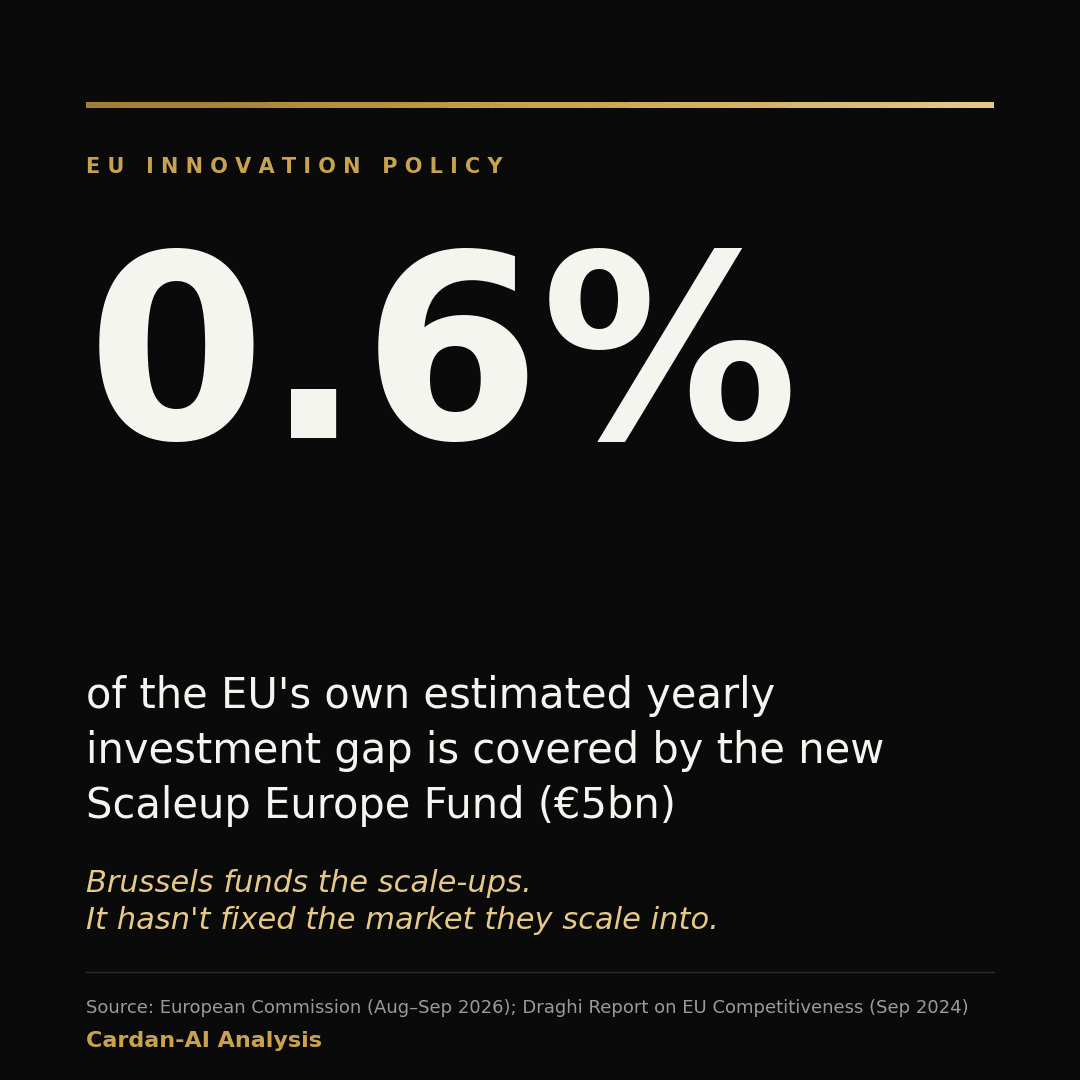
That is not a scheduling coincidence — it is an admission. The Draghi report on the future of European competitiveness (September 2024) had already laid out the diagnosis in precise terms: closing the investment gap with the US and China would require, the report estimated, an additional effort on the order of €750–800 billion per year — not just in R&D, but in deployment capacity at scale. Set against that figure, the Scaleup Europe Fund's €5 billion target represents less than 1% of the annual effort the Commission itself deems necessary. A fund of that size cannot, on its own, change the trajectory — and the Commission appears to know it, since it followed up five weeks later with a text that no longer talks about funding, but about the market.
Economist Paul Krugman formalized, in his foundational "new trade theory" work (1979–1980, which later earned him the 2008 Sveriges Riksbank Prize), why domestic market size matters independently of available capital whenever an industry combines high fixed costs with increasing economies of scale. Building an industrial-grade AI system — a trained model, compute infrastructure, regulatory compliance, a certification cycle for an aerospace or energy use case — entails a substantial fixed cost, largely independent of the number of end customers. A company that amortizes that fixed cost over a unified domestic market of several hundred million consumers or businesses reaches minimum efficient scale faster, at an identical venture-capital budget, than one that must duplicate tax compliance, insolvency law, labor law and sector certifications across 27 distinct national regimes.
That is precisely what the Innovation Act targets, at least in its stated intent: a more homogeneous single market for scale-ups, potentially a harmonized insolvency regime, a simplified European company statute — all frictions that, in Krugman's framework, are not solved by adding capital but by reducing fragmentation itself. Pouring €5 billion into companies that remain, structurally, below minimum efficient scale amounts to financing a cost disadvantage faster, not making it disappear. The funding-then-legislation sequence is only coherent if the second step actually tackles fragmentation — not merely compliance simplification, which is not the same thing.
For the sectors Cardan-AI works with — aerospace and defense, energy and oil & gas, manufacturing industry — this distinction has direct bearing. These are sectors with particularly high fixed development costs (certification, safety, scarce sector-specific data), where a European AI vendor that is sub-critical in addressable market size stays structurally disadvantaged against US or Chinese competitors operating natively on a larger domestic market — regardless of how much venture capital is available in Europe. A genuinely unified single market for industrial AI scale-ups would change the competitive picture; one more fund would not.
A reason for caution: the Innovation Act is only a proposal as of September 9, 2026, and the most recent precedent — the "Digital Omnibus" on AI, which entered into force on July 27, 2026 — shows that horizontal EU legislation often ends up simplifying regulatory compliance rather than genuinely unifying the underlying market (insolvency regimes, taxation and labor law remain, for the most part, national competences). The Parliament–Council codecision procedure typically takes 12 to 24 months before final adoption, and how much of Krugman's scale effect actually materializes will depend on trade-offs that haven't been made yet.
For a European industrial or energy executive evaluating a domestic AI vendor, the practical takeaway is twofold: track the Innovation Act as a leading indicator of a potential loosening of the single market for European tech scale-ups, but don't base a sourcing strategy today on its swift adoption — the fund has been operating since August 4; the law has yet to be written.
Analysis by
Cardan-AI Intelligence
Our research and analysis unit, dedicated to applied AI for business, industry and regulatory compliance.
Sources
- European Commission — "Commission proposes new European Innovation Act," digital-strategy.ec.europa.eu, September 9, 2026
- European Commission — "Scaleup Europe Fund to start making investments," digital-strategy.ec.europa.eu, August 4, 2026
- European Commission — "Commission starts enforcing AI Act rules and new transparency requirements on 2 August," July 31, 2026
Let's talk about your next competitive edge
Thirty minutes to identify the two or three use cases in your operations that pay for themselves within the first year.