
Critical-minerals exploration as an under-provided public good: what the EIB report reveals about AI sovereignty's blind spot
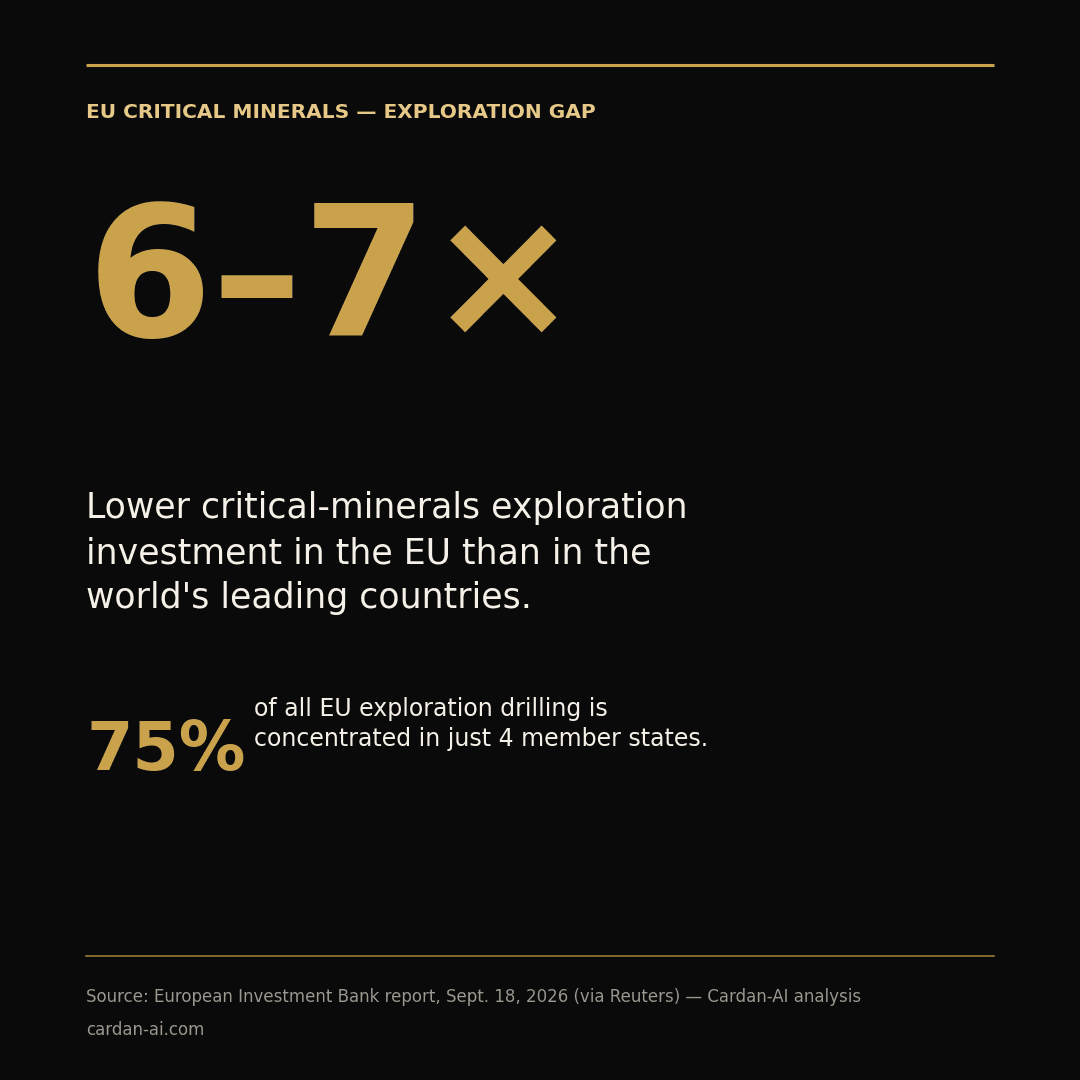
An EIB report published September 18 quantifies the EU's mineral-exploration gap: investment 6-7 times below world leaders, 75% of drilling concentrated in 4 countries. Samuelson's (1954) public-good framework explains why this underinvestment is structural, not accidental.
The European Investment Bank published a report on September 18 that quantifies, with unusual precision, the scale of Europe's lag in critical-minerals exploration: EU exploration investment runs six to seven times lower than in the world's leading countries, and 75% of all exploration drilling carried out across the Union is concentrated in just four member states. The finding deserves attention beyond its geological dimension, because exploration is the first — and least visible — step in the value chain that feeds raw materials into the semiconductors, permanent magnets and batteries underpinning AI's physical deployment.
The most useful economic lens here is not underfunding per se, but the nature of the good involved. The geological data produced by an exploration campaign — subsurface mapping, drilling results, deposit characterization — is largely non-rival (one firm's use of it does not preclude another's) and, once published by a national geological survey, non-excludable. That is precisely Paul Samuelson's (1954, 'The Pure Theory of Public Expenditure') definition of a public good: one whose collective production benefits every economic agent in the internal market, regardless of who funded it.
Samuelson's classic result is that under decentralized funding — where each jurisdiction finances its own provision — collective investment remains structurally below the social optimum: a member state that funds an exploration campaign internalizes only the share of the benefit accruing to it (local tax revenue, employment), while a substantial share of the value — secure raw-material access for European industry as a whole, regardless of where a firm is based — spills across the single market. Twenty-seven states, each rationally underinvesting in a good whose return it only partially captures: that is exactly the mechanism the EIB report documents, without naming it as such.
The 75% concentration in four countries confirms this diagnosis rather than contradicting it. That concentration does not reflect an efficient allocation based on current geological potential; it reflects the legacy of national geological surveys built during earlier phases of industrial or mining policy — path dependency rather than a market optimum. States without a historically well-resourced geological survey have no individual incentive to close that gap today, since the benefit of doing so would flow to the entire European industrial value chain, exploration included.
This diagnosis complements, without repeating, the one we drew on September 15 from Deloitte's Midyear Outlook on forging and refining capacity as a bottleneck for defense AI (Hirschman's framework and Farrell & Newman's weaponized interdependence): that piece concerned the midstream — processing minerals already extracted. The EIB report pushes the problem upstream, to the exploration stage itself, where geological uncertainty is greatest and where the return horizon — often exceeding a decade before first extraction — discourages purely national, short-term financing.
The policy implication follows directly from the theoretical framework: the standard fix for public-good underprovision is not to exhort each state to spend more, but to match the scale of funding to the scale of the spillover — either through centralized EU-level provision (a pooled European geological survey, on the model of what the European Space Agency does for earth observation), or through inter-state transfer mechanisms that internalize the cross-border externalities. The Scaleup Europe Fund and the European Innovation Act, which we analyzed on September 13 through the lens of Krugman's new trade theory, sit on the same collective-investment-gap logic — but mineral exploration is a particularly clean case, since the good in question (geological data) is almost a textbook public good, which makes the market failure easier to diagnose and, in principle, easier to fix with targeted action.
For industrial clients — aerospace, defense, energy — the operational lesson is distinct from the policy question: don't wait for the EU to solve this public-good problem before acting. Firms structurally dependent on these minerals for their own AI and electrification roadmaps (magnets, batteries, semiconductors) have a direct interest in funding or co-funding private exploration campaigns or vertically integrated joint ventures, rather than betting on a European domestic-extraction timeline (10% by 2030 under the Critical Raw Materials Act) that, at the current pace of upstream underinvestment, looks optimistic.
Analysis by
Cardan-AI Intelligence
Our research and analysis unit, dedicated to applied AI for business, industry and regulatory compliance.
Let's talk about your next competitive edge
Thirty minutes to identify the two or three use cases in your operations that pay for themselves within the first year.