
AUTOWARCOM: why the Pentagon is recombining decision and control over military AI
The creation of a four-star command over military autonomy and the 20% cut to general officer billets, announced the same day by Pete Hegseth, are the same economic decision seen from two angles. Fama & Jensen's (1983) separation of decision management and control explains why — and what it means for suppliers and decision-makers.
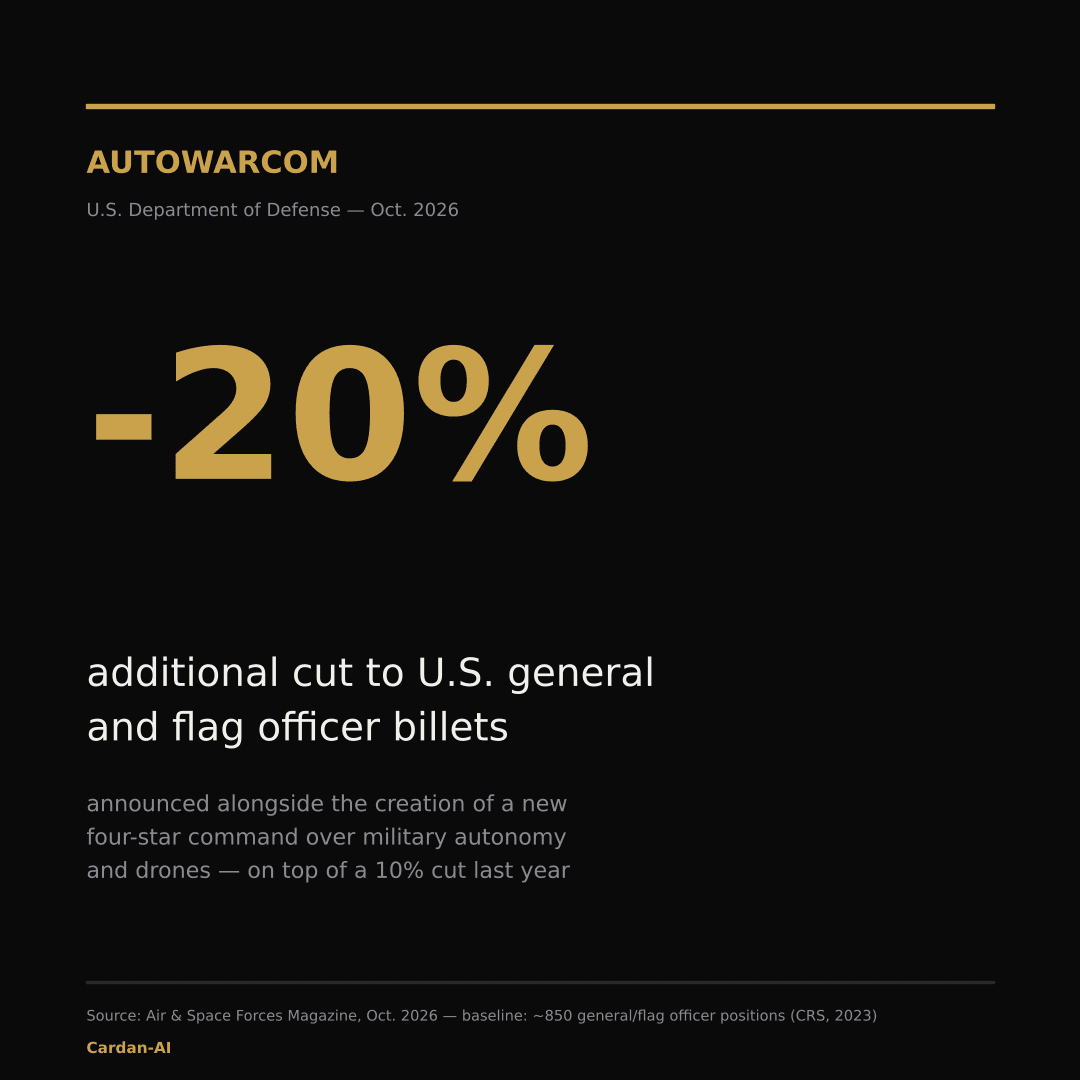
On September 30, US Defense Secretary Pete Hegseth announced two seemingly separate decisions that are, in fact, tightly linked. First, the creation of an Autonomous Warfare Command: a four-star combatant command with “service-like authorities” over the design, development and fielding of drones, military AI, and command-and-control systems, targeting full standup by October 1, 2027 (pending a House vote — the Senate has already cleared the provision in committee). Second, a further 20% cut to general and flag officer billets, on top of a 10% cut last year — against a baseline of roughly 850 positions counted by the Congressional Research Service in 2023.
Trade coverage rarely reads these two announcements together, treating them as separate stories — a capability restructuring on one side, a headcount reduction on the other. Yet they are the same economic decision seen from two angles: a reallocation of decision rights inside a large organization. The sharpest lens for reading it is the one Eugene Fama and Michael Jensen offer in “Separation of Ownership and Control” (Journal of Law and Economics, 1983).
Fama and Jensen break any organizational decision into four functions: initiation and implementation (what they call “decision management”) on one side, ratification and monitoring (“decision control”) on the other. Their core result: large, complex organizations typically separate these two blocks — one agent proposes and executes, another (a board, a hierarchy, a regulator) ratifies and monitors — because the separation limits any single agent's ability to capture value for itself. But that separation has a cost: it assumes outside controllers can evaluate decisions at reasonable cost. When a decision is too specific, too fast-moving, too dependent on tacit, local information for an outside party to ratify efficiently, the theory predicts the opposite: management and control recombine under a single, smaller, more concentrated agent who directly bears the consequences of its own choices.
Today's Pentagon fits the first case for autonomous systems: each service (Air Force, Army, Navy, Marine Corps, Space Force) runs its own drone and AI programs through scattered program offices (“decision management”), while ratification and monitoring are themselves split across service staffs, the Office of the Secretary of Defense, and Congress (“decision control”). That architecture is efficient for generic, slow-moving decisions (a tank, a carrier) where several layers of review can check the work cheaply. It becomes costly when the doctrine-hardware-software loop needs to iterate fast — exactly what the interim “Project Agincourt” effort implicitly acknowledges, by trying to pair operators and entrepreneurs outside the usual approval chains.
Creating a single four-star command with “service-like authorities” across the full chain — design, development, fielding — is precisely what Fama-Jensen theory predicts in this case: a recombination of management and control into one agent, more directly accountable for the outcome, for decisions that have become too idiosyncratic for the existing approval chain to handle.
The 20% cut to generals and admirals — which, on the CRS's roughly 850-position 2023 baseline and the two cuts stacked since then, would put the headcount in the order of 610-650 positions (an indicative, unofficial estimate) — follows from the same mechanism, viewed in mirror image: an architecture with fragmented decision rights needs many intermediate layers to ratify and monitor. Concentrating decision rights in a specialized command mechanically reduces the number of checkpoints needed elsewhere in the hierarchy.
For industrial suppliers (integrators, AI vendors, drone makers) and for European decision-makers tracking this file, the direct implication is the emergence, by 2027, of a single, powerful buyer-operator for US military autonomy, replacing what used to be a multi-service, multi-entry-point sales motion. That is a commercial simplification over time, but also a concentration risk: a single point of refusal or delay can now close off the entire US autonomy market, where convincing several services independently used to be the norm.
Three operational recommendations: (1) map today which of your current programs sit inside the management/control split that the Autonomous Warfare Command will absorb, to anticipate who the 2027 counterpart will be; (2) engage with Project Agincourt now, an early-access channel explicitly open to entrepreneurial companies, rather than waiting for the formal standup; (3) watch the House vote on the FY2027 NDAA as the binary trigger — without it, today's fragmented decision rights remain the rule, and the multi-service engagement model stays fully relevant. One economist's caveat to close: concentrating decision rights only lowers agency costs if the new command's own incentives are well specified — otherwise the residual-loss problem isn't solved, just moved up one level.
Analysis by
Cardan-AI Intelligence
Our research and analysis unit, dedicated to applied AI for business, industry and regulatory compliance.
Sources
Let's talk about your next competitive edge
Thirty minutes to identify the two or three use cases in your operations that pay for themselves within the first year.