
Who Pays for AI's Grid? FERC Picks Price Over Rules
FERC's June 18, 2026 order (RM26-4-000) ends decades of socialized grid interconnection costs, forcing AI data centers to internalize the marginal cost they create — a textbook case study in choosing price over rules to address an externality.
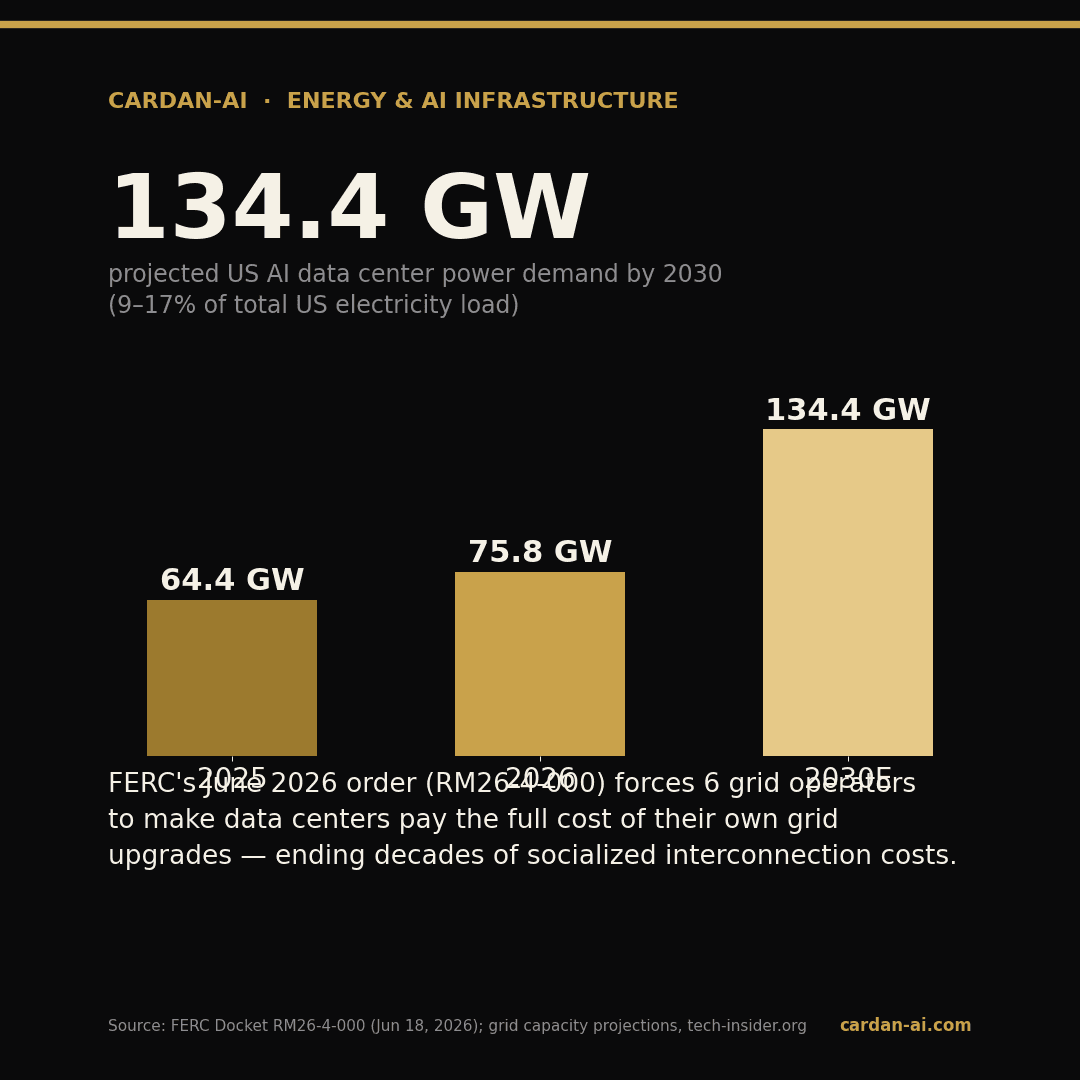
On June 18, 2026, the Federal Energy Regulatory Commission unanimously adopted an order that looks technical and minor at first glance — a show-cause order asking six regional grid operators (PJM, MISO, SPP, CAISO, ISO New England, NYISO) to revise their interconnection tariff rules within sixty days. What the order actually does is a textbook case of economic regulatory design applied to AI infrastructure.
The underlying economic problem is a classic one. For decades, US interconnection tariffs have socialized part of the cost of grid upgrades triggered by a new large consumer across the entire ratepayer base in a given zone. That mechanism, designed for gradual, predictable load growth, becomes a collective-action problem once a small number of actors — data centers built for AI training and inference — trigger upgrade needs of unprecedented scale. The true marginal cost of their interconnection is hidden, socialized; it is an externality in the full sense of the term: the data center does not bear the full cost it imposes on the grid.
Ronald Coase's framework (1960) reminds us that an externality does not necessarily call for a ban — it calls for clarifying property rights, here the right to grid capacity, so that the marginal cost is borne by whoever causes it. That is exactly what the FERC order does: by imposing the "cost causation" principle on new large-load interconnections, it reassigns the marginal congestion cost to the data center that triggers it, rather than to the broader ratepayer base.
What makes the case interesting for an economist is the choice of instrument. Facing an externality, regulatory theory (Weitzman, 1974, "Prices vs. Quantities") distinguishes two families of instruments — a price instrument (charge the marginal cost, here via the interconnection tariff) or a quantity/rule instrument (cap, ban, or ration new connections). FERC unambiguously picks the price instrument: no power cap, no ban on new data centers — only a requirement of cost truth.
This choice contrasts sharply with the EU's approach to critical infrastructure under the AI Act, built around compliance and audit obligations — a rule instrument, not a price one. The two frameworks address different externalities (systemic risk on the EU side, grid congestion on the US side), but the instrument gap illustrates a broader transatlantic divergence in how AI is made to bear the real cost of its externalities: economic price regulation on one side of the Atlantic, regulatory compliance on the other.
For energy and O&G players, the direct implication is financial and strategic: a data center internalizing the true cost of its interconnection changes its siting calculus — it becomes rational to seek sites with already-robust grid capacity, or to secure dedicated generation (Microsoft's, Amazon's and Meta's direct power deals with nuclear capacity are early instances of exactly this), rather than rely on a connection subsidized by the broader ratepayer base. Energy-adjacent land near spare grid or generation capacity — and the producers who hold it — mechanically gains negotiating value.
The limit of the exercise, at this stage, is implementation uncertainty: the deadline for revised tariff filings fell around August 17, 2026, and nothing guarantees uniform application across the six grid operators, each retaining latitude in technically defining which costs are attributable to the data center. A price instrument is only as effective as the price's fidelity to true marginal cost; how well each revised tariff translates that principle technically will determine whether the FERC order genuinely changes incentives or remains a signal without second-round effects.
Analysis by
Cardan-AI Intelligence
Our research and analysis unit, dedicated to applied AI for business, industry and regulatory compliance.
Let's talk about your next competitive edge
Thirty minutes to identify the two or three use cases in your operations that pay for themselves within the first year.