
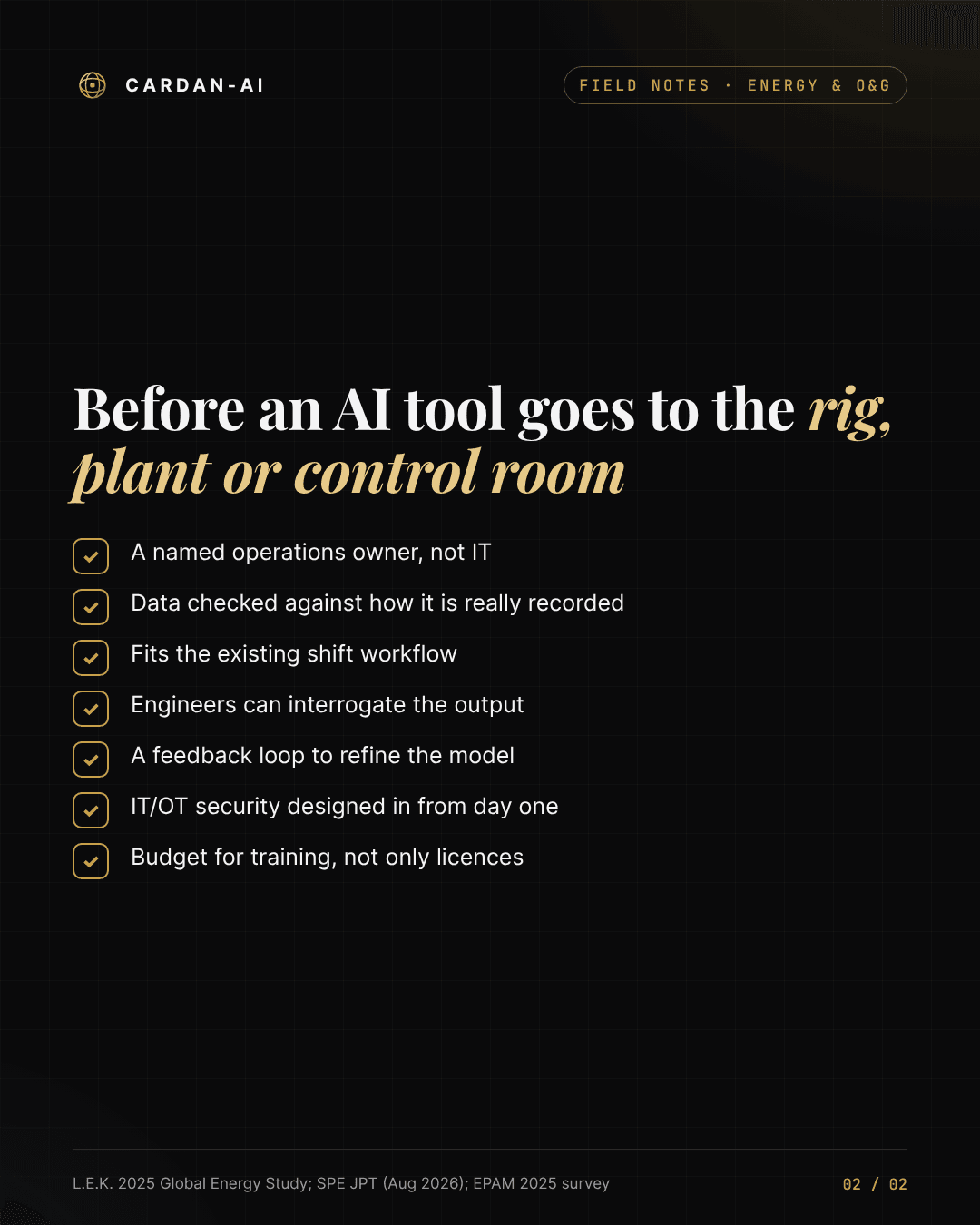
Why energy AI stalls at the last mile: seven checks before it reaches the asset
L.E.K. finds only 44% of oil and gas respondents fully realise AI's value today, and more than a quarter call implementation the clearest bottleneck. Operators should treat the handover to operations as the project.
Key takeaways
- 44% of oil and gas respondents say they fully realise AI's value today; 78% expect to in ten years (L.E.K.).
- More than one quarter name implementation as the clearest bottleneck.
- 54% of energy respondents believe their workforce lacks the skills to deploy generative AI (EPAM, via SPE JPT).
- The fix is organisational: ownership, data, workflow fit, trust and security.
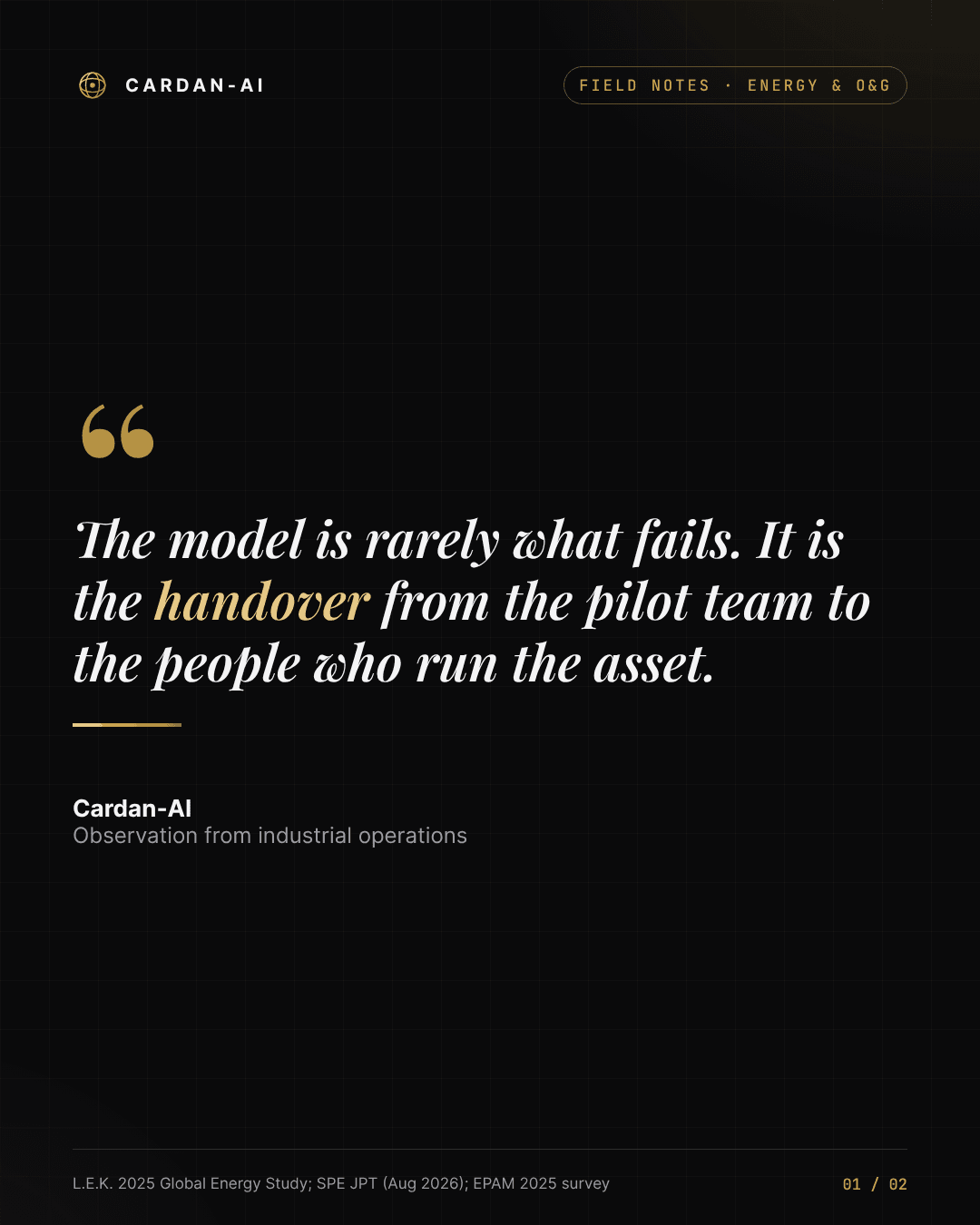
What we see on shop floors and operating sites is consistent: the model is rarely what fails. The failure happens at the handover from the pilot team to the people who run the asset.
L.E.K. Consulting's 2025 Global Energy Study, based on more than 300 senior executives and over 25 interviews, finds that 44% of oil and gas respondents (49% of utilities) believe their organisation is fully realising AI's value today. Over a ten-year horizon the figures rise to 78% and 83%. Operators expect the value, but most do not yet capture it.
The same study shows where adoption sits. More than half of oil and gas respondents use AI for market-sentiment modelling and performance analytics, which support trading, planning and scheduling. Field-level uses, such as virtual flow metering and real-time drilling optimisation, are less widespread. Analytical tools sit close to the office; field tools sit close to the asset, where integration is harder.
Barriers named by L.E.K. are mostly not about algorithms: limited or inconsistent data, incomplete workflow integration, gaps in ownership and oversight, missing feedback loops, and difficulty quantifying return. More than one quarter of respondents call implementation the clearest bottleneck.
An SPE Journal of Petroleum Technology article by Mohamed Alzaabi (7 August 2026) describes the same last mile. Production systems must run continuously on incomplete data, across many assets, often without the original development team. Seismic, well-log, SCADA, drilling and maintenance data were often never built to work together, and experienced engineers are reluctant to rely on models they cannot interrogate.
People and security add to the load. The article cites an EPAM 2025 survey in which 54% of respondents believe their workforce lacks the skills to deploy generative AI effectively, and 40% of staff on average will need upskilling within 18 months. It also cites GETI/Airswift data showing professionals aged 45 and over make up 48% of the traditional energy workforce, against 19% aged 25 to 34, so knowledge transfer matters. From DNV's 2025 survey of 375 respondents, 57% say their OT defences still lag behind IT.
The economic mechanism is simple. A model has near-zero marginal cost to copy; an operating change does not. Every site adds integration, training, validation and cyber work. Firms that budget for the model and not for the handover pay for the pilot and never collect the value.
By type of actor: operators should put the budget and ownership in operations; service companies should sell integration and support as part of the product; and data and IT teams should treat OT security as a design constraint, not a late audit.
Limits. L.E.K. reports executive perceptions, not measured returns, and the SPE article is an expert's synthesis. The seven checks are a practitioner's filter, not a guarantee, and some pilots should simply be stopped.
Our recommendations
- 1
Put an operations owner on every initiative
COO or asset manager, within 30 days: each AI project has a named operations owner who signs the target. IT and data teams support.
- 2
Audit the data as it is really recorded
Data and operations leads, before build: test the inputs against how shifts actually log them across SCADA, maintenance and drilling systems.
- 3
Design for the shift workflow and for scrutiny
Project leads: embed the tool in the existing routine and favour outputs engineers can interrogate, such as models that combine physics and machine learning.
- 4
Fund the handover in the same budget line
CFO and COO: include integration, training and change management in the business case, and release funds site by site.
- 5
Design IT/OT security in from day one
CISO and OT leads: segment networks and monitor OT before an AI tool connects to the asset.
Analysis by
Cardan-AI Intelligence
Our research and analysis unit, dedicated to applied AI for business, industry and regulatory compliance.
Let's talk about your next competitive edge
Thirty minutes to identify the two or three use cases in your operations that pay for themselves within the first year.