
Distribution Settled, Profits Relocated: What Christensen Says About the Rush on GenAI.mil
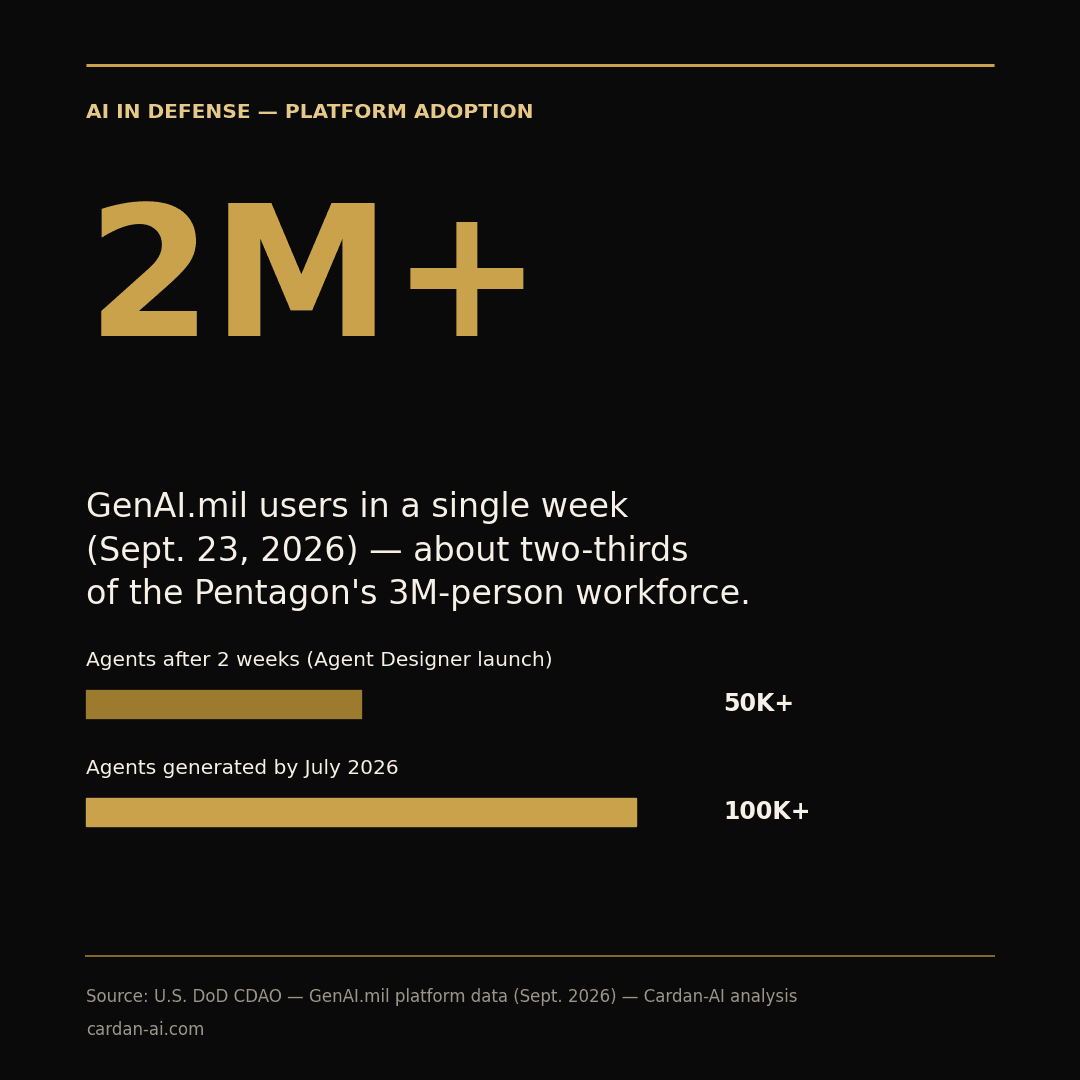
GenAI.mil topped 2 million users in a week and generated over 100,000 autonomous agents by July 2026. Christensen's law of conservation of attractive profits explains why the real economic battle is no longer about model access.
In the week of September 23, 2026, the U.S. Department of Defense's GenAI.mil platform crossed 2 million active users — roughly two-thirds of the department's 3 million personnel. Three commercial models coexist on it: Gemini for Government (Google), ChatGPT Mil (OpenAI), and Grok for Government (xAI). More telling still, the platform had generated over 100,000 autonomous agents by July 2026, up from more than 50,000 in just the first two weeks after Gemini's Agent Designer launched.
What these figures describe is not merely fast adoption: it is a base-model market that has effectively settled. Three vendors now split the "front door" into U.S. defense, each nearly interchangeable for everyday tasks — drafting, summarizing, conversational queries. This pattern echoes a mechanism Clayton Christensen and Michael Raynor formalized in 2003 in "The Innovator's Solution" as the law of conservation of attractive profits: when a link in the value chain standardizes and becomes "good enough" to be interchangeable, the margin does not vanish — it migrates to the adjacent link that remains non-standardized and proprietary.
Christensen illustrated the mechanism with the PC: commoditized, IBM-compatible hardware interchangeable across manufacturers pushed profit toward the microprocessor (Intel) and the operating system (Microsoft) — the layers that stayed differentiated. Cloud computing repeated the pattern a decade later: raw compute commoditized while value concentrated in managed services and orchestration layers. GenAI.mil is following the same trajectory, only far faster: the model layer commoditized within quarters, not years.
The strategic implication is direct for vendors and integrators orbiting U.S. defense — and, by extension, for any aerospace and defense ecosystem watching this market as a leading indicator. Competing with the three model vendors on their own turf no longer makes economic sense: distribution there is already settled. The available value sits in the layers not yet standardized — secure integration into classified information systems, sensitive data connectors, and above all agent-evaluation frameworks, which must certify the reliability of tens of thousands of autonomous agents before they are trusted to act on live workflows.
That last point is precisely where today's bottleneck sits. The pace of agent creation (100,000-plus within months) almost certainly outstrips the capacity of governance and evaluation frameworks to validate them one by one. In Christensen's terms, that is the very definition of the "not yet good enough" link — and it is there, not in model access, that the constraint — and the available economic margin — now resides.
One caveat is warranted: 2 million users in one week measures adoption, not depth of use. The figure says nothing about actual usage intensity, retention, or workflow-level productivity gains — a distinction Cardan-AI has flagged repeatedly regarding the gap between stated adoption and measured gains in industrial agentic AI. Caution is warranted before extrapolating these volumes into operational performance gains.
For aerospace-and-defense players positioning their AI offering, the economic reading is clear: do not chase the base-model race, already lost to three entrenched vendors, but concentrate resources on integration layers, data governance, and agent-evaluation frameworks — that is structurally where the law of conservation of attractive profits places the next generation of margin.
Analysis by
Cardan-AI Intelligence
Our research and analysis unit, dedicated to applied AI for business, industry and regulatory compliance.
Let's talk about your next competitive edge
Thirty minutes to identify the two or three use cases in your operations that pay for themselves within the first year.