
Energy: the grid's real shortage isn't megawatts — it's flexibility, already installed and idle
The IEA's Electricity 2026 quietly reframes the grid's binding constraint from generation to flexibility. Read as an economist: the world uses ~100 GW of demand response while single load categories run into the hundreds of GW. The scarce resource is the AI layer that turns loads you already own into dispatchable capacity.
The public debate about the power grid is stuck on the wrong variable. Every headline counts megawatts to build — new plants, new lines, new gigafactories. The IEA's Electricity 2026 quietly reframes the constraint. The binding limit isn't how much capacity exists; it's flexibility — the ability to move demand and supply in time — and most of the flexibility a modern grid needs is already installed, sitting idle.
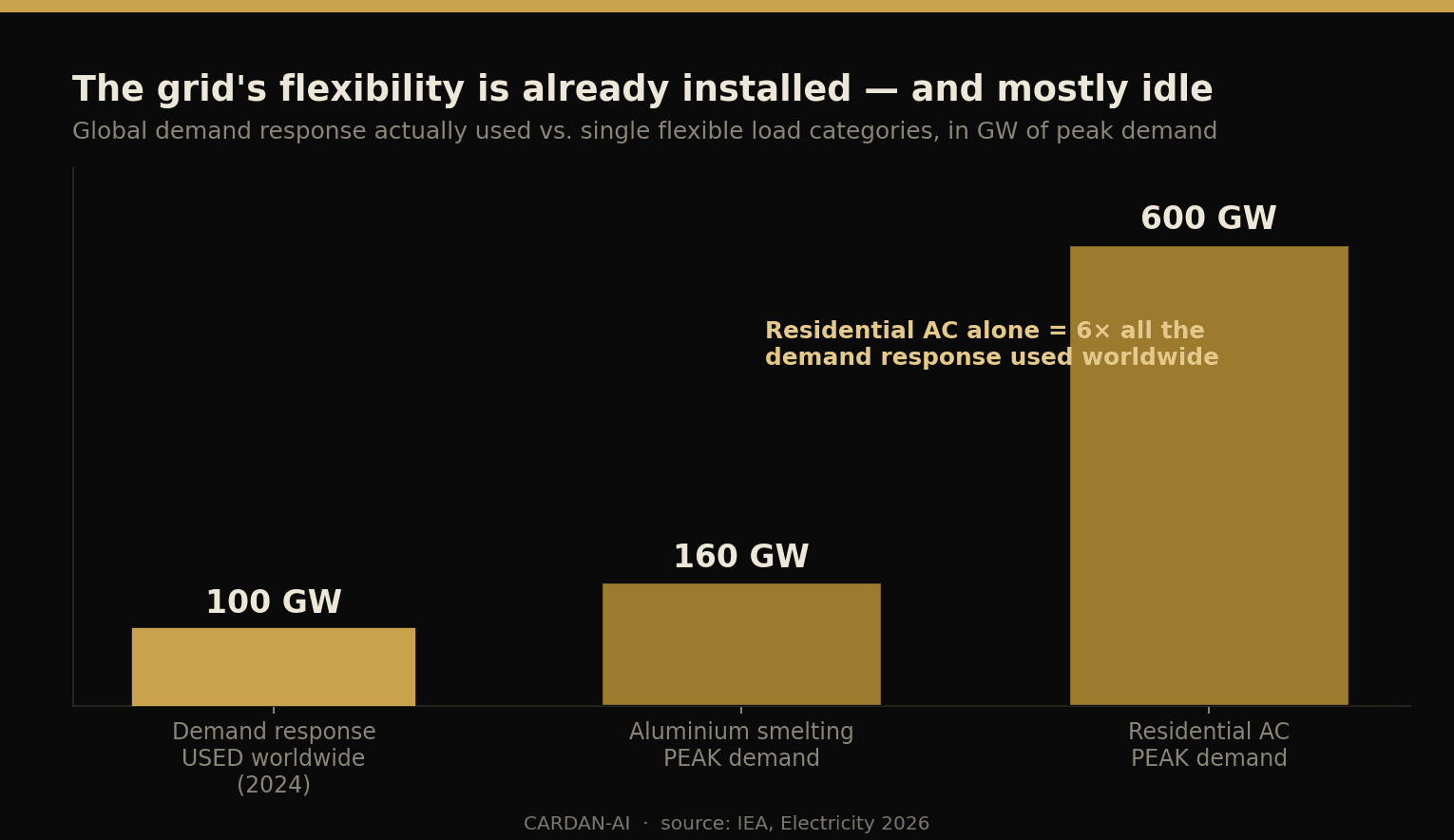
The numbers are stark. As of 2024, the world actively uses only about 100 GW of demand response — roughly 75 GW in industry, 30 GW in buildings and under 5 GW in transport. Against that, single load categories dwarf the total: residential air conditioning represents around 600 GW of peak demand, and aluminium smelting another 160 GW, yet flexibility from either remains marginal. The flexible capacity physically present on the grid is an order of magnitude larger than the slice we actually dispatch.
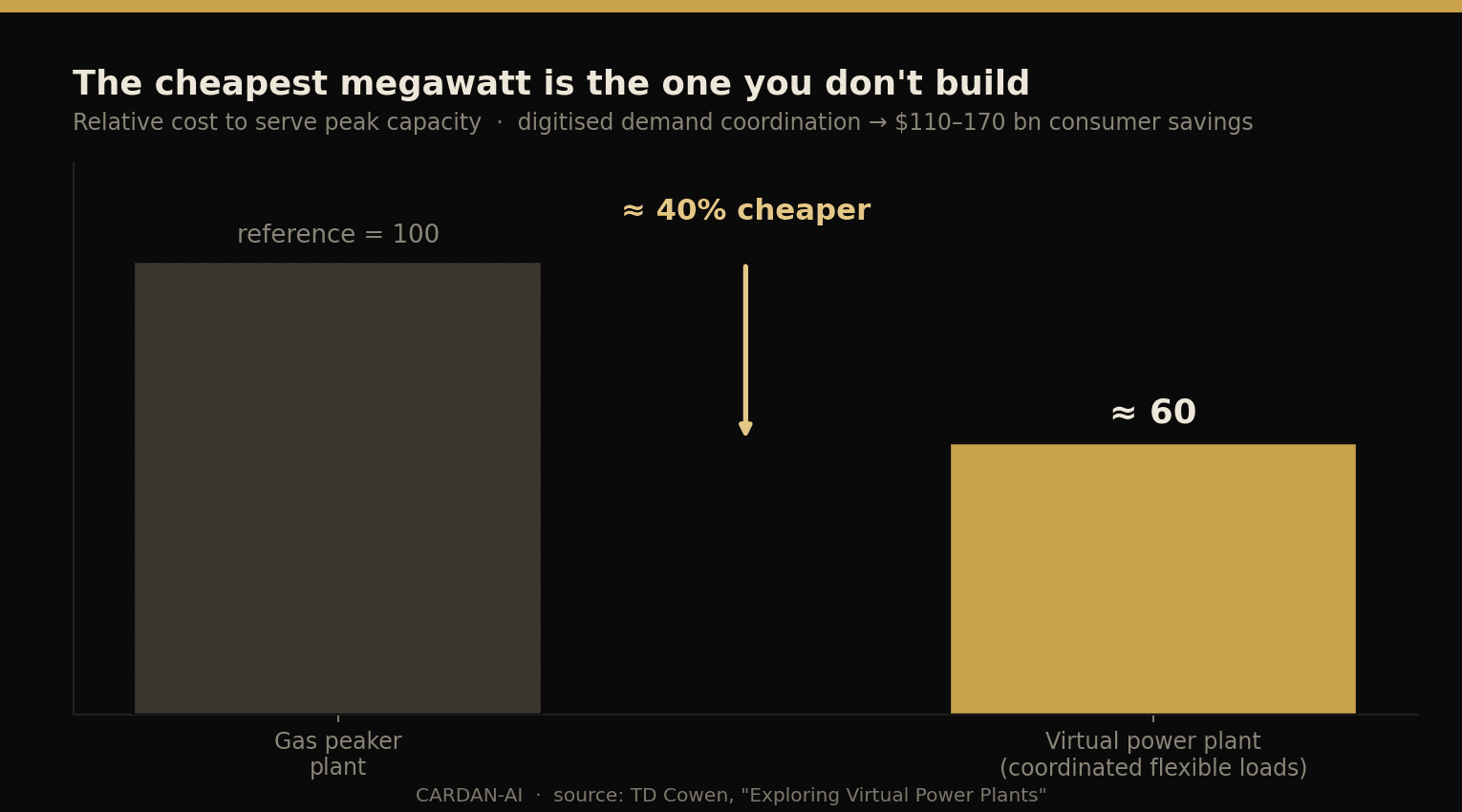
Read as an economist, this is a story about two megawatts with two very different marginal costs. The megawatt you shift costs almost nothing — the asset already exists and already consumes; you are only changing when it draws power. The megawatt you build is a gas peaker, with its capital, fuel and emissions. TD Cowen puts virtual power plants at roughly 40% cheaper than peaker plants, and estimates $110-170 bn in consumer savings from better, digitised grid coordination. The cheapest megawatt is the one you never build.
So the binding constraint has quietly moved from steel in the ground to the software and AI layer that sits on top of it. Flexibility is no longer a hardware problem — the loads are already there. It is an orchestration problem: forecasting demand and prices, signalling thousands of distributed loads, and dispatching them in real time against grid state without breaking the process each load serves. That is precisely the class of problem machine learning handles well, and precisely where most operators have done nothing.
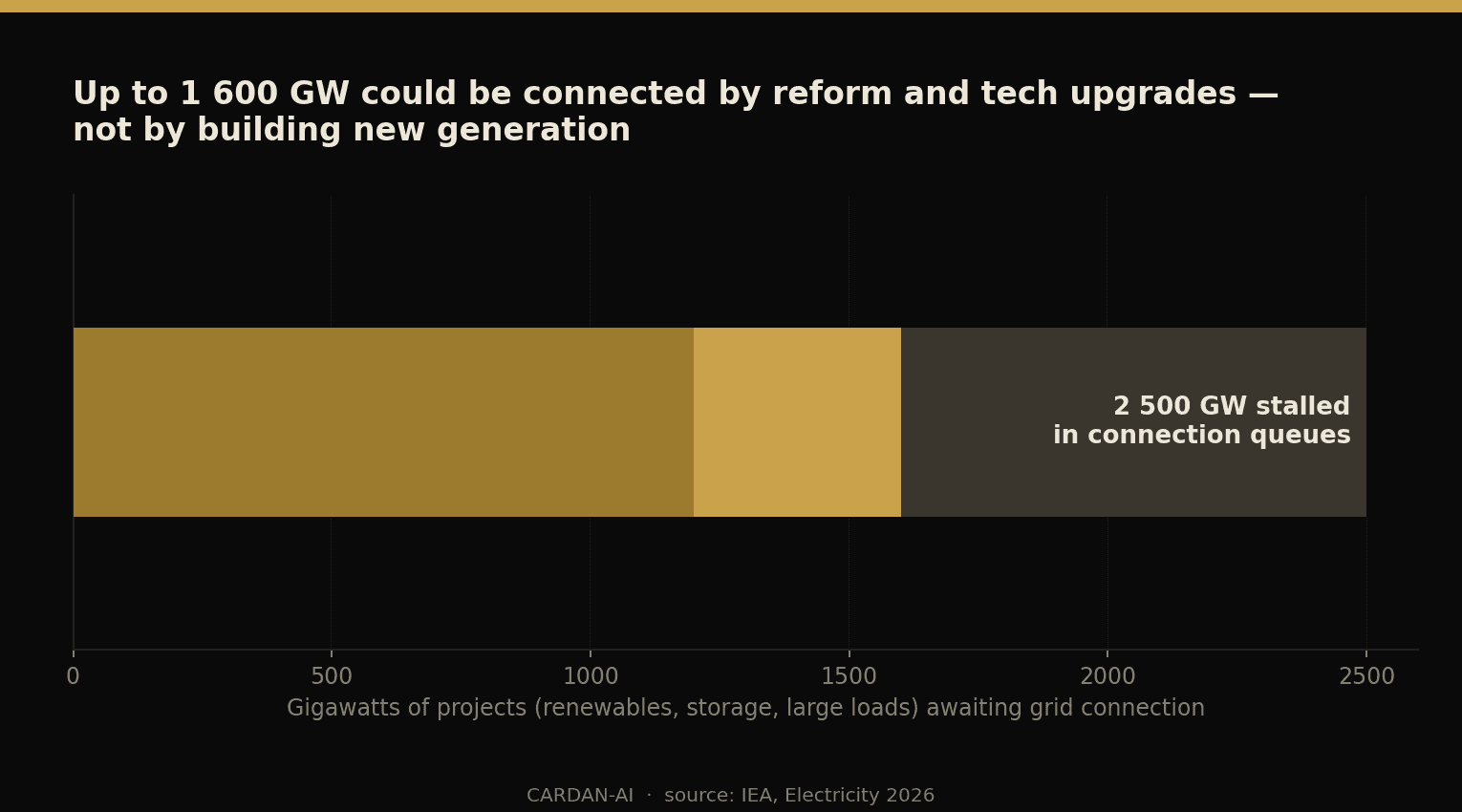
The connection queues tell the same story from the supply side. More than 2,500 GW of projects — renewables, storage and large loads such as data centres — are stalled worldwide waiting to connect. The IEA estimates that 1,200 to 1,600 GW of them could be freed through regulatory reform and technology upgrades such as grid-enhancing hardware and smarter queue management — not by building new generation. Whether you look at demand or at the queue, the scarce resource is the coordination and utilisation of infrastructure that already exists.
The timing sharpens the point. Global electricity demand is forecast to grow 3.6% a year through 2030, and meeting it is expected to require grid investment to rise by roughly 50% from today's $400 bn baseline. Battery storage is scaling fast — 63 GW added in 2024 for 124 GW cumulative, with costs down 40% to around $150/kWh — but storage is flexibility you buy, while demand response is flexibility you already own. Inside a stretched capital budget, unlocking installed flexibility is the highest-return lever available before a single new asset is financed.
For an operator in energy, O&G or heavy industry, this converts directly into a project shortlist. Your consuming assets — compressors, chillers, electrolysers, pumps, HVAC, furnaces, smelters — are latent flexibility. The first profitable AI project is rarely a new asset; it is mapping the loads you already run against the hours when flexibility is worth the most and the process constraints that must hold, then making the eligible ones dispatchable. The payback is the value of avoided peak charges and grid-service revenue, and it is a decision taken in weeks, on data you already have.
One caution keeps this honest, and it is where regulated sectors have an edge. Flexibility touches safety-critical and production-critical processes: you cannot shed a load that breaks a batch, violates a safety envelope or misses a delivery. So making demand flexible is a governance problem as much as an optimisation one — which loads may flex, within what limits, under what human oversight — the same discipline aerospace, defence, energy and O&G already run for their safety cases. The question facing every board isn't how many gigawatts to build. It is how much of what you already run is idle flexibility, and whether the software exists to ask it.
Analysis by
Cardan-AI Intelligence
Our research and analysis unit, dedicated to applied AI for business, industry and regulatory compliance.
Sources
- IEA — Electricity 2026, Flexibility (demand response utilisation ~100 GW in 2024; residential AC 600 GW and aluminium 160 GW of peak demand; utility-scale batteries 63 GW added / 124 GW cumulative in 2024, cost -40% to ~USD 150/kWh)
- IEA — Electricity 2026, Executive summary (global electricity demand +3.6%/yr 2026-2030; 2,500 GW of projects stalled in connection queues, 1,200-1,600 GW freeable via reform and tech upgrades; grid investment needs ~+50% from the USD 400 bn baseline)
- TD Cowen — 'Exploring Virtual Power Plants' (VPPs ~40% cheaper than gas peaker plants; ~USD 110-170 bn consumer savings from digitised grid coordination), via Renewable Energy World
Let's talk about your next competitive edge
Thirty minutes to identify the two or three use cases in your operations that pay for themselves within the first year.