
Hayek and SwarmOS: What Decentralized Knowledge Says About Palladyne AI's Bet on Drone Swarms
On October 9, 2026, Palladyne AI unveiled SwarmOS, software that puts decision-making on each drone rather than in a central system, tested at the US Army's Project Convergence Capstone 6 exercise. Friedrich Hayek's theory of decentralized knowledge (1945) explains why this architectural bet is rational — and what it costs in traceability.
On October 9, 2026, US company Palladyne AI unveiled SwarmOS, a "decentralized embodied collaborative AI" (DECA) software that turns each drone into an autonomous decision node rather than a mere executor tethered to a command center. According to CEO Ben Wolff, the technology was tested at the US Army's Project Convergence Capstone 6 (PC-C6) exercise, where drones from different manufacturers, carrying different sensor payloads, shared curated information within the same swarm over a mesh network, without a single point of control.
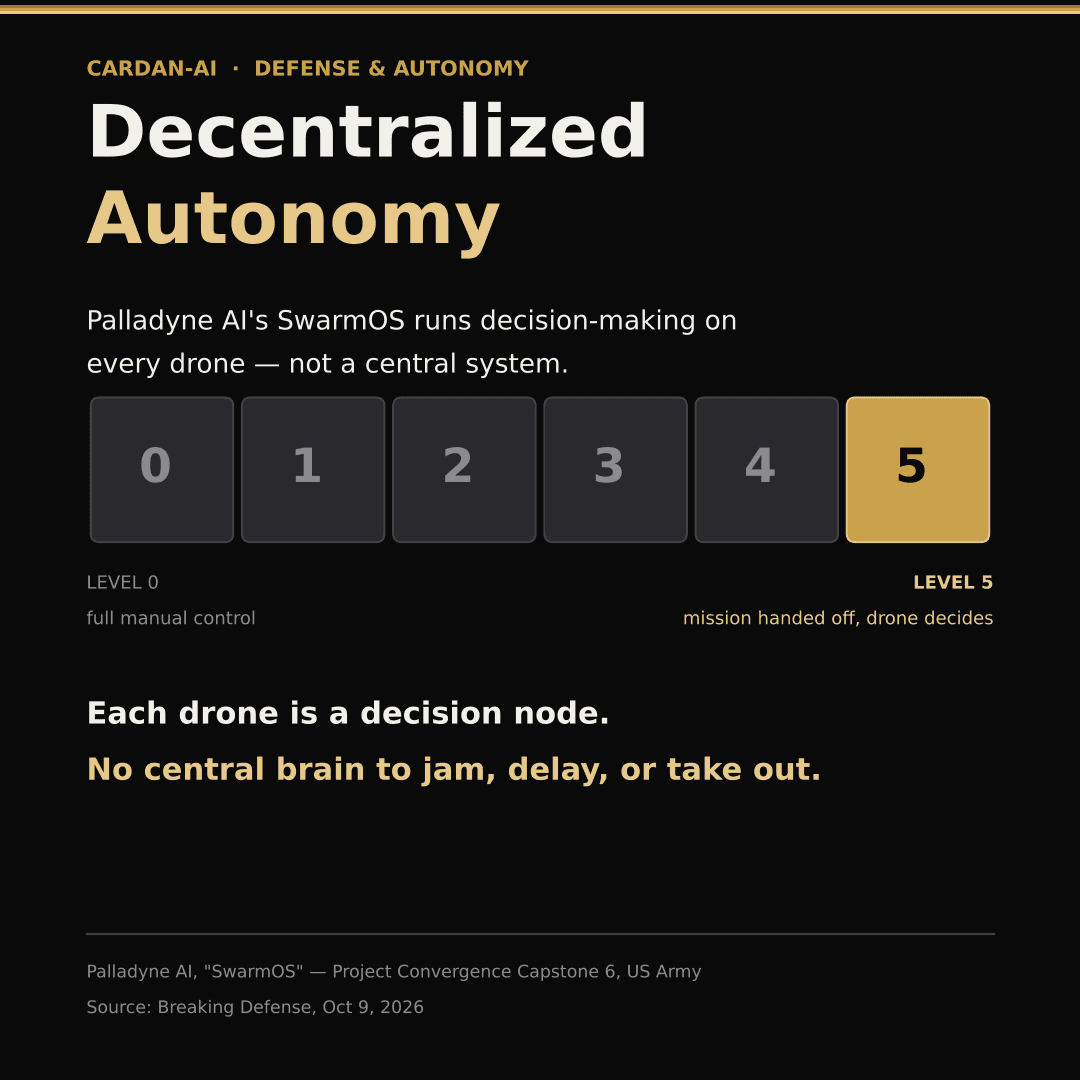
SwarmOS runs its algorithms locally on each device — what Palladyne calls "Oracle-Class Wolf Pack Swarming," predictive algorithms estimating friendly and adversary unit behavior — and positions its technology on a five-level autonomy scale (0 to 5), modeled on self-driving car standards: from full manual control (Level 0) to a drone independently executing a high-level mission assigned by an operator (Level 5). Wolff is explicit: pre-programmed waypoint-following does not, in his view, constitute real autonomy, which he defines as the machine making real-time decisions. He maintains, however, that the decision to launch or abort a kinetic strike must remain human at every level of the scale.
Economist Friedrich Hayek offers the most direct lens on this architectural choice. In "The Use of Knowledge in Society" (American Economic Review, 1945), Hayek distinguishes generalizable scientific knowledge — the kind a central expert can reasonably hold — from knowledge of the particular circumstances of time and place, which is by nature dispersed among many local agents and often tacit, hard to formalize and transmit. His central thesis: no planner, however well informed, can recentralize that second category of knowledge without losing information or time — which is precisely why price systems, in a market economy, outperform central planning at coordinating the action of millions of dispersed agents.
Applied to the battlefield, the intuition transposes almost term for term. The information a drone holds in contact — the precise position of a threat, terrain conditions, a neighboring sensor's failure, a firing window closing within seconds — is a textbook case of circumstantial knowledge: local, perishable, costly to send up to a center and costly to wait for an instruction to come back down. SwarmOS bets that the cost of that round trip (latency, vulnerability of the communication link to jamming) exceeds the cost of imperfect coordination among autonomous nodes. It is a deliberately Hayekian bet: decentralize the decision wherever information decays too fast to justify centralizing it.
That bet runs term for term against the one the US Army made on NGC2, where it handed Anduril exclusive control of building a centralized, common data layer (see our October 18 and 19 analyses, read through Arthur's lock-in theory and Rochet-Tirole's two-sided markets). NGC2 targets generalizable, scientific knowledge — theater-wide sensor fusion, cross-service interoperability — where SwarmOS targets circumstantial knowledge specific to the tactical instant. The two architectures are not substitutes: they answer two different layers of decision-making, and that complementarity is exactly what the Hayekian lens reveals — centralize what is generalizable, decentralize what is local and perishable.
The Hayekian framework has a limit it does not resolve on its own: it addresses the efficiency of coordination, not the governance of decision-making. A swarm where each node decides locally, without a centralized log visible in real time, raises a traceability and accountability problem after the fact — who decided what, on what basis, and how to audit it later. That is a question the regulatory debate over lethal autonomy (see our October 16 analysis of the "AI Guardrails Act") addresses from another angle: the requirement for a human in the loop at every level, as Wolff himself frames it, is one answer to that governance problem — but it says nothing about how decentralized information can stay auditable without losing the speed that makes it valuable in the first place.
For aerospace-and-defense companies and their AI subcontractors, the lesson is twofold. First, architecture is not a neutral choice: it encodes a trade-off between decision speed (favored by decentralization, especially in a degraded electronic-warfare environment such as Ukraine) and control-traceability (favored by centralization). Second, integrators that control a central data layer like NGC2 and vendors betting on embedded autonomy like Palladyne are not head-to-head competitors: they occupy two complementary segments of the same federal market, and product positioning should turn less on an ideological preference for one model over the other than on the nature of the information being processed — generalizable, or local and perishable.
Analysis by
Cardan-AI Intelligence
Our research and analysis unit, dedicated to applied AI for business, industry and regulatory compliance.
Let's talk about your next competitive edge
Thirty minutes to identify the two or three use cases in your operations that pay for themselves within the first year.